
Issue 6: Jan - Mar 2026
www.vf.dhan.orgCase study on Paddy Seed Distribution & Agriculture Intervention
Case Study: The Farmland That Guided Bountiful Paddy Yield – Transformation of a Small-Scale Farmer through Scientific Interventions
Mrs. S. Devi, a resident of Neivasal village in the Thirumayam block operational area and a member of the Elavenil Farmers’ Group, represents a typical small-scale farmer cultivating paddy on one acre of land. The Thirumayam constituency is characterized by rain-fed agriculture, where paddy and groundnut are the major crops. The Elavenil Farmers’ Group was established in 2019 with 17 members, and Mrs. Devi has been an active participant since its inception.
In the initial phase of her farming journey, Mrs. Devi faced numerous agricultural challenges that severely limited her productivity and profitability. These challenges included the use of poor-quality, uncertified seeds that had low germination rates and poor disease resistance, leading to weak crop establishment. Additionally, she practiced unbalanced fertilizer application, relying heavily on nitrogenous fertilizers while neglecting phosphorus and potassium, which resulted in nutrient imbalance, poor soil health, and inefficient plant growth. Her lack of knowledge about integrated pest management forced her to use chemical pesticides indiscriminately, which not only increased costs but also harmed beneficial insects and led to pest resurgence. Furthermore, she never conducted soil testing, so fertilizers were applied without any scientific basis, causing both wastage and environmental harm. Being entirely dependent on monsoon rains with no water conservation or moisture retention practices, her farming was highly vulnerable to rainfall variability.
As a direct consequence of these agronomic deficiencies, her yield was only 23 bags per acre, and with a selling price of ₹1,200 per bag, her gross income stood at a mere ₹27,600 per acre. However, the total production cost, including seeds, fertilizers, pesticides, labor, and irrigation, was ₹12,700 per acre, leaving her with a net profit of only ₹14,900. This low profitability, combined with high input costs and unpredictable weather, made agriculture economically challenging and unsustainable for her.
Agriculture Intervention
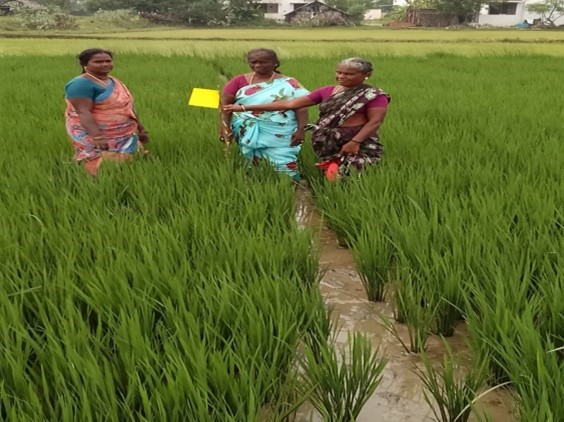
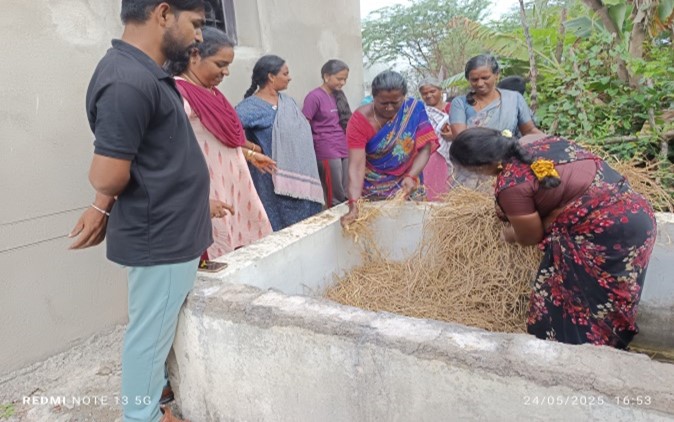
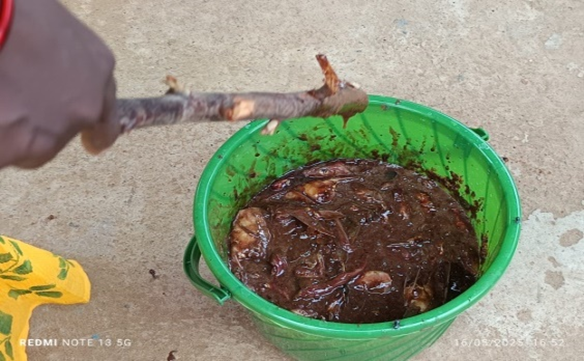
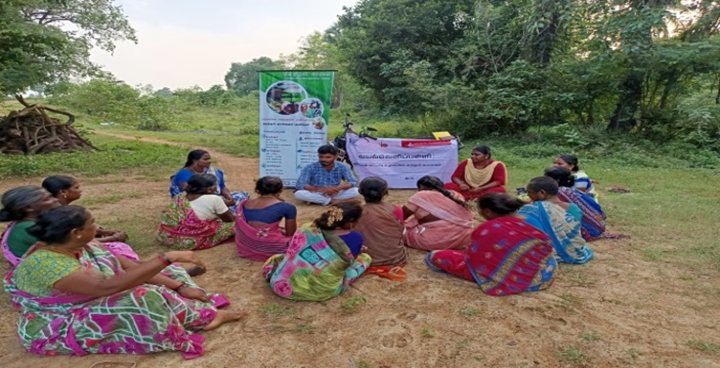
To address this critical situation, the Thirumayam Farmland intervened under the TANA project with a comprehensive, science-based agricultural extension program. The intervention began with the direct supply of certified, high-yielding, disease-resistant paddy seeds to farmers, replacing the low-quality seeds previously used. Subsequently, a Farm Field School was established to provide hands-on technical training on a range of modern and sustainable agricultural practices. The training covered summer ploughing to destroy pest eggs and improve soil aeration; Integrated Pest Management using pheromone traps, biocontrol agents like Trichogramma, and neem-based sprays; Integrated Nutrient Management combining chemical fertilizers with organic manure, green manure, and biofertilizers; soil test-based fertilizer application to tailor nutrient doses precisely to soil needs; preparation of low-cost organic inputs such as Panchagavya and fish amino acid; and compost production to enhance soil organic matter.
Improved Agricultural Practices Adopted
Mrs. Devi actively participated in these training sessions and began implementing the recommended practices on her one-acre field. She treated her seeds with Trichoderma viride and Pseudomonas fluorescens to prevent soil-borne diseases. She carried out summer deep ploughing, which reduced pest load and improved soil structure significantly. For pest management, she installed light traps and sticky traps and released Trichogramma eggs to control stem borer, completely avoiding chemical pesticides.
Improved Income and Cost Analysis
These scientific interventions produced remarkable results. Her yield increased from 23 to 26 bags per acre, a 13% improvement, raising her gross income to ₹31,200. Even more significantly, her total production cost dropped from ₹12,700 to just ₹9,200. Consequently, her net profit rose from ₹14,900 to ₹22,000 per acre, an impressive increase of ₹7,100, which represents a 47.6% growth in net income. Moreover, over two seasons, she achieved additional savings of ₹5,000 through the reuse of on-farm inputs and reduced pest control needs, bringing her total savings to ₹8,500.
This case study clearly demonstrates that when quality seeds, scientific training in IPM and INM, soil testing, and low-cost organic inputs are integrated and provided to small-scale farmers in rain-fed areas, it is possible to increase yields, reduce production costs, enhance net profits significantly, and achieve sustainable, profitable, and resilient agriculture. The experience of Mrs. S. Devi serves as a replicable model for transforming rain-fed farming systems across semi-arid regions. Policymakers and development agencies are encouraged to scale up such integrated interventions through farmers’ groups and Farm Field Schools to enhance food security and rural livelihoods on a broader scale.
 Facebook
 Instagram
Comments