Issue 6: Jan - Mar 2026
www.vf.dhan.orgVayalagam Mutual Movement (VMM) Silver Jubilee Celebration
March 7, 2026
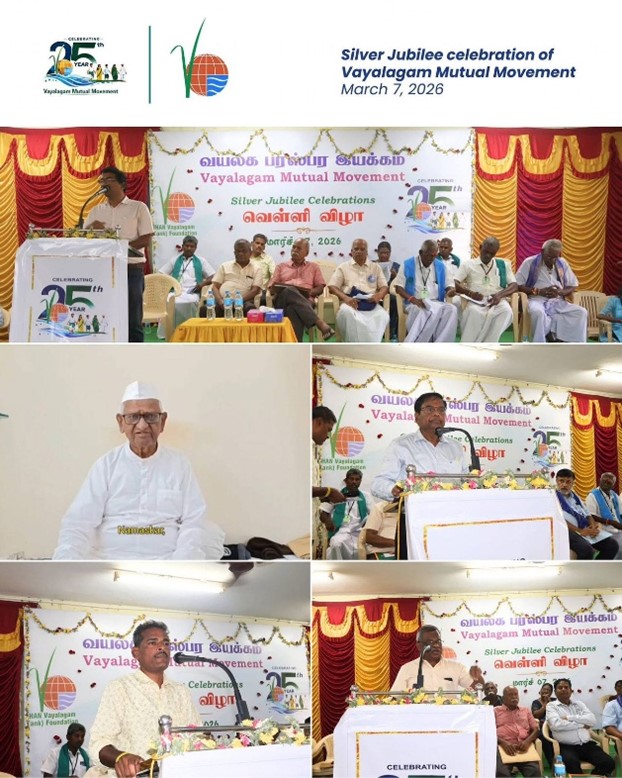
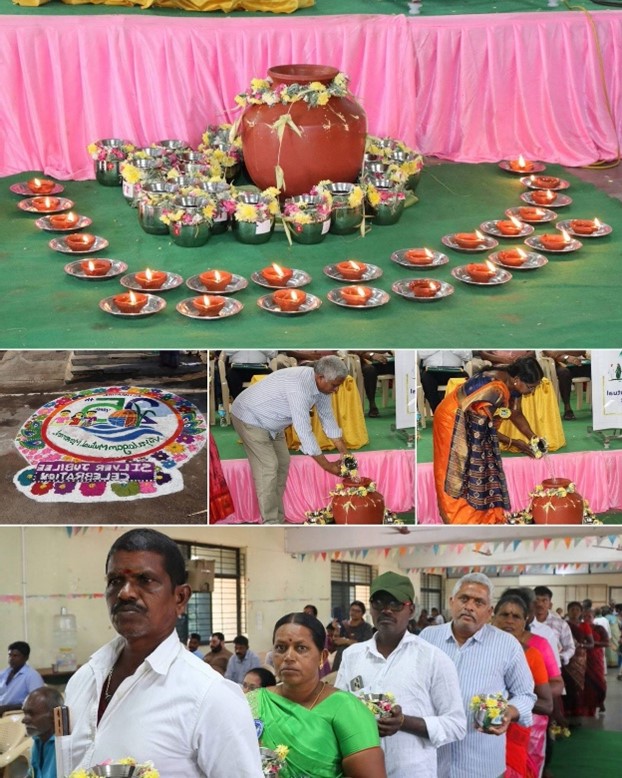
The Silver Jubilee celebration of the Vayalagam Mutual Movement (VMM) commenced with the Vayalagam Prayer, followed by a formal welcome address by Mr. Durairaj, President of VMM. He extended a warm welcome to the distinguished chief guests, community leaders, Neerkattis from various regions, and Vayalagam executives. A significant highlight of the morning was the Ceremonial Water Ritual coordinated by Mr. Kannan of the DHAN People Academy. To symbolize regional unity, leaders from 25 river basins poured water sourced from their respective rivers into a collective pot. This was followed by a symbolic lighting of 25 agal lamps by senior associates from 25 Federations, representing each year of the movement's growth. The main ceremonial lamp was then lit by a cohort of dignitaries including the Chairman and CEO of VMM, the HR of Hi-Tech Arai Pvt. Ltd., the Trustee of DVTF, and various Vayalagam leaders and Neerkattis.
Padmabushan Anna Hazare, who originally inaugurated the movement 25 years ago, shared a congratulatory message emphasizing that while water is a universal element present in the soil, aquifers, and air, it is not equally accessible to all. He underscored the moral obligation of the wealthy to support water security for the poor.
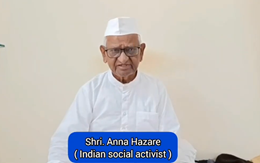
Anna Hazare message
Youtube Link: https://youtu.be/rBAFLVnNvKc?si=v34cPBtrfdTsbSeA
Following this, Mr. N. Venkatesan provided a detailed historical deep-dive, tracing the movement back to its 1992 research foundations involving Anna University and the Bard Center under the guidance of Mr.M.P.Vasimalai, Executive Director of DHAN Foundation. He noted that the structural strategy was driven by the DHAN Foundation, starting in Melur and Mudukulathur, and reached a major milestone in 2007 when 35,000 people gathered at Tamukkam Maidanam.
Mr. Venkatesan also detailed the current impressive scale of the movement, which now encompasses 7,000 Vayalagams, 470,000 members, and 38 federations across states including Tamil Nadu, Andhra Pradesh, Telangana, Bihar, Kerala, Karnataka, Maharashtra, and Pondicherry. He emphasised that the core philosophy of the movement was reaffirmed through its six pillars: Vayalaga Dhanam, Jothi, Kanikai, self-regulation, Dhaniya kanikkai, and Virudhu. These principles focus on peer mentoring, sustainability funding, treating water bodies as sacred spaces, self-regulation, grain sharing, and rewarding excellence.
During the session, Mr. Gurunathan, Director of the DHAN Academy, led an emotional tribute by honoring 25 veteran leaders and recollecting the names of over 100 pioneers who contributed to the movement's foundation.
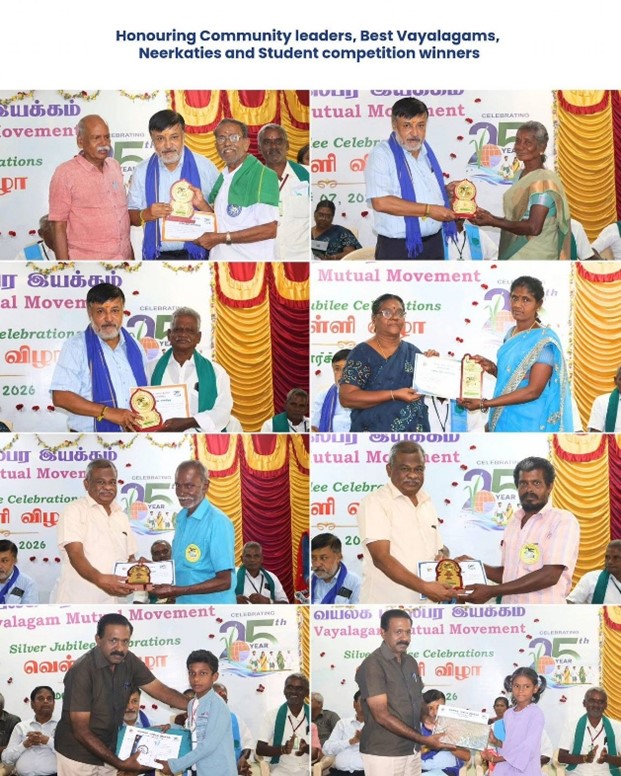
Representing the corporate sector, Mr. Durairaj, HR of Hi-Tech Arai Pvt. Ltd., discussed the long-standing partnership in restoring ooranis in Madurai. He highlighted that his organization had been engaged in CSR activities since 1993, long before legal mandates. He, on behalf of his chairman Mr.BT Bangera, announced awards for the best-maintained ooranis. As a token of gratitude, VMM leaders Mrs. Poomalai and Mr. Poosari presented a memento to Mr. Durairaj.
The meeting further explored leadership and traditional roles, with Mr. J. Mohan (COO of DVTF) describing Vayalagams as both "Temples" and "Polar Stars." Mrs. Shanthi Maduresan, CEO of Dhan Panchayat Development Foundation, presented awards to 25 top-performing Vayalagams and defined a leader as an enabler and achiever. She also reflected on the movement's expansion from tanks to ponds and ooranis and noted her contribution of the "Neerindri Amayathu" song.
The vital role of Neerkattis as technical custodians was celebrated by Dr. Vasanthakumar, trustee of DVTF and former Vice Chairman of Alagappa University who presented awards to 16 traditional water managers. Dr. Vasanthakumar also addressed modern agricultural challenges, proposing solutions such as village-level certified seed security, online market innovation to bypass middlemen, and the integration of livestock and fish farming into existing water management activities.
Mr. V. Venkatesan, CEO of DVTF, concluded the speaker sessions by invoking the compassion of Vallalar and sharing "The Sparrow Lesson" from Chinese history to illustrate the dangers of ecological imbalance. He emphasized VMM's role in biodiversity management to prevent animal loss due to environmental changes. Regarding the current objective, the movement aims for "zero encroachment" across all 6,000 restored water bodies, managed through the "Vayalagam 10" institutional framework. He stressed that committees are being formed at all levels to execute this vision, guided by the principle that education should lead to goodness. Before sub-group discussion.
Dr. Thiyagarajan, Deputy Director of The DHAN Academy, distributing prizes to school students for the "Water for All" competition, noting how the movement unites diverse traditions. The event transitioned into sub-group discussions to plan specific action items for the 2022–2027 strategic roadmap.
Subgroup discussion leads
- Strengthening Women’s Inclusion in Leadership: Farmers emphasized the need to expand opportunities for women to actively participate and take leadership roles within Vayalagam institutions and community decision-making processes.
- Continuous Efforts for Encroachment Removal: The discussion highlighted the importance of sustained collective action to identify and remove encroachments in traditional water bodies such as tanks and ponds to ensure equitable water access and ecological restoration.
- Revitalizing the Neerkati System: Participants suggested recognizing and strengthening the traditional Neerkati (water manager) system, acknowledging their crucial role in equitable water distribution and tank management.
- Multilingual Inclusiveness for Wider Engagement: To expand outreach across regions, farmers proposed communication and engagement in multiple languages including Tamil, Telugu, Kannada, and Hindi, enabling wider participation in the movement.
- Expansion of Social Capital: Strengthening community institutions, farmer networks, and collective action was identified as essential to expand the social capital of Vayalagam, ensuring sustainability and stronger community ownership.
- Vision for Vayalagam 10: Farmers discussed the roadmap for Vayalagam 10, focusing on scaling the movement, deepening community institutions, and enhancing sustainable water and agriculture practices.
- Encroachment Eviction as a Collective Campaign: Beyond individual efforts, farmers proposed that encroachment eviction should be taken up as a structured, collective campaign across all Vayalagam villages.
- Building Community Leadership – 25 Leaders for the Future: In line with the Silver Jubilee milestone, farmers suggested identifying and nurturing 25 potential community leaders who can guide the next phase of the movement.
- All Dhan Collective for Members and Non-Members: The concept of All Dhan collective should be expanded to include both Vayalagam members and non-members, ensuring broader farmer participation and collective benefits.
- Focus on Systemisation: Participants stressed the need for stronger systems, processes, and institutional mechanisms within Vayalagam to support long-term sustainability and efficient functioning of community institutions.
Mr Vasimalai, ED, DHAN Foundation – Way Forward Leads
- District-Level Advisory Platform with Government: Establish a structured advisory meeting every three months in each district with the District Collector, DRDA, and other relevant government departments to review water conservation efforts, tank restoration progress, and community initiatives.
- Reviving the Tradition of Kumbabishegam for Water Bodies: Community leaders will take responsibility to organize Kumbabishegam for traditional tanks and water bodies once every three years, reinforcing cultural ownership and collective responsibility for water resource management.
- Leveraging Government and Donor Partnerships: Strengthen collaboration with government departments, CSR partners, and development donors to mobilize resources and increase investments up to five times the current CSR contributions for water conservation and livelihood development.
- Green River Basin Initiative: Inspired by global environmental movements such as the UN declaration for grasslands, Vayalagam will promote the development of Green River Basins through large-scale tree plantations, restoration of sacred groves, biodiversity conservation, and eco-restoration of river ecosystems.
- Virtual Tank Museum: Develop a Virtual Tank Museum to document and showcase the history, engineering, ecological importance, and community stewardship of traditional tank irrigation systems.
- Recognition of Tank Systems as Living Heritage: Explore avenues to work with UNESCO to recognize the traditional tank irrigation systems as a “Living Heritage System,” highlighting the cultural, ecological, and community governance aspects of these water structures.
- Water Mithras – Expanding the Volunteer Network: Launch a large-scale initiative to induct 25,000 “Water Mithras”, community volunteers who will support water conservation, tank maintenance, and community mobilization.
- Water Panchayat and Encroachment Panchayat: Establish platforms such as Water Panchayat and Encroachment Panchayat where communities can collectively discuss water governance issues, address encroachments, and find local solutions to emerging challenges.
- Expanding the Vayalagam Farmer Network: With 5 lakh farmers already part of Vayalagam, the movement aims to expand the network to 10 lakh farmers, strengthening the collective voice for water and agriculture sustainability.
- Creation of an Endowment Fund for Tank Sustainability: Develop an Endowment Fund dedicated to the maintenance and sustainability of all functioning tanks, ensuring long-term financial support for community-led water management.
- Farmer Exposure Visits Across States: Facilitate exposure visits for farmers to other states to learn from successful community-based natural resource management initiatives and strengthen cross-learning among farmer institutions.
- Institutionalizing Block-Level Maha Sabha: Conduct Block-Level Maha Sabha meetings as a regular forum for collective decision-making, with the momentum of the Silver Jubilee celebrations continuing into future years.
Event ended with vote of thanks and National anthem
 Facebook
 Instagram
Comments