
Issue 6: Jan - Mar 2026
www.vf.dhan.orgGuardians of Water: Life journey of Vayalagam leaders
WATER, SOIL, AND LIFE: MURALI’S INTEGRATED FARMING MODEL
1. Early Life
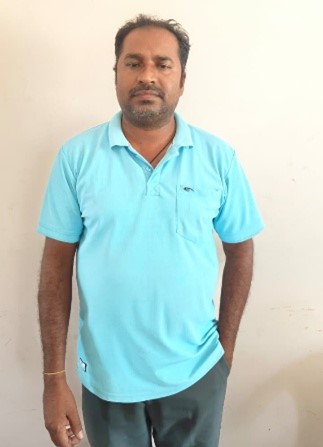
Mr. Murali was born on 30th May 1984 in a small semi-arid village called H. Mallandalli in Kolar district of Karnataka. He belongs to a poor agricultural family; his father, Rangappa, worked as a farmer and wage labourer, while his mother, Padmamma, was a housewife who later took up wage labour to support the family. His childhood was marked by severe poverty and hardship. At the age of 12, Murali lost his father, which brought a major responsibility onto his mother, who struggled to raise three children under very difficult conditions.
The family lived in a hut and often faced food insecurity due to lack of stable income and limited agricultural land. Murali completed his primary education in Mallandalli, pursued high school in Harati, and completed his Pre-University Course at Government Boys PU College in Kolar. However, due to financial constraints, he discontinued his education after PUC. These early struggles shaped him into a responsible, resilient, and determined individual. From a young age, he took responsibility for supporting his family and began working towards improving their livelihood.
2. Work Life
After discontinuing his education, Murali began focusing on livelihood activities to support his family. In 1999, he joined as a helper in a milk dairy run by KOMUL (Kolar Milk Union Limited). Through his dedication and hard work, he gradually progressed to the role of milk tester and is currently serving as the Secretary of the Mallandalli Village Milk Dairy. His work in the dairy sector provided him with a stable source of income and strengthened his connection with the farming community.
In 2012, he married Ramadevi, who has been a strong pillar of support in managing both household and farm activities. The couple has two children, a son studying in 3rd standard and a daughter in 6th standard. Murali’s professional journey reflects his commitment to improving his family’s socio-economic condition while also contributing to the local community.
3. Journey with DHAN Founadation
Murali’s transformation as a progressive farmer and community leader began in 2010 when the DHAN Foundation entered his village. The organization introduced AFG and community-based water resource management concept through Vayalagam institutions. Murali was deeply inspired by the ideology and actively participated in community mobilization and awareness programs. He played a key role in organizing farmers and promoting collective action for water conservation. His leadership and dedication contributed significantly to the renovation of the Mallandalli tank during 2023–24, which improved water availability in the village. Over time, he emerged as a community leader and currently serves as a Board of Director at the regional level in Kolar. Through his association with DHAN Foundation, Murali gained exposure, knowledge, and confidence to adopt sustainable agricultural practices and support other farmers in the region.
4. Integrated Organic Farming Model of Mr. Murali
Mr. Murali, a progressive young farmer from a semi-arid region of Kolar district, was deeply inspired by the classic Kannada film Bangarada Manushya, where the hero is portrayed as a dedicated farmer. This inspiration, along with his concern for human health, soil degradation, and water pollution, motivated him to shift towards sustainable agriculture. He recognized that excessive use of chemical fertilizers was polluting water bodies and degrading soil health. Determined to make a change, he decided to adopt organic farming practices.
Murali owns 2 acres of land, which was initially barren and severely affected by soil erosion due to continuous rainfall. The land had uneven surfaces and multiple pits, making it unsuitable for cultivation. With determination, he restored the land by leveling it using tank silt application, improving soil fertility and structure. In 2018, he began his journey into organic farming by planting mango saplings using natural inputs like red soil and neem cake. He adopted improved planting techniques and gradually implemented innovative methods through self-learning and personal interest.
As the land lacked irrigation facilities, Murali completely depended on rainwater for cultivation. To address water scarcity, he constructed two farm ponds. One pond was lined with tarpaulin to store water for longer durations, while the other was left unlined to facilitate groundwater recharge through percolation. This dual approach not only ensured water availability but also improved the water table in the area. He efficiently utilizes the stored water through a drip irrigation system, ensuring optimal water use.
Murali follows a diversified integrated farming system. On his farm, he has planted around 180 mango trees of different varieties such as Totapuri, Mallika, and Badami. In addition, he grows neem and sandalwood trees, contributing to biodiversity and long-term income. He practices mixed cropping and has allocated 10 guntas of land for cultivating Super Napier fodder, which supports his livestock.
Livestock plays a crucial role in his farming system. He rears around 30 goats and sheep and manages a dairy unit with 2 HF (Holstein Friesian), 3 Hallikar, and Malnad Gidda breeds. Dairy farming provides him with a regular source of income through daily milk sales. Importantly, all animal waste is effectively utilized to produce organic inputs, making the system self-sustaining.
Poultry farming is another key activity in his farm. He rears local breeds along with DV380 birds and sells brown eggs. He feeds the poultry with Azolla and other organic feed, ensuring cost-effective and nutritious feeding. Azolla cultivation itself is an integral component of his farming system, used as feed for both livestock and poultry.
Murali has fully converted his farm into a chemical-free organic hub. He prepares Jeevamrutha, a natural growth enhancer, to improve soil fertility and crop productivity. Initially, the preparation process took about a week using traditional drums. Later, he adopted an improved method using the “Surabhi Jeeva Sudha” unit, which enables continuous and efficient production of Jeevamrutha on a daily basis.
He also practices vermicomposting with three units on his farm. Every three months, he produces nearly one ton of vermicompost, which he uses for his crops, while the surplus is sold for additional income. Along with this, he prepares vermiwash and regularly sprays it on crops to enhance plant health.
Bee-keeping is another innovative component of his integrated farming model. With four bee boxes, he enhances pollination in his crops, leading to better yields, while also generating supplementary income from honey.
Murali’s journey stands as a powerful example of how vision, perseverance, and sustainable practices can turn barren land into a thriving agricultural hub. His 2-acre farm, once degraded and unproductive, now flourishes with organic mango orchards, fodder cultivation, livestock, poultry, and beekeeping, forming a fully integrated and self-sustaining farming system. By constructing farm ponds, adopting rainwater harvesting, and following chemical-free cultivation methods, Murali has ensured water security, restored soil fertility, and promoted biodiversity on his land.
This remarkable transformation was achieved through collaboration with the DHAN Foundation, Krishi Vigyan Kendra (KVK), and the Agriculture Department, who provided guidance, training, and essential resources. Always innovating, Murali plans to cultivate millets (Siri Dhanya) in the spaces between mango trees, optimizing land use and further enhancing farm productivity. His model proves that with determination, knowledge, and integrated farming, even semi-arid regions like Kolar can achieve resilient, sustainable, and profitable agriculture.
Beyond his own farm, Murali actively shares his knowledge with fellow farmers, serving as a resource person and conducting training on organic farming, soil health, and water conservation. Through his work, he not only secures his own livelihood but also nurtures a community of sustainable farmers. His story is an inspiring example for anyone seeking to embrace eco-friendly agriculture, improve livelihoods, and build long-term food and income security in challenging environments.
 Facebook
 Instagram
Comments