
Issue 6: Jan - Mar 2026
www.vf.dhan.orgBeyond Infrastructure: People’s Institutions as the Leading Link in Effective Irrigation and Drainage
Lessons from Smallholder-Dominated and Traditional Water Systems in India
1.0 Small, Marginal, and Landless Farmers: The Real, Often Invisible Water Users
Before engaging with this article, it is useful to pause and ask a few foundational questions.
- Should irrigation projects be evaluated only by irrigated area and productivity, or also by the number of people they actually serve?
- Which systems—large, capital-intensive irrigation projects or traditional water bodies—reach the greatest number of farmers, and how small are those farms in reality?
- Why do responses to large irrigation challenges continue to focus primarily on engineering and technical outcomes, while comparatively little attention is paid to building strong local people’s institutions capable of managing water equitably?
- Finally, what happens to irrigation systems when a significant share of users do not own land at all?
At the global level, agriculture is numerically dominated by small farms. Of the approximately 570 million farms worldwide, nearly 84 per cent are smaller than 2 hectares, yet together they contribute close to one-third of global food production. Defining these farmers, however, is not straightforward. The Food and Agriculture Organization (FAO) does not rely on a single land-size threshold, instead adopting a functional definition that recognises variation across regions, agro-ecologies, and production systems. For analytical consistency in global comparisons, most empirical research adopts 2 hectares as a working threshold. What is beyond dispute is that world agriculture is overwhelmingly characterised by very small, family-operated farms, whose water needs are dispersed, intensive, and highly sensitive to institutional arrangements.
India represents one of the clearest and most well-documented examples of this global pattern. Official census and survey data show that nearly nine out of ten Indian farms are below 2 hectares, making smallholder-focused irrigation governance unavoidable rather than optional.
| Indicator (India) | Value | Source / Note |
|---|---|---|
| Population dependent on agriculture | ~613 million (≈42%) | Labour & NSS estimates |
| Total farmland holdings (2015–16) | 146.45 million | Agriculture Census |
| Small + marginal holdings (<2 ha) | ~126.1 million (≈86%) | Core structural fact |
| Avg. farmland holding size (2015–16) | 1.08 ha | Increasing fragmentation |
| Landless farmers (Includes leases) | 115–120 million | Synthesised from NSS bootstrap table |
Within this already fragmented agrarian structure lies an even more invisible group: landless farmers and land-insecure cultivators. India has no single official census of landless farmers; instead, landlessness is inferred using multiple proxies across datasets. Synthesised estimates suggest that around 65 million people belong to pure landless households, while an additional 50–55 million are tenant or leased-in cultivators, resulting in a total landless and land-insecure population of roughly 115–120 million people. This constitutes nearly one-fifth of India’s agriculture-dependent population, most of whom remain institutionally excluded from formal irrigation governance.
The other reality is particularly visible in traditional irrigation systems. In India, as per national minor irrigation estimates Tanks and other traditional water bodies irrigate approximately 2.18 million hectares, corresponding to around 2 million farm holdings, of which nearly 1.7 million belong to small and marginal farmers. In contrast to large modern irrigation projects, traditional systems often support a larger number of smaller farmers, highlighting their social reach and institutional importance.
Taken together, the global and Indian evidence points to a central structural reality: most irrigation users—especially within traditional systems—are small, marginal, or landless, yet most irrigation projects and institutions are not designed with them at the centre. The next section examines why conventional irrigation institutions struggle to respond to this reality, and how DHAN Foundation’s Vayalagam model offers an alternative by treating people’s institutions as core irrigation measures, rather than as peripheral social components.
2.0 DHAN Foundation’s Vayalagam Approach and the CAUSE Framework: Linking Irrigation Institutions to Holistic Development
Across the world, experience increasingly shows that irrigation performance depends not only on physical infrastructure, but also on the strength of local institutions that govern water access, maintenance, and collective decision-making. While many irrigation programmes have promoted Water User Associations and similar bodies, results have often been uneven due to limited social legitimacy and weak local ownership. In this context, the Vayalagam approach of the DHAN Foundation offers a distinctive and field-tested model that treats people’s institutions as hydraulic–social systems, rather than as purely administrative arrangements.
A Vayalagam is a voluntary, membership-based people’s institution formed around a shared surface water body such as an irrigation tank or pond. It brings together all categories of users—small and marginal farmers, tenants, women farmers, landless households, and agricultural labourers—who depend on that water system. Through collective action, Vayalagams take responsibility for conserving and restoring water commons, regulating water use, preventing and removing encroachments, sustaining agriculture-based livelihoods, and securing usufruct rights and public entitlements for vulnerable groups. By placing decision-making in the hands of users themselves, the programme rebuilds social capital and revives traditional practices of collective maintenance, such as kudimaramath.
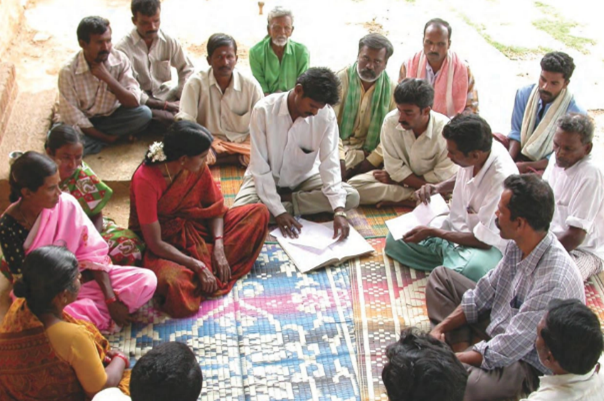
The Vayalagam programme is strengthened through a nested institutional structure. Primary Vayalagams operate at the level of individual tanks or water bodies; these are then networked at the cascade level to reflect hydrological linkages among chains of tanks, and further federated at block or district levels. This structure enables coordinated action at scale, facilitates engagement with government agencies and other stakeholders, and allows local institutions to influence planning beyond the village level.
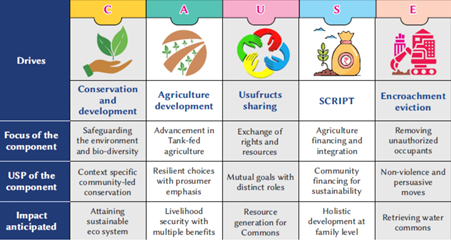
At the core of this programme is the CAUSE framework, which provides a clear operational pathway for advancing people’s institutions from basic water management to holistic development. CAUSE integrates Conservation and development of water assets, Agriculture development aligned with water availability, Usufruct sharing to ensure equity (including for landless households), SCRIPT (SCRIPT is a community-based financial inclusion system—Savings, Credit, Remittance, Insurance, Pension, and Transactions—that strengthens farmers’ financial resilience and enables people’s institutions to sustainably manage and invest in irrigation systems.), and Encroachment control, endowments, and entitlements to protect commons and ensure long-term sustainability. Rather than treating these as separate interventions, the CAUSE framework enables Vayalagams to function as comprehensive governance institutions, capable of managing irrigation systems while translating water access into inclusive, resilient, and sustainable livelihood outcomes.
3.0 Effective Irrigation and Drainage Performance: An Institution–Infrastructure View
Conventional irrigation assessments emphasise physical indicators such as irrigated area, efficiency, and crop output. In systems dominated by small, marginal, tenant, and landless farmers, these indicators capture only part of system performance. Field evidence shows that irrigation outcomes depend as much on institutions as on infrastructure. Infrastructure creates water availability; institutions determine how equitably, efficiently, and sustainably that water is used.
Effective irrigation and drainage performance is therefore defined as a balanced outcome of infrastructure functionality and institutional effectiveness, with equal weight assigned to both:

Where EIDI is the Effective Irrigation and Drainage Index, I_frepresents infrastructure performance, and I_crepresents institutional performance.
Infrastructure performance is not defined by engineering complexity, but by simplicity, reliability, and farmer operability. Systems that farmers can operate and maintain locally tend to perform better over time. Accordingly, infrastructure performance is expressed as:

Here, 𝑊𝑝and 𝐷𝑝represent water and drainage infrastructure, while Conservation and development (C), Agriculture development (A), and Encroachment control, endowments, and protection of commons (E) directly reinforce infrastructure functionality and longevity.
Institutional performance captures how water is governed and benefits are shared among users. It is defined as:

Where Usufruct sharing (U) ensures equity in access to water-related benefits, including for landless and tenant households, and SCRIPT (S) strengthens financial resilience through savings, credit, insurance, pensions, and digital transactions.
Combining these elements, effective irrigation and drainage performance can be expressed as:

This formulation highlights a simple but critical insight: irrigation systems perform best when simple, farmer-operated infrastructure is matched with strong people’s institutions that conserve resources, support productive use, and ensure equity. Strengthening institutions is therefore not an add-on, but a core requirement for achieving inclusive and sustainable irrigation and drainage outcomes.
4.0 Case Evidence: Institutions Improving Irrigation Performance
Case Study 1: Usufruct Rights Reviving Village Tanks in Kottampatti, Tamil Nadu:
In Kottampatti block of Madurai district, two traditional irrigation tanks—Kumarasamudram and Adiya Kulam—illustrate how clearly defined usufruct rights can transform declining water bodies into self-sustaining irrigation systems. After severe damage to tank bunds in the early 1990s disrupted irrigation and livelihoods, farmers in Vellinipatti village came together, with facilitation from DHAN Foundation, to form Vayalagam (tank) associations. The tanks were initially restored through public funding combined with a 25 per cent contribution from farmers, re-establishing their physical storage and irrigation functions. However, the most significant transformation occurred when farmers were enabled to collectively exercise usufruct rights over tank-based resources.
The Vayalagams systematically used these rights to generate revenue by leasing fisheries, harvesting tamarind trees planted on tank bunds, selling water from community wells during dry periods, and removing invasive Prosopis species. All income was transparently managed and reinvested into tank maintenance, feeder channel repairs, and the creation of endowment funds. Over time, Kumarasamudram tank alone accumulated a fixed deposit of nearly ₹5.8 lakh, enabling the association to maintain not only its own tank but also support nearby tanks within the cascade. This experience demonstrates that when communities hold clear rights and collective responsibility, village tanks shift from being neglected assets to locally governed, financially viable irrigation systems, benefiting both landholding and landless households.
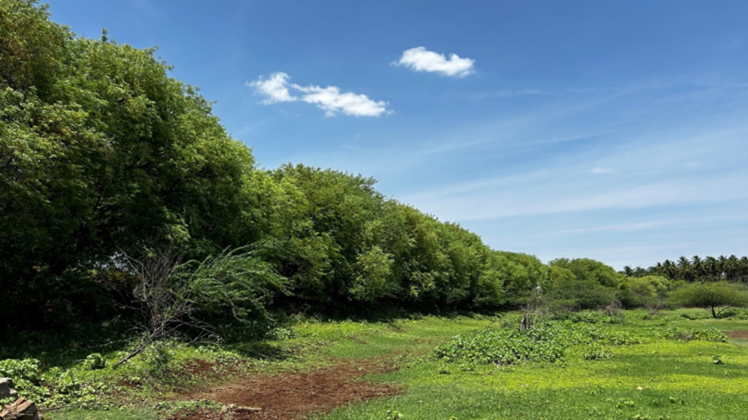
CAUSE linkage: This case primarily reflects the Usufruct sharing (U) and Encroachment control, endowment, and sustainability (E) components of the CAUSE framework, supported by Conservation and development (C) through tank rehabilitation. By institutionalising usufruct rights within a Vayalagam, the irrigation system generated its own maintenance resources, ensured equitable benefit sharing—including for landless households—and strengthened the long-term institutional capacity to govern water commons.
Case Study 2 : Farm Pond Fisheries Enhancing Irrigation and Livelihoods in Viralimalai, Tamil Nadu:
In the drought-prone Viralimalai block of Tamil Nadu, farm ponds constructed primarily for irrigation have evolved into multi-functional water assets supporting both agriculture and inland fisheries. With facilitation from DHAN Foundation and support from corporate social responsibility (CSR) programmes, 546 farm ponds were constructed between 2018 and 2025, of which 346 farmers adopted fish rearing as a supplementary livelihood. These ponds, with an average storage capacity of about 540 m³, enabled protective irrigation during critical crop stages while allowing productive use of stored water. Small and marginal farmers—many with limited or no access to wells—began rearing locally preferred fish species such as tilapia, catla, and murrel, using family labour and local markets to keep costs low.
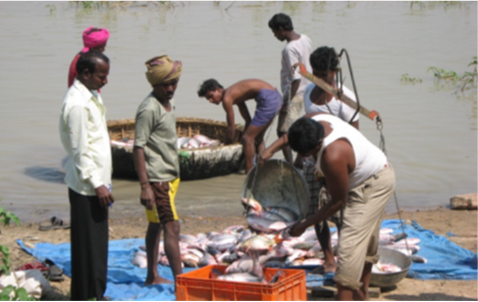
The results demonstrate the value of integrating livelihood-oriented water use with irrigation infrastructure. Survey data from 103 farmers indicate that fish rearing generated an average annual gross income of about ₹1.1 lakh per pond, with net profits of around ₹70,000, significantly strengthening household resilience. Farmers also reused nutrient-rich pond water for crop irrigation, improving soil health and enabling double cropping. Beyond income gains, the ponds enhanced water-use efficiency, improved household nutrition through fish consumption, and reduced dependence on rainfall. This experience shows how simple, farmer-managed water infrastructure, combined with productive use rights and institutional facilitation, can deliver both irrigation security and sustainable livelihoods in water-scarce regions.
CAUSE linkage: This case primarily reflects the Agriculture development (A) and Usufruct sharing (U) components of the CAUSE framework, supported by Conservation and development (C) through decentralized water storage. By enabling farmers to use irrigation infrastructure for multiple livelihood purposes, the Vayalagam-supported approach increased water productivity, diversified incomes, and strengthened resilience—demonstrating how CAUSE translates water access into holistic development outcomes.
Case Study 3: Reclaiming the Paralaiyaru Supply Channel through Collective Action, Tamil Nadu:
The Melakodumalur irrigation tank in Ramanathapuram district supports over 150 farming families across a 695-acre command area, with regulated water distribution managed by the local Vayalagam (tank association). Farmers operate a transparent system in which water is released only upon presentation of paid irrigation receipts, enforced by elected Neerkattis (water managers). Despite this strong local governance, tank performance declined sharply due to severe encroachment along the Paralaiyaru supply channel, one of the tank’s two main feeder sources. Over time, the channel width was reduced from its original 15 metres to just 4–6 metres, with sections converted into roads and culverts that diverted runoff away from the tank. As inflows from the Vaigai River became increasingly unreliable, the reduced supply from the Paralaiyaru resulted in frequent second-crop failures and growing financial stress among farmers.
In 2025, the Melakodumalur Vayalagam, with facilitation support from DHAN Foundation’s federation, initiated a coordinated effort to reclaim the encroached channel. Using locally generated funds from the auction of Prosopis juliflora, the association contributed 50 per cent of the ₹6 lakh restoration cost and persistently engaged district authorities, leading to formal action by the Revenue and Public Works departments. While 2.5 km of the 3 km channel was restored smoothly, a contested 500-metre stretch required intensive community negotiation, combining official boundary demarcation with sustained peer engagement in the neighbouring village. After 11 days of collective effort, the encroachment was fully removed. With the channel restored to its full width, farmers expect 1.5 times higher water augmentation, enabling reliable second cropping and fisheries, and an estimated ₹20,000 per acre increase in annual income, amounting to ₹1.4 crore annually across the command area. This case demonstrates how strong local institutions, community investment, and negotiated governance can restore critical irrigation infrastructure.
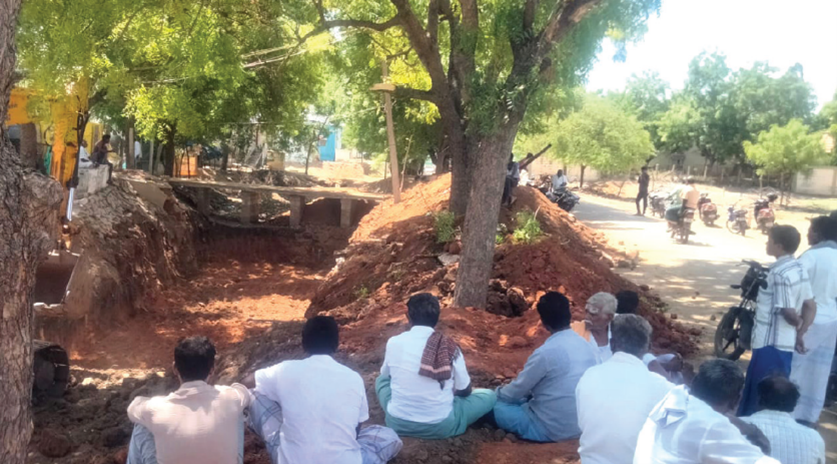
CAUSE linkage: This case reflects a strong integration of Conservation and development (C) and Encroachment eviction (E), reinforced by SCRIPT (S) logic. Regular water charges collected through the Vayalagam, transparent financial management, and savings generated from common-property resources enabled the association to co-finance channel restoration and sustain follow-up actions. By linking financial discipline (SCRIPT) with collective action and institutional legitimacy, the Vayalagam was able to overcome entrenched encroachments and restore the hydrological integrity of the irrigation system.
5.0 Way Forward: Strengthening Institutions for Sustainable Irrigation and Water Governance
The future of effective irrigation and drainage lies in building strong social capital that enables holistic governance of water resources. People’s institutions such as Vayalagams demonstrate that when farmers collectively manage water, infrastructure performance improves, conflicts are reduced, and benefits are distributed more equitably. Strengthening these institutions should be treated as a core investment—on par with physical infrastructure—to ensure long-term protection of water commons and sustained farmer welfare.
Addressing contemporary challenges requires continuous capacity building at the local level, equipping communities to respond to climate variability, land fragmentation, and market uncertainties. Placing hydrology at the centre of ecosystem development—by understanding flows, recharge, and surface–groundwater interactions—allows irrigation systems to be designed and managed in harmony with local landscapes. This must be supported by integrated management of surface water and groundwater, recognising them as a single interconnected resource rather than separate domains.
Finally, achieving scale and durability calls for long-term partnerships among communities, governments, research institutions, and private actors. Such partnerships enable saturation of successful models, sustained financing, and adaptive learning over time. By combining simple, farmer-operated infrastructure with strong institutions, hydrology-based planning, and integrated water management, irrigation systems can deliver inclusive growth, climate resilience, and sustainable outcomes—offering a globally relevant pathway for the future of water governance.
Water systems endure not because of concrete and canals alone, but because communities care for them across generations. When people’s institutions are placed at the heart of irrigation, water becomes not just a resource to manage, but a shared responsibility that sustains life, livelihoods, and hope.
 Facebook
 Instagram
Comments