
Apr - Jun 2025
www.dhan.orgUsufruct Rights in Water Commons Case study from Kottampatti , Madurai, Tamil Nadu
Towards Sustainable Model of Water Conservation and Governance
DHAN Vayalagam (Tank) Foundation has pioneered a community-led approach to reviving and sustaining traditional water bodies by empowering local farmers through usufruct rights (the right to use and derive benefits from common resources). By enabling communities to generate revenue from irrigation tank resources, the foundation has led the way in the sustainable and replicable model of water body conservation and governance. In this case study examines two village tanks and their respective Vayalagams (farmer associations) that have successfully implemented usufruct-based livelihood activities, ensuring both the protection of water bodies and sustainable income generation for farmers. By institutionalizing usufruct rights, DHAN’s model has transformed village tanks from neglected water bodies into thriving economic and ecological assets. This approach offers a replicable blueprint for sustainable water management across India. The success of these Vayalagams proves that when communities are empowered with rights and responsibilities, they can effectively protect and profit from common resources, ensuring long-term sustainability.
Usufruct Rights in Water Commons
Environmental resources are generally classified into four categories based on the relationship between the resource and its users: private property resources, state property resources, open access resources, and common property resources. CPRs are characterized as goods or services shared by a well-defined community, which collectively regulates their use through informal, community-based norms. Although these norms are often unwritten, they guide how resources like village ponds are used for purposes such as irrigation, livestock rearing, and domestic needs. However, the enforcement of these norms can be weak due to the challenges associated with monitoring.
According to the NSSO (2000), approximately 48% of rural households collected materials from CPRs, 20% used them for grazing livestock, 23% used CPR water sources for irrigation, 30% depended on them for livestock rearing, and 3% used them for household enterprises. These figures highlight how CPRs serve as vital support systems, especially for landless and marginal farmers who rely heavily on these resources for their livelihoods.
Despite the economic benefits, a major concern is the lack of reinvestment of this revenue into the conservation and protection of the very resources being utilized. This often leads to resource degradation over time. The practice of usufruct rights, while beneficial in providing access and income, tends to prioritize short-term gains over long-term sustainability. To ensure that CPRs continue to support rural livelihoods, there is a pressing need for stronger institutional mechanisms that promote sustainable use, equitable access, and community reinvestment in resource management.
A usufruct is a legal right accorded to a person or party that confers the temporary right to use and derive income or benefit from someone else's property. A usufruct combines the two property rights of ‘usus’ and ‘fructus’. ‘Usus’ refers to the right to use something directly without damaging or altering it, and ’fructus’ refers to the right to enjoy the fruits of the property being used—that is, to profit from the real property by leasing it, selling crops produced by it, charging admission to it, or similar. Usufruct rights refer to the legal or customary entitlements that allow individuals or groups to use and benefit from resources owned by someone else—usually the state or community—without owning them. In many panchayats across India, such rights are exercised through practices like auctioning fishing rights in village ponds, selling timber from community lands, renting water for irrigation, leasing land for cultivation or grazing, and selling tank silt at nominal prices to farmers. These activities contribute significantly to local revenue generation.
Usufruct rights in Tamil Nadu have traditionally enabled individuals and communities to access and benefit from land and natural resources—such as trees, water bodies, and common lands—without holding formal ownership. These rights are especially significant in rural areas, where Panchayats play a key role in managing commons and granting temporary or shared access for cultivation, grazing, or other livelihood activities. While not always codified in statutory law, usufruct rights are often recognized through administrative practices, customary norms, and local governance mechanisms. For instance, tree pattas, lease agreements for tank fisheries, and community use of poramboke lands reflect how such rights are exercised in practice. These arrangements contribute to rural livelihoods, environmental stewardship, and inclusive governance, particularly when supported by transparent, community-based decision-making processes within the Panchayat Raj framework.
TN Panchayat Raj act
Section 132: Vesting of communal property or income in Village Panchayat.- Any property or income including any fishery right which by custom belongs to, or has been administered for the common benefit of the inhabitants of the village or of the holders in common of village land generally or of the holders of lands of a particular description or of the holders of lands under particular source of irrigation shall, if so declared by the Government, vest in the Village Panchayat and be administered by it for the benefit of the inhabitants or holders aforesaid.
Section 133: Maintenance of irrigation works, execution of kudimaramat, etc.-
- Subject to such conditions and control as may be prescribed, the Government may transfer to any Village Panchayat or to any Panchayat Union Council the protection and maintenance of any irrigation work, the management of turns of irrigation, or the regulation of distribution of water from any irrigation work to the fields depending on it.
-
The Village Panchayat or the Panchayat Union Council shall have power, subject to such restrictions and control as may be prescribed, to execute kudimaramat in respect of any irrigation source in the village and to levy such fee and on such basis for the purposes thereof as may be prescribed:
Provided thatnothing contained in this section shall be deemed to relieve the village community or any of its members of its or his liability under the Tamil Nadu Compulsory Labour Act, 1858 (Central Act I of 1858), in respect of any irrigation source in the village in case the Village Panchayat makes default in executing the kudimaramat in respect of that irrigation source. - Where the maintenance of any irrigation work is transferred under this section, the fishery rights of Government in such work shall be transferred to and be vested in the Village Panchayat or the Panchayat Union Council, as the case may be, subject to such terms and conditions including terms and conditions regarding the utilisation of the income, as may be specified by the Government.
One of the key approach of DHAN Vayalagam (Tank) Foundation is enabling communities to effectively utilize usufruct rights for revenue generation and protection of village water bodies. DHAN supports farmers in managing these rights through activities such as fish rearing, tamarind seed collection, and the removal of encroachments. The following is a case study of two tanks and their respective Vayalagams, which have successfully leveraged these opportunities over the past two decades to build a self-reliant and sustainable model.
Case study from Kottampatti Block, Madurai, Tamil Nadu
The use of tank (kanmai) rights is one of the key factors contributing to the self-reliance of Vayalagam farmers’ associations. Farmers who utilize water from these tanks do not need to depend on external support to manage them. They undertake various activities not only to create and maintain common property resources but also to generate revenue and cover the long-term maintenance expenses of the tanks. Some of these activities include leasing out fishing rights in the tanks, collecting and selling tamarind from tamarind trees along the tank bunds, selling water from community wells, and cutting and selling Seemai Karuvelam (Prosopis juliflora) trees.
One such village is Vellinipatti in the Kottampatti block of Madurai district. This village is home to the Kumarasamuthram tank. In 1992–93, due to heavy rains, the Kumarasamuthram tank and its chain of tanks were damaged, and the bunds were breached. As a result, the villages that depended on the command area of these tanks were affected. With the tanks unable to store water, the farmers could not cultivate their fields properly. Farmers in these villages submitted petitions to various government officials, from the local panchayat to the district collector. However, no immediate intervention or solution was provided.
In 1994, the DHAN Foundation’s Vayalagam programme studied the issue, engaged in discussions with the farmers, and suggested the formation of a farmers’ association. Following this, 33 farmers came together to form an association. With financial assistance from the District Rural Development Agency (DRDA) and a 25% contribution from the farmers themselves, the tank was renovated at a cost of ₹64,000. Later in 1997, seeing their efforts, the DRDA funded the construction of a community/public well in the tank’s water spread area. During summer and water-scarcity periods, farmers draw water from this well.
A diesel motor was also used to supply water to farmers at a minimal charge, with the collected fees deposited into the association’s account. After the renovation, farmers decided to generate revenue by developing common property assets rather than relying on others. In 2000, with support from the Council for Advancement of People's Action and Rural Technology (CAPART), they received ₹1 lakh for the restoration of the tank bund. Along with this, 80 tamarind trees were planted, and a fixed deposit of ₹10,000 was created with a 50% contribution each from CAPART and the farmers. This tamarind trees have since been maintained and have started yielding well. The tamarind harvest is now leased out. During the initial periods, funding support from Axis bank was given for renovation of bunds, sluice and surplus weirs with community contribution of 25%. Once the Tamarind start to yield in the last eight years, it is generating income. Last year, the lease was auctioned for ₹50,000, which was deposited into the Vayalagam bank account. This amount was again added to the fixed deposit and is being used for further maintenance of the tank.
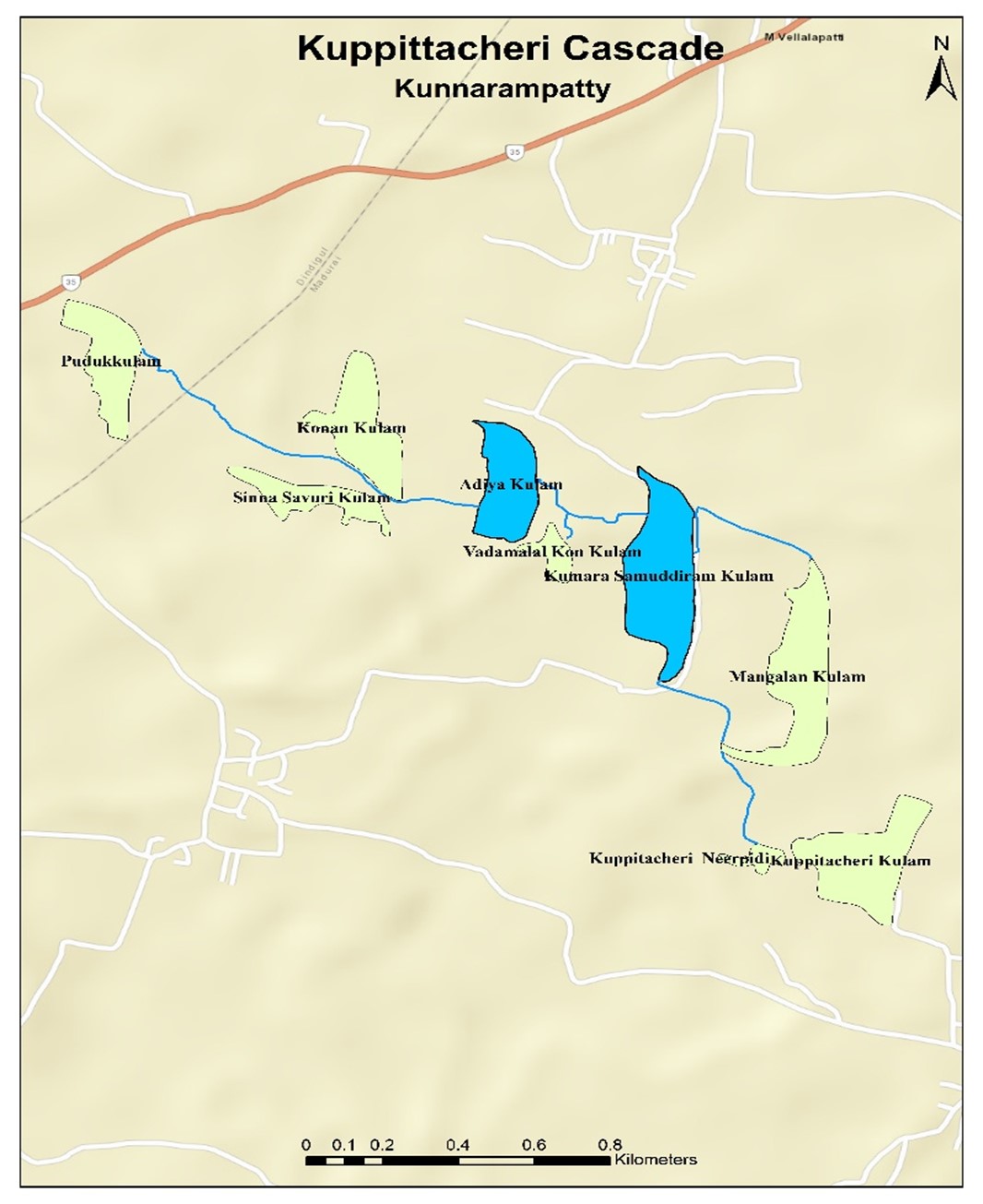
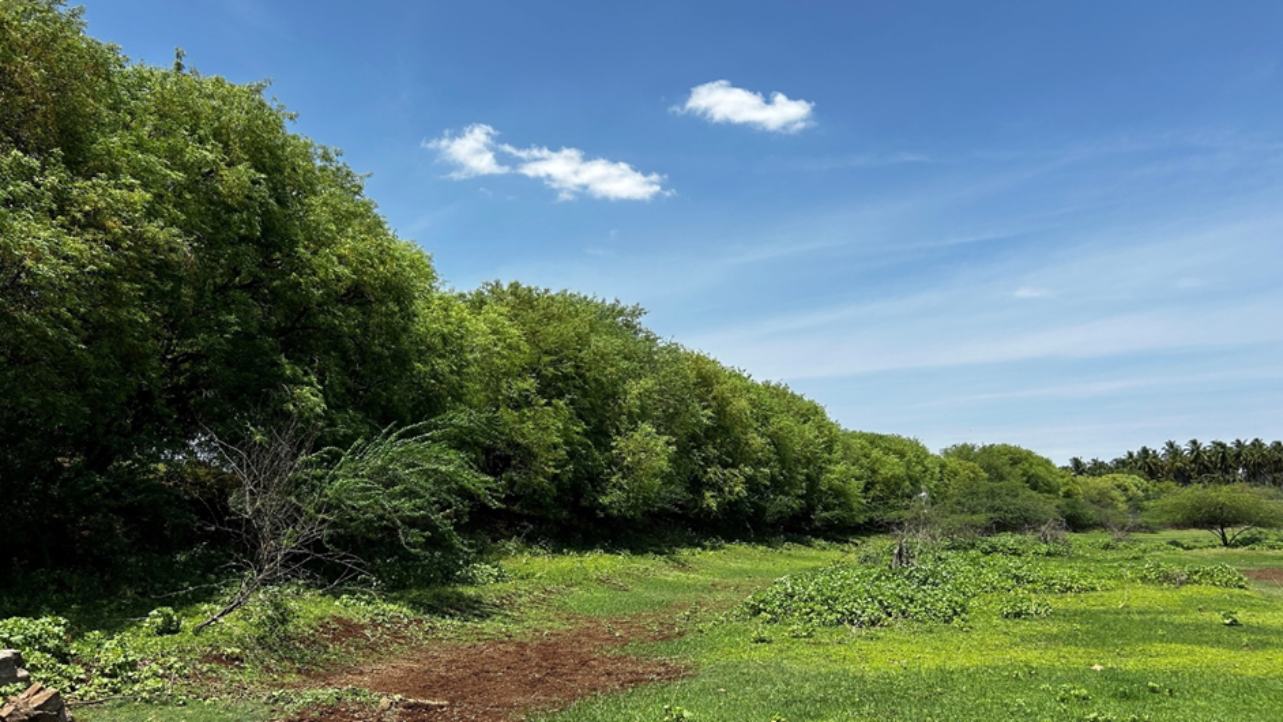
Tamarind Trees planted in the bund of Kumarasamudiram Tank
The past 5 years income and expenditure is given below
| Year | Income Source | Amount (₹) | Expenditure Details | Amount (₹) |
|---|---|---|---|---|
2024 |
Leasing Tamarind trees
Leasing community well water
Prosopis juliflora removal and selling
Fish rearing leasing
|
50,000
1,850
5,000
16,500
|
Tank maintenance – JCB works
Community well maintenance
Donation for Kottampatti Vayalagam office building
Expenses for bank travel and logistics
|
4,600
2,345
10,000
6,600
|
2023 |
Leasing Tamarind trees |
8,100 |
Pipe works maintenance |
650 |
2022 |
Leasing community well water
Leasing Tamarind trees
|
6,160
32,000
|
Motor maintenance
Pipe works maintenance
Surplus weir renovation works
|
5,400
740
7,990
|
2021 |
- |
- |
Travel and small maintenance works |
800 |
2020 |
Leasing Tamarind trees
Selling the prosophis trees
|
50,000
50,000
|
Tender for prosophis cutting rights
Surplus weir & tank maintenance (Konarkulam, Solakulam)
Travel, notebooks and logistics
|
24,000
44,891
605
|
The table indicates the revenue generated through various activities of the tank. They have maintained an extensive account of travel and even notebook buying cost details also in the accounts book by the farmers themselves, which shows their dedication. This also shows the expenditure of the tank maintenance was taken care by themselves using the funds in the association itself. At present, the Vayalagam association has a fixed deposit of ₹5,80,000. They also helped in maintenance works in the other tanks in their cascade.
Like Kupidacheri Tank, the Adiya Kulam tank also followed the similar process and formed the association in the year 1995. They have also first renovated the bund and then planted tamarind trees.
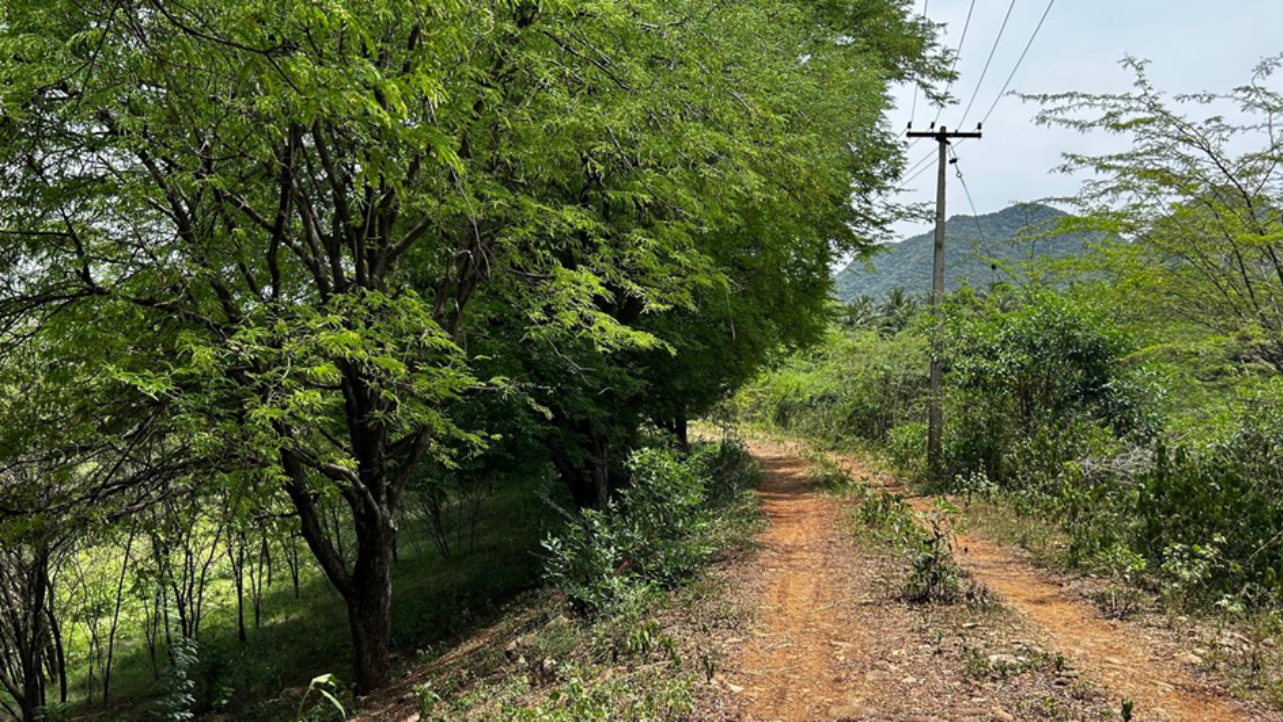
Tamarind Trees planted in the bund of Adiya Kulam Tank
| Year | Income Source | Amount (₹) | Expenditure Details | Amount (₹) |
|---|---|---|---|---|
2024 |
Leasing Tamarind trees
Fish rearing leasing
|
23,000
16,500
|
Bund strengthening works
Clearing encroached areas by JCB
Donation for building Kottampatti Vayalagam office
Bank travel and logistics
|
1,600
5,560
10,000
5,050
|
2023 |
Fish rearing leasing |
10,000 |
Pipe purchase and laying of pipes & maintenance |
6,400 |
2022 |
Leasing Tamarind trees |
25,500 |
Tree plantation (tree, fence, travel) expenses
Renovation of feeder channel work
|
15,160
55,300
|
2021 |
Leasing Tamarind trees |
34,000 |
Renovation of feeder channel work
Bund and Sluice maintenance
Renovation of Karupu temple (clearing, levelling, fencing, stone, roof)
Pipe fixing works
Feeder channel and related works
|
21,240
21,350
74,050
1,000
5,000
|
2020 |
Tree selling at Karuppu temple and Prosopis removal |
1,29,000 |
Tender for trees to panchayat |
21,000 |
Here also, The table indicates the revenue generated through various activities of the tank and the detailed management of funds for the continued maintenance of tank and related activities. Adiya Kulam tank also stared with the endowment fund of Rs. 10,000 and at present 7,00,000. Here they are generating revue through tamarind trees leasing and fish rearing leasing. Through this this tank and association also become a sustainable model.
The farmers of Vellinipatti continue to protect their tank, which serves as a vital source for water and agriculture, by exercising their rights. Farmers everywhere should take advantage of such opportunities and protect the tanks that are the lifelines of their livelihoods. The success factors include the collective leadership, systems set by the vayalagam association, dedication and transparency of leaders, collaboration with government officials and leveraging suitable opportunities, maintaining clear documents. Together, these factors paved the pathway to become one of the sustaining vayalagam model.
Reference
1. Arunkumar R, “Rural Poor and Dependence on Seasonal Common Property Resources (SCPRS)”, International Journal of Research in Social Sciences and Humanities (IJRSSH) 2017, Vol. No. 7, Issue No. III, Jul-Sep
2. Raghunath Sahoo and Mamata Swain, “Contribution of Common Property Resources for Sustainable Rural Livelihoods in Odisha: Prospects and Constraints”, Journal of Rural Development, Vol. 32, No. 3, July - Sept. : 2013
3. Satyasovan Das, 2024, “Why ‘Mission Govardhan’ is needed to preserve traditional knowledge on natural resources, protect community forest land”, Down to Earth.
Comments