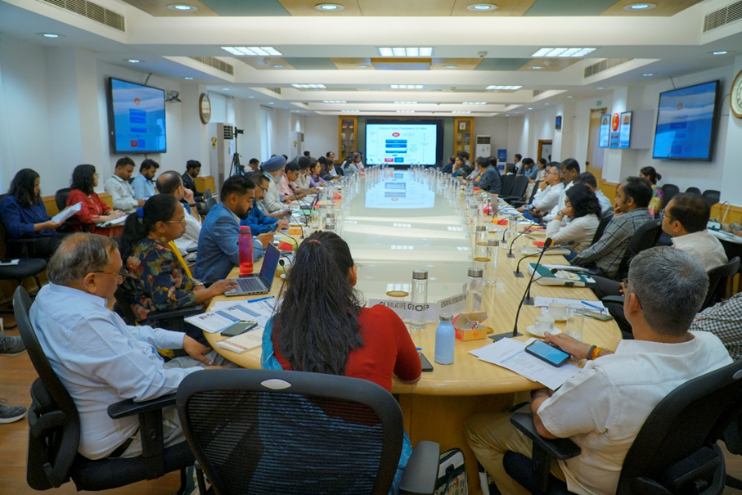
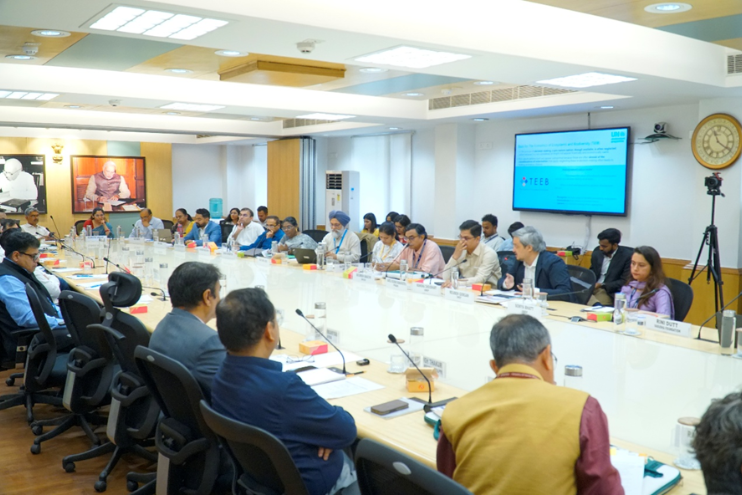
NITI Aayog convened a National Workshop on ‘Mainstreaming Climate Adaptation into Local Development Planning’ bringing together policymakers, climate experts, civil society organizations, and development practitioners to explore effective strategies for integrating climate resilience into Panchayat Development Plans.
The workshop emphasized the need for equipping Gram Panchayats with tools, knowledge, and resources to effectively address climate challenges. It was emphasized that climate adaptation must be woven into all aspects of sectoral planning at the Panchayat level, rather than being treated as a standalone effort. It was underscored that climate modelling must be coupled with community-level knowledge to develop locally relevant adaptation strategies.
A major focus was on institutionalizing climate resilience within Panchayati Raj Institutions (PRIs) and embedding climate-responsive planning into local development frameworks. Discussions highlighted the growing frequency of extreme weather events and their impacts on rural livelihoods, agriculture, and water security, reinforcing the need for disaggregated Gram Panchayat-level data for precise planning and informed decision-making.
Showcasing best practices from different states and Panchayats, the discussions highlighted the value of peer learning and knowledge-sharing in scaling up climate action. The shift from climate adaptation to proactive local climate action was a key takeaway, emphasizing the role of Panchayats in climate risk-informed development and disaster preparedness.
The workshop concluded with a call for multi-stakeholder collaboration, to foster climate-resilient rural livelihoods. Strengthening institutional capacity and encouraging innovation in Panchayat-led climate action were identified as key enablers. Integrating climate adaptation into local governance can help India foster a more sustainable and resilient rural development model. DHAN Foundation, being a pioneer in the country participated in the workshop. Ms.Shanthi Maduresan, CEO of DHAN Panchayat Development Foundation and Mr.Kishan Jindal, Program Advisor of DHAN Foundation emphasized our interventions in the workshops as follows:
DHAN Foundation: Mahatma Gandhi’s concept of “Village Swaraj” envisions self-reliant yet interdependent village republics. Strengthening this vision, the DHAN Foundation has empowered over 46 lakh low-income families through community-led, sustainable development with 5075 panchayats in India. . Through its DHAN Panchayat Development Foundation (DPDF), it fosters grassroots democracy across five states, promoting model villages, localized SDGs, and active people participating in Panchayat systems. DPDF focuses on empowering the poor, women, and Panchayat leaders, while encouraging self-sufficiency and integrating traditional governance with formal structures. Its triangular approach—creating an enabling environment, downscaling appropriate technology, and building people institutions—drives effective, inclusive, and participatory local governance. (annexure -1)
DHAN Foundation, in collaboration with MoRD and GIZ, implemented a pilot project under MGNREGA in Vijayanagaram, Andhra Pradesh, focusing on tank cascade development in Gurla Mandal. Technical orientation was provided to MGNREGA staff across 13 Panchayats, and water budgets were prepared using secondary data. A total of 54 tanks were rejuvenated in two cascades (Tettangi and Garida), generating over 1.67 lakh labour days and completing 1.78 lakh cubic meters of work valued at ₹3.34 crores. Using a cascade and river basin approach, tank boundaries were verified with GIS maps. DHAN added value by ensuring high-quality work, such as proper bund strengthening, slope maintenance, and model tank development. Inland fish rearing was initiated in 31 tanks, and Farm Field Schools were organized to support agriculture in tank command areas. The initiative demonstrated successful community-driven tank rehabilitation with technical rigor and sustainability.
In the Pambar Basin of Tamil Nadu, Axis Bank and DHAN Foundation collaborated to raise awareness on MGNREGA schemes, with the Vayalagam playing a crucial role in mobilizing communities and facilitating individual works worth Rs. 0.62 crore. These included soak pits (147), azolla units (26), cattle sheds (18), land development (31), and farm ponds (6), among others, with shared costs between labour and material. Over 2023–26, the initiative spans 50 Gram Panchayats, 15 tank cascades, and 60 tanks, with a total budget of Rs. 300 lakhs. The model emphasizes a tank cascade planning approach, community-led implementation, capacity building, demonstration, documentation, and sustainable, integrated development.
A Public Private Civil Society Partnership (PPCP) was established between the District Rural Development Agency (DRDA) Munger, 1TC Limited, and DHAN Foundation to restore the traditional Ahar-Pyne irrigation system in Munger district, Bihar. Under the Mahatma Gandhi National Rural Employment Guarantee Scheme (MGNREGS), this collaboration focuses on providing technical expertise and building the capacity of stakeholders to revive and sustain these community-managed water systems through a participatory and sustainable approach.
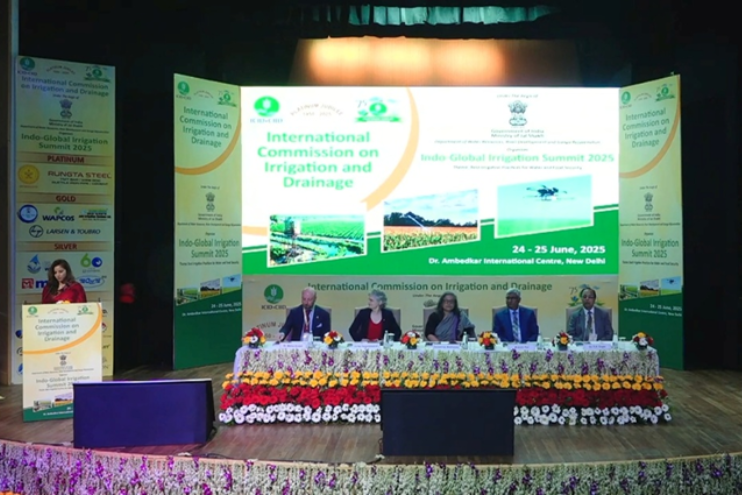
The Indo-Global Irrigation Summit 2025, jointly organized by the International Commission on Irrigation and Drainage (ICID) and the Ministry of Jal Shakti, Government of India at Dr.Ambedkar International Centre, New Delhi on 24th and 25th, June 2025, convened global thought leaders, policymakers, and grassroots institutions to deliberate on the future of irrigation in a climate-stressed world. As a Direct Member of ICID, DHAN Foundation was privileged to participate in this high-impact forum, which brought together delegates from across the globe to share insights on climate-resilient irrigation systems, food and water security, and the importance of inclusive governance in water resource management.
Over two days, the summit featured learnings from leading institutions like UN ESCAP, FAO, World Bank and IWMI, alongside senior representatives from Indian ministries and international agencies. Technical Sessions focused on innovations in irrigation technologies, water use efficiency, and participatory approaches. A commemorative session marking 75 years of ICID, showcasing global irrigation success stories (Canada, South Africa), traditional heritage systems such as KHETTARA in Morocco, and a historical documentary reflecting on ICID’s legacy. Recognizing the gap of top-down approach, many experts agreed poses risks to sustainability and long-term ownership of water systems. DHAN Foundation reaffirmed its commitment to promoting farmer-led irrigation models, particularly the Vayalagam model, as scalable alternatives that combine traditional wisdom with modern practices. We envision a more significant role as a representative institution within ICID platforms, voicing the concerns and aspirations of the smallholder farming community. Our participation reinforces DHAN’s core belief: "Global Thinking for Grassroots Action." By representing the collective voices of India’s smallholder farmers on global platforms, DHAN continues to advocate for equitable, sustainable, and community-driven solutions to water and irrigation challenges. Mr.V.Venkatesan, CEO of DVTF, and Mr.Lokesh Sinram, Senior Project Executive, participated in this submission.
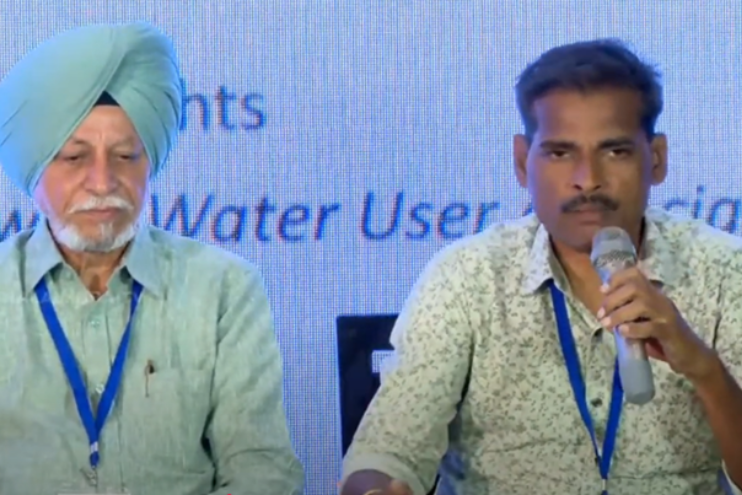
On June 14, 2025, the Tamil Nadu Water Resources Department hosted a workshop in Chennai on the theme "Community participation for sustainable water resources management." DHAN Foundation was invited as a panel for the module "Simplifying the procedures to facilitate restoration of water resources by all stakeholders,". On behalf of us, our colleague Mr. V.Venkatesan, CEO, DVTF, joined the panel and discussed the success stories of the Vayalagam model. The delegates applauded DHAN for our community-driven conservation strategies and continued emphasis on social capital.
Our Voice during the panel Discussion:
https://www.youtube.com/watch?feature=shared&v=7GXUZSSitPg
The 11th meeting of the Executive Committee of the Life Insurance Council was held on 13th May 2025 at 10:30 AM at Bhubaneswar, Odisha. The meeting commenced with a welcome address by Shri S.N. Bhattacharya, Secretary General of the Life Insurance Council. Shri Siddhartha Mohanty, Chairman of LIC of India and Chairman of the Executive Committee, addressed the members, after which updates were provided on the DFS meeting held on 16th April 2025 and the takeover of the Grievance Call Centre and Bhima Bharosa operations by the General and Life Insurance Councils. The Committee proceeded to deliberate on two key items: the forbearance of the Expense of Management for the financial year and the appointment of a new Secretary General.
DHAN Foundation, being one of the EC members, was represented by Executive Director, Mr. M.P. Vasimalai, who actively participated in the meeting and represented the NGO sector in Micro Insurance.
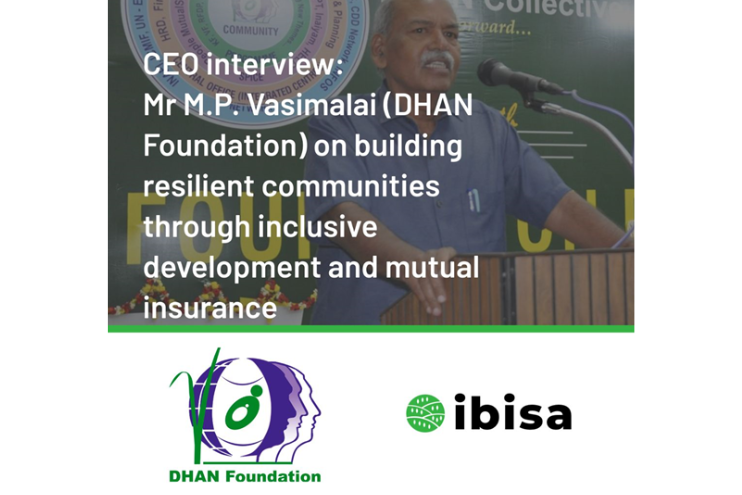
Our Executive Director Mr.M.P.Vasimalai’s Interview on building resilient Communities through inclusive development and mutual insurance was released in the ICMIF’s website:
ISF being the partner have released a case study on the impactful collaboration with our Foundation and IBISA Network, which showcases how innovative, community-driven insurance solutions can transform the lives of smallholder farmers in India. India is among the most climate-vulnerable countries globally, and so its agriculture sector. Through the development of index-based crop insurance and indemnity-based livestock insurance, combined with agri-advisory support and climate-smart agriculture practices, this initiative is helping farmers across six Indian states better manage risk, secure their livelihoods, and build long-term resilience.