Issue 5: Oct - Dec 2025
www.vf.dhan.orgReclaiming encroachments in water commons through DHAN’s democratic way, 2025
This article documents successful case studies of encroachment eviction and restoration of water commons across Tamil Nadu, demonstrating the critical importance of community-led water governance in addressing the complex challenges facing traditional water bodies. The six case studies, spanning both rural and urban contexts, reveal how irrigation tanks, ooranis (drinking water ponds), and their associated channel systems have been systematically degraded through encroachment, yet can be effectively restored through strategic community mobilization, multi-stakeholder partnerships, and innovative technical solutions.
The documented interventions across Melakodumalur and Sirumaniyendal demonstrate that encroachment on water commons stems from interconnected factors including environmental degradation through siltation and invasive vegetation, governance failures marked by inadequate investment and weak enforcement, and socio-economic pressures driven by urbanization and land value appreciation. These cases particularly highlight how marginalized communities, historically forced to settle on tank bunds, become vulnerable to displacement during restoration efforts, necessitating careful attention to social equity in the eviction process. The remaining cases such as Pothivani Cheruvu, Avaniyapuram, K. Pudhupatti, Badava Cheruvu are document in the ‘Moved out of Encroachment’ book given in the ‘New launches section of this issue.
The restoration efforts, facilitated primarily by DHAN Vayalagam Tank Foundation through its Centre for Urban Water Resources, achieved remarkable returns on a collective investment of ₹32 lakh, creating an additional water holding capacity of 16,000 cubic meters, securing irrigation for over 800 acres, and recovering land parcels worth ₹37 crores from encroachers. More significantly, these interventions generated projected annual agricultural returns of ₹20 crores for over 300 farming families while establishing robust Vayalagam (water user) associations capable of sustaining long-term water governance. The success of these initiatives relied on a combination of strong district-level administrative support, community co-financing ranging from 25-50% of project costs, evidence-based approaches using georeferenced cadastral maps and legal documentation, and prioritization of dialogue and negotiation over forced eviction.
The report concludes with comprehensive policy recommendations calling for systemic reforms including establishment of a State Mission for encroachment eviction, creation of district-level Water Commons Restoration and Monitoring Cells, implementation of time-bound eviction mechanisms, and development of self-revenue generating models for sustainable water body maintenance. These recommendations emphasize the need for democratized access to water body data through digital platforms, mandatory social impact assessments to address historical injustices, and innovative nature-based solutions for ecological restoration. The evidence presented makes a compelling case that protecting and restoring water commons requires transformation from reactive to proactive governance, supported by appropriate institutional frameworks, adequate financial resources, and sustained multi-stakeholder engagement to ensure water security for current and future generations.
Case studies on Moved Out of Encroachment
Case 1 : Reclaiming the Flow: Overcoming Resistance to Evict Encroachment on the Paralaiyaru supply Channel of Melakodumalur Irrigation Tank
"The water receipts for the irrigation tank supply are the evidence of our accountability to water," stated Mr.Ramu, the vice president of the Melakodumalur Kanmoi Vayalagam (Irrigation Tank Association). Melakodumalur, famous for its unusually west-facing Lord Murugan Temple, is named after a legend of Lord Murugan, meaning 'the village of the one who holds the mighty weapon and faces west.'
The Melakodumalur irrigation tank has a water spread area of 507 acres and irrigates a command area of 695 acres, supporting over 150 farming families among the village's 800-plus households. The community relies on the tank for agriculture, livestock, fish rearing, and groundwater recharge.
The farmers implement a unique, regulated water management system. They appoint two Neerkatti (water managers) for each of the tank's seven sluices on an annual, rotational, and volunteer basis. Farmers in the command area pay ₹200 per acre per irrigation and receive a receipt from the association. Water is only released by the Neerkatti upon submission of this receipt, ensuring equitable and regulated supply. The Neerkattis are paid an annual stipend of ₹3,000, and all collected payments are deposited into a bank account for tank maintenance.
Optimal water supply is crucial for the agricultural economy. A single full filling allows for a successful paddy crop, yielding a net profit of ₹22,000–27,000 per acre. If the tank fills 1.5 times, a second crop (cotton or chilies) is possible, increasing the annual net profit to ₹40,000–50,000 per acre.
The Challenge: Channel Encroachment and Water Scarcity
The Melakodumalur tank is fed by two sources: the Vaigai River and the Paralaiyaru (an artery of the Gundar River) via respective supply channels.
The Paralaiyaru supply channel faced significant impairment due to encroachment, leading to reduced water flow:
- Channel Reduction: The channel's effective width was reduced from a designated 15 meters to a width of only 4–6 meters.
- Infrastructure Encroachment: Portions of the feeder channel were converted into roads, and six small culverts were constructed by individuals, further shrinking the waterway.
- Water Diversion: These encroachments diverted significant runoff from the catchment area into waste areas, preventing replenishment of the tank.
Mr.K.Selakannu, Secretary of Melakodumalur Vayalagam expressed, “Historically, the flow from the Vaigai River compensated for the reduced supply from Paralaiyaru, leading to a decade of neglect regarding the channel retrieval. However, over the last ten years, the supply from the Vaigai River has become drastically unreliable, dropping from an estimated 60–70% of the total water augmentation to less than 50%. This insufficient augmentation severely impacted the second crop, forcing farmers to either abandon it or rely on saline groundwater, which reduced overall yield”.
The association recognized that insufficient tank water had resulted in severe financial distress due to frequent second-crop failures.
Collective Action and Channel Retrieval Process
In 2025, the Melakodumalur Vayalagam mobilized resources and action. Following the generation of common village funds through the auctioning of Prosopis juliflora (Neltuma juliflora) in the tank water-spread area, the villagers engaged the Mudukulathur Farmers Vayalagam Federation (promoted by DHAN Vayalagam Tank Foundation) to facilitate the restoration of the Paralaiyaru supply channel.
The Vayalagam leaders pursued the issue at the Ramanathapuram District Collector’s farmers grievance meeting. Following persistent follow-up (more than 10 instances) with the Thalisdhar and the Public Works Department (PWD), the retrieval process was initiated in August 2025.
The total estimated cost for the retrieval of the 3 km Paralaiyaru supply channel was ₹6,00,000, with the Melakodumalur Kanmoi Vayalagam contributing 50% of the total cost.
The initial phase successfully retrieved 2.5 km of the channel to its full 15-meter width. However, a final 500-meter stretch was contested by six individuals.
Resolution of Resistance
The process to resolve the final resistance involved:
- Official demarcation of boundary: A three-day process was required to survey the 500-meter stretch and demarcate the boundaries with stones in the presence of government officials and villagers.
- Community negotiation against targeted resistance: While most residents of the nearby Seyyamanagalam village accepted the demarcation, one socio-economically dominant individual resisted the eviction of their encroached land. The Melakodumalur farmers conducted a series of meetings with Seyyamanagalam villagers in their common community hall. Through peer pressure exerted by their own community members, the encroacher was ultimately compelled to comply with the eviction process.
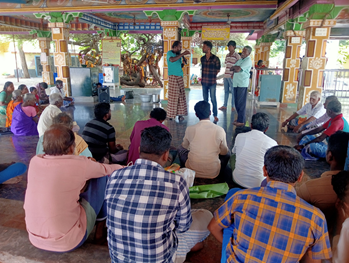
Community Meetings at Melakodumbalur temple
After 11 days of continuous engagement, the 500-meter stretch was successfully evicted, and the channel was fully restored to its designated 15-meter width. Leaders of the Vayalagam association reported collectively investing approximately 200 person-days in the channel retrieval efforts.
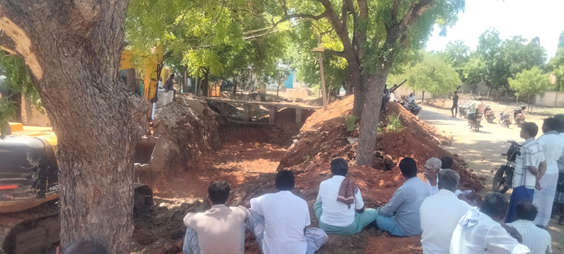
Evicting channel encroachment
The successful eviction of encroachments and the clearance of the feeder channel restored the full potential flow of water to the tank. The Vayalagam leaders projected that the restored channel capacity will enable the tank to augment its capacity by 1.5 times, supporting the second crop and increasing income from fisheries. This enhanced water retention is expected to improve groundwater quality, which was demonstrated in past instances of high-water retention.
Mr.M.Nararajan, the treasurer of Vayalagam was confidently sharing, “The projected the economic benefit is significant: an estimated increase of ₹20,000 per acre across the entire ayacut, totaling an annual benefit of ₹1.4 crores for the command area”.
This case demonstrates the effectiveness of a multi-faceted approach involving strong local institutional capacity (Vayalagam), Collective action and financial investment by the community, persistent advocacy with government agencies (Collector, Tehsildar, PWD) and use of community negotiation and peer pressure to overcome localized resistance and resolve complex encroachment issues.
Restored supply channel
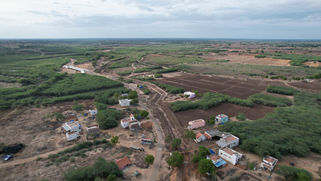
Restoration of 3-km long supply channel
Case 2 : From Single to Double Crop: The Sirumaniyendal Vayalagam's Success in Channel Encroachment Eviction
The village of Sirumaniyendal in the Kamuthi block of Ramanathapuram district is primarily dependent on Sirumaniyendal irrigation tank. This tank, with a water-spread area of 19.4 acres, is a critical resource for irrigating 50 acres of land. The command area farmers are largely small and marginal, sustaining themselves by cultivating a single annual crop of Paddy, Chilli, or Cotton on red sandy and black cotton soil. The village name itself is rooted in this history, referring to the yendhal (irrigation tank) that supports the cultivation of small-size paddy grains.
The tank's water source is the surplus flow from two water bodies in the upstream of the tank cascade system: the Kil Vidathakulam irrigation tank and the Pagalaneri irrigation tank.
The local association, the Sirumaniyendal Kanmoi Vayalagam, has a history of community action, having been promoted in 2005 by Mr. V. Venkatesan, the current CEO of DHAN Vayalagam Tank Foundation (DVTF), to restore a village drinking water pond.
Limiting the feed and food:
The primary obstacle preventing the Sirumaniyendal tank from reaching its full potential was the dilapidated state of its feeder channels.
- Physical Impairment: The channels, which direct surplus water from Kil Vidathakulam and Pagalaneri, were severely impaired by encroachments made by several farmers from the command area of the Kil Vidathakulam tank.
- Water Insecurity: The channel's reduced carrying capacity directly limited the water harvested by the irrigation tank, impeding the possibility of a financially critical second crop.
- Conflict Risk: The encroachment was located in a neighboring village, creating a significant risk of communal conflict, as they were from two different castes. This led to years of inaction and reluctance to address the issue.
- Financial Barrier: The village lacked an established common village fund, which was essential for initiating any project requiring a community contribution.
COVID brought the Catalyst
The catalyst for action was Mr. Pandidurai, the President of the Vayalagam. Although he owned 3 acres of command area land, he was working in Coimbatore as a shopkeeper and load van operator. Out of interest, he pursued a part-time certificate course in Agriculture at TNAU in his 50s. Due to his family issues, he returned to the village during the COVID-19 pandemic after 20 years away.
Mr. Pandidurai dedicated four years to consistently advocating for the channel's retrieval. He successfully re-prioritized the project interventions stating, "When the Tank Appraisal Exercise was conducted, most of the farmers prioritized the repair of a leaky sluice, but then I explained them the importance of retrieving the channel and motivated the villagers to invest in it."
The lack of a village fund was resolved through auctioning Prosopis (Neltuma) juliflora, invasive tree species in the tank water spread area for ₹3,00,000. From this, ₹82,000 was contributed by the villagers, and the remaining ₹2,46,000 was secured through CSR support from Axis Bank Foundation.
Inclusion to negotiate eviction
To neutralize the conflict risk, the Sirumaniyendal Vayalagam secured support from Pagalaneri Village, which also benefited from the channel system. Pagalaneri's farmers belonged to the same community as those in Kil Vidathakulam. Though not heavily reliant on agriculture, Pagalaneri recognized the long-term benefit of increased augmentation in their own tank and provided crucial support by accompanying Sirumaniyendal farmers in petitioning the District Collector and assisting in the negotiation with the encroaching farmers in Kil Vidathakulam.
A key factor in securing Pagalaneri's cooperation was the dedicated effort of Sirumaniyendal farmers like Mr. Ravi (who commutes from Chennai for meetings), demonstrating sincere commitment. Mr.Aaron, a village leader from Pagalaneri, confirmed, "Initially we were reluctant... but the sincere effort of Sirumaniyendhal villagers... convinced us to stand by them."
Throughout the project, the District Administration provided consistent and critical support. The Collector of Ramanathapuram, Mr.Simranjeet Singh Kahlon IAS, ensured routine follow-ups, speedy approvals, and maintained communication with the community, serving as a model of public-NGO-community partnership.
The channel was surveyed, boundaries were demarcated, and boundary stones were laid in the presence of the Tehsildar, Revenue Inspector, and community members. Given the unanimous stand of the Sirumaniyendal and Pagalaneri Vayalagams, the encroachers offered no resistance.
In September 2025, the 3 km channel was successfully restored, widening its dimensions from approximately 3 feet to 20 feet and deepening it from 2 feet to 3 feet.
The increased water harvesting potential is expected to allow farmers to cultivate two crops per year instead of one. This transition is projected to increase farmer earnings by at least ₹25,000 per acre, providing a critical lifeline for small and marginal farmers.
Vision for 100% restoration
Following the uprooting of Prosopis, the Vayalagam has planned to plant tamarind trees along the tank bunds, creating an asset that will eventually contribute to the village fund. If the water retention period increases, the farmers intend to invest in fish rearing.
The Vayalagam recognizes that the journey continues; as the treasurer noted, “The next steps include repairing the leaky sluice and desilting the tank to its original capacity. For which we are developing a ‘self-revenue generating irrigation tank model’ to mobilize an endowment fund and capital. Our vision is 100% restoration of Sirumaniyendal irrigation tank and we are confident about it”.
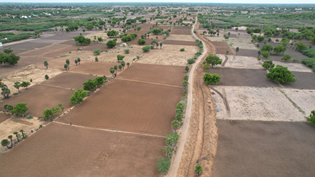
Restored supply channel flowing along the fields of Kil Vidathakulam
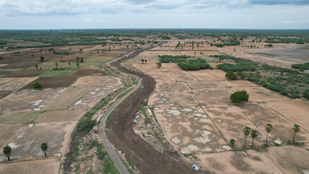
Restored supply channel flowing along the fields of Pagalaneri
Knowledge Brief - Root Causes of Encroachment
1. Environmental and Physical Factors
Prolonged Siltation and Invasive Vegetation
Irrigation tanks and ponds (used for drinking and domestic purposes) in Southern India are earthen structures. As they harvest runoff from free and combined catchments upstream, they are prone to continuous siltation from sediment carried by rain and river flow. Since these water bodies have a falling gradient toward the embankment, siltation predominantly occurs in the deepest portion.
As these water bodies are seasonal and gradually dry up in the summer, vegetative growth emerges, capitalizing on the soil moisture and organic load in the foreshore area and extending into the waterspread area. This vegetation traps the silt carried by runoff before it reaches the deepest portion. Since this deposited silt is rich in organic content, it further enriches the soil and enhances vegetative growth in the foreshore and the littoral zone. This process is further aggravated by the invasion of Neltuma (Prosopis) juliflora, a common invasive tree species in tank cascade systems. This dense vegetative growth leads to the siltation of the littoral zone and results in raised bed levels.
In urban tank cascade systems, where grey water is a major challenge, sludge and slurry are deposited along with the runoff, settling in the littoral zone. Being rich in organic load, this sludge serves as a favorable environment for the proliferation of invasive grasses, reeds, and water hyacinth. This vegetation, in turn, accelerates the silt and sludge deposition in the littoral zone, further raising the bed levels.
In both urban and rural cases, the raised bed levels in the littoral zone, when neglected due to lack of desiltation and vegetative uprooting, effortlessly invite adjacent landowners to encroach. They gradually extend their land parcel boundaries, effectively claiming the water body's edge.
A similar challenge exists with channels. When a channel is silted after every monsoon, farmers adjacent to it remove the silt and deposit it along the channel border next to their land, raising their land level and extending their parcel. This practice gradually encroaches upon the channel, thereby shrinking its width.
2. Economic and Governance Failures
Lack of Investment and Ignoring Eviction
Neither the dependent community nor the government regulatory bodies have developed a 'self-revenue' generating model that pools investment for these traditional water bodies. This omission directly affects regular investment in maintenance and restoration. Since the ownership formally lies with government departments, the community often disowns the water body by withholding investment, expecting the government to bear the cost.
While some government schemes for water body restoration and MGNREGS are improving conditions, they generally focus less on the eviction of encroachment. Eviction is a time-consuming process that requires systemic effort to combat influential encroachers. Ignoring eviction during restoration efforts essentially licenses the encroacher to expand further.
Power, Greed, and Return of Encroachment
The booming real estate market and the increasing land value in urban and peri-urban areas make every square foot of annexed land worth thousands or even millions of rupees. In rural areas, annexing adjacent common land (water bodies and channels) is driven not just by the need for increased production, but also by the desire to legitimize the annexed land by utilizing it for generations, which promises a significant return on encroachment due to future land value appreciation.
On the other hand, resource-rich and socio-politically dominant individuals use their influence and supremacy to 'grab the commons,' diluting regulatory forces and attempting to legitimize their encroached parcels.
3. Social and Institutional Dynamics
License to Encroach from Inaction
Encroachment is as infectious a disease as greed. When there is no visible action from the community, regulatory authorities, or governing departments against the initial encroacher, it effectively licenses neighbors to do the same. A lack of 'social vigilance' and 'social capital' to combat encroachers and their affiliations becomes a key reason for inaction. Furthermore, a lack of 'social incentives' and 'social reorganization' for individuals who fight against encroachments demotivates them and can adversely affect their 'social life.' This inaction also provides a license for existing encroachments to expand. Over time, the collective nature of encroachment strengthens its possession, further complicating the eviction process.
Historical and Urban Social Injustice
Historically, in tank-dependent rural areas, marginalized families who worked as landless labor for landowners were forced to settle on the embankments of the dependent water bodies. Families from marginalized sections—including those involved in washing clothes, operating the sluice, or watching over the command area crops—built their huts on the bunds. Although embankments are vulnerable to breaches, they were fixed places for settlement, not the main village hamlet. Since these families were small in number, resource-poor, and often bonded to the landowners, they were effectively voiceless.
In the urban setting, water body embankments often represent the only land freely available for settlement for migrants from resource-poor, socially marginalized, and outcast sections.
Despite persistent efforts to obtain 'patta' (land titles) or compensatory land, their voices often remain unheard by the village, Gram Panchayat, municipality, or district administration. Over generations, due to snail-paced economic graduation and a need to secure their vulnerable habitations (originally thatched huts), they gradually upgrade their homes from kaccha to semi-pucca housing.
It is an irony that government departments provide electricity supply, offer groceries through public distribution schemes, and ensure other welfare schemes to these settlements, but fail to provide the fundamental 'land' or safe 'house,' which is a basic right to live. It is important to note that the historical social injustice of forcing landless marginalized communities to settle on embankments leads them to become the encroachers of the water body in the 'legal' sense, thus imposing further social injustice upon them.
Conclusion
The challenge of encroachment on water commons represents a complex interplay of environmental degradation, institutional failures, social inequities, and economic pressures. As this brief demonstrates, successful eviction and restoration of water bodies requires far more than legal enforcement—it demands a comprehensive approach that addresses root causes while building robust community institutions, ensuring adequate financial resources, leveraging data and technology, and fostering multi-stakeholder collaboration.
The documented cases reveal that investments in encroachment eviction and water body restoration yield substantial returns—both financial and social. With a relatively modest investment of ₹32 lakh generating projected annual returns of ₹20 crores while recovering commons worth ₹37 crores, the economic case for action is compelling. More importantly, the social returns—strengthened local institutions, enhanced community cohesion, and improved water security—create the foundation for sustainable water governance.
Moving forward, the transformation from reactive to proactive water governance requires systemic changes: developing self-revenue models, democratizing access to data, building cascade-level institutions, and ensuring that eviction processes address rather than perpetuate social injustices. The success stories presented here demonstrate that with appropriate enabling platforms, sustained investment in both hard and soft infrastructure, and committed multi-stakeholder engagement, communities can effectively reclaim and protect their water commons. These lessons provide a roadmap for scaling successful interventions while ensuring that the fundamental right to water is preserved for current and future generations.
 Facebook
 Instagram
Comments