
Issue 5: Oct - Dec 2025
www.vf.dhan.orgWorld Fisheries Day – Sate level Inland Fisheries Workshop, Chennai
Proceedings Brief
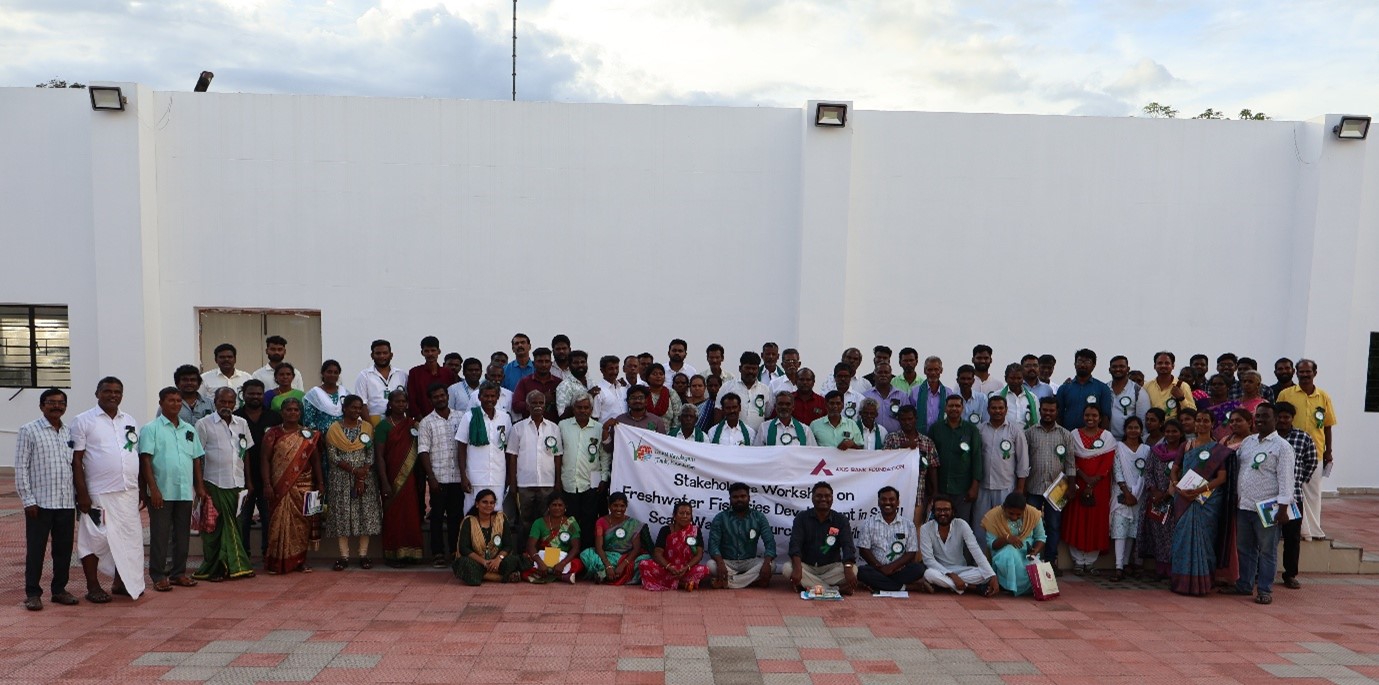
Stakeholders Workshop on Freshwater Fisheries Development in Small-Scale Water Resources in Tamil Nadu
Date: 21 November 2025
Venue: State Institute of Rural Development, Chennai
This workshop brought together key stakeholders from government departments, academic institutions, NGOs, and community representatives to collectively deliberate on strengthening inland freshwater fisheries in Tamil Nadu. The workshop served as a collaborative platform to share field experiences, success stories, scientific advancements, and policy needs for developing fisheries in tanks, ponds, and farm ponds. The discussions highlighted the urgent need for sustainable water resource management, farmer-centric policy support, scientific fish farming practices, and strong community institutions to enhance rural livelihoods and food security. The participants collectively affirmed their commitment to advancing freshwater fisheries through coordinated action, resource mobilisation, policy advocacy, and continuous capacity building.
Mr. J. Mohan, COO, DVTF: He warmly welcomed all dignitaries and participants and highlighted the importance of collective action in strengthening inland fish farming. He emphasised the role of community involvement and cooperation among institutions.
Mr. V. Venkatesan, CEO, DVTF: He explained the purpose of the workshop and DHAN’s work with 30 lakh families across Tamil Nadu. He stressed the need to support small and marginal farmers, showcased the Viralimalai farm pond success story, and called for participation, experience sharing, and action.
Dr. B. Manimaran, Founder & First Vice Chancellor, TNJFU: He appreciated DHAN’s efforts and spoke about the huge potential in inland fisheries despite water limitations. He emphasised the need for documentation, digital registration, forward–backward linkages, and cluster-based fish farming.
Dr. D. Manikandavelu – Retired Professor, TNJFU: He discussed the scientific and economic importance of fish farming and community collaboration. He encouraged value addition, processing, integrated farming models, and research-based practices for sustainable growth.
Ms. R. Rajakumari, DVTF: She presented India’s and Tamil Nadu’s inland fisheries status and achievements under DHAN projects. She highlighted challenges like fingerling availability, feed cost, and awareness gaps, and proposed policy recommendations for strengthening fisheries in small water bodies.
Mr. K. Udhayakumar, DVTF: He shared successful field evidence from Viralimalai on the benefits of farm pond fish rearing for income and water security. He stressed cluster-based development and skill-building to scale up the model.
Mrs. Geetha, AEE, Rural Development Department: She detailed the government’s restoration plan for 5,000 Minor Irrigation Tanks and the role of MGNREGS and CSR in rejuvenation. She emphasised quality monitoring, community participation, and linking fisheries with tank restoration.
Mr. Selvaraj – Assistant Professor, Ponneri Fisheries College: He explained global and local significance of fisheries related to World Fisheries Day. He clarified scientific fish rearing practices and answered practical queries from farmers regarding pond depth, stocking, feeding, water quality, and market access.
Subgroup discussion facilitated by Mrs Senthilarasi and Mrs Senthilarasi
Sub-Group Discussions: Key points
Participants discussed challenges and proposed actionable solutions for scaling up inland fisheries:
- Improve access to quality fingerlings, feed, aeration units, power connections, and insurance.
- Promote cluster-based fish farming system and FPO model for marketing and input supply.
- Advocate subsidy for liner ponds and encourage continuous fish farming to improve profitability.
- Ensure local decision-making in village ponds through people institutions and MoUs with panchayats.
- Prioritise local fish varieties, eradicate African catfish, and enable water bodies to be continuously used for fish rearing.
Mr. Prahaladen – Programme Leader, DPDF: He consolidated resolutions focusing on institutional strengthening, cluster-based fish units, FPO formation, insurance coverage, subsidy linkages, and permissions support. He stressed Vayalagam Federation leadership in policy advocacy and scheme access.
Declarations
- Strengthen Vayalagam Federations to link schemes and support permissions, inputs, and insurance.
- Establish Fish Farmers Producer Organisation (FPO) for collective bargaining and enterprise.
- Create experimental learning centers and conduct regular training and demonstrations.
- Allocate AFG funds for water body improvement and fisheries development.
- Improve fisheries-specific loan products and subsidy communication systems.
- Convert workshop resolutions into a structured action plan and communicate them to village communities.
- Promote monthly training, scientific practices, cluster development, and grassroots policy advocacy.
- Scale up farm pond fish rearing and tank-based fisheries as sustainable livelihood strategies.
Mr. V. Venkatesan, Way Forward Address: He called for converting workshop outcomes into action plans, regular training, technical support systems, and development of fish-based loan products. He highlighted the importance of monthly awareness programmes and experimental learning centers.
The participants committed to strengthening community governance, promoting FPOs, improving access to resources, and enhancing livelihoods through sustainable freshwater fisheries.
Dr. Sivasubramanian, Programme Leader, DHAN Foundation: He delivered the vote of thanks, appreciating the collaboration of all departments, communities, and institutions. He reinforced the need to continue joint efforts to strengthen fish-based livelihoods and water resource management.
 Facebook
 Instagram
Comments