Issue 5: Oct - Dec 2025
www.vf.dhan.orgDistrict Level Seminar on Family Farming through Integrated Farming System (IFS), Pambar Region, Sivaganagai district, Tamil Nadu
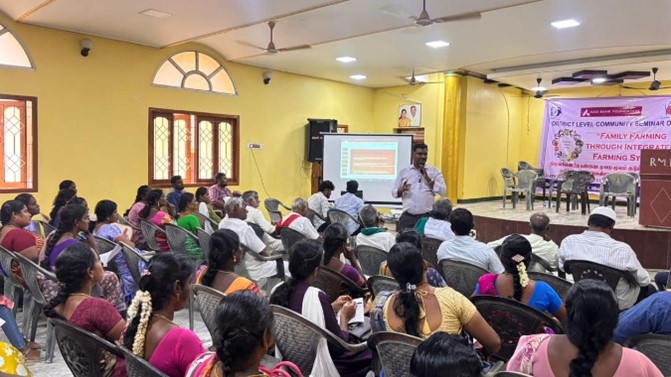
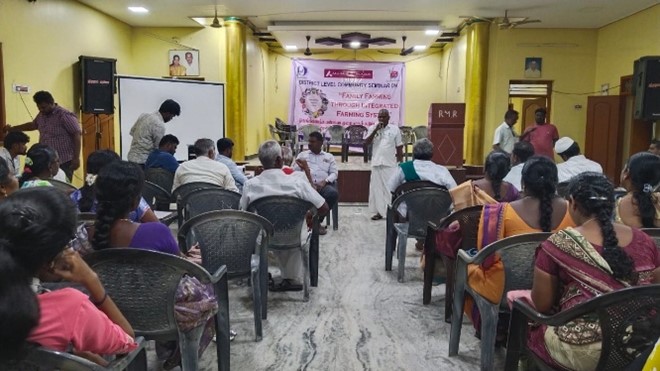
The District Level Seminar on Family Farming through Integrated Farming Systems (IFS) held on 26.11.2025 in Pambar Region, Sivagangai district, emphasized five key points: (1) strengthening family farming in rainfed areas through Integrated Farming Systems that combine crops, livestock, fisheries, poultry, and other allied activities to enhance income and reduce risk; (2) reinforcing the role of Vayalagams and Federations in promoting sustainable practices such as soil testing, organic farming, technological training, and credit facilitation; (3) revitalizing traditional farming practices by reducing chemical dependency and linking farmers with government schemes, training programmes, and subsidies; (4) improving farmers’ access to regulated market facilities, storage, and credit support to secure better prices and financial stability; and (5) fostering knowledge sharing, collective action, and marketing structures without middlemen to ensure long-term sustainability and improved livelihoods for farming families.
Proceedings
Date: 26.11.2025
Chief Guests:
- Mr. R. Selvam, Superintendent Officer (Agriculture), Regulated Market, Sivagangai
- Mr. B. Yogeswaran, Seed Certification Officer, Sivagangai
The District Level Community Seminar was inaugurated with a reflection followed by the lighting of the lamp by the chief guests, officials, leaders, and staff of the Pambar region.
Welcome Address
Mr. Prakash, FC (Thirupathur), welcomed the honourable chief guests, regional coordinators, leaders, and staff members and expressed gratitude for their participation.
Purpose of the Seminar
Mr. Rajasekar, FC (Kottampatti), explained the objective of the seminar. He shared that policy workshops are conducted once in three months at the regional level to promote awareness, provide in-depth understanding of key themes, and facilitate policy-level changes at the community level. The focus of this seminar was on strengthening family farming through Integrated Farming Systems (IFS).
Presentation on Family Farming in Rainfed Areas
Mr. N. Saravanan, RC (RFDP, Pambar), presented the concept and current status of family farming. He highlighted the role of DHAN and people’s institutions in improving productivity with minimal cost of cultivation, especially in rainfed areas.
He emphasized the responsibilities of Vayalagams and Federations in promoting sustainable farming practices. Integrated Farming Systems include agriculture crops, horticulture, cattle, poultry, fisheries, and beekeeping, which naturally support family farming by generating additional income and reducing risk.
He also explained Vayalagam interventions such as technological training, credit facilitation, knowledge sharing, and farm planning for higher productivity. The importance of soil testing, reduced fertilizer use, organic farming, and integration of farming practices was stressed.
An example of Mrs. Amutha, an integrated farmer from Thirumayam Federation earning an additional income of Rs.1,20,000 per year, was shared through a PPT presentation.
Lead Remarks
Mr. U. Vellaiyappan, RC (Pambar), spoke about the changes in farming practices from the past to the present. He explained how modern trends, chemical usage, low yield, low income, and increasing barren lands have weakened family farming and IFS.
He suggested that Vayalagam institutions should collect information from members regarding cultivable and barren lands, family involvement, IFS adoption, and technology usage, and link them with government departments for revival.
He emphasized that family farming is not new but hidden under current chemical-based practices, and it must be renewed through proper guidance and management.
Special Address by Chief Guests
Mr. R. Selvam explained the importance of regulated markets in Sivagangai district, which has seven regulated market centers. These markets provide storage facilities and offer up to 75% credit on stored produce at low interest. By storing produce, farmers can sell at better prices later.
He also shared about the “Uzhavarai Thedi Velanmai” scheme, focusing on cattle management. The Veterinary Department provides free training in cattle and silkworm rearing with allowances. After training, farmers can start enterprises on small land holdings, increasing income and livelihood security.
Mr. B. Yogeswaran spoke about the evolution of IFS. He mentioned the Green Revolution introduced high yielding varieties but also increased chemical use, causing environmental and health issues.
He stressed that integrating agriculture with allied activities reduces cultivation cost, increases income, and protects the environment. IFS follows traditional practices without harmful effects, and farmers should revive them using government schemes, subsidies, and trainings.
Both chief guests were honoured with shields by the Pambar Region Vayalagam leaders.
Experience Sharing
Leaders Mr. Kesavan, Mr. Chinnakannu, Mr. Poosari, and Mr. Chinnaponnu shared their experiences and benefits from family farming and IFS. Their stories motivated participants to revive sustainable farming and improve environmental practices.
Way Forward
- Revive and strengthen family farming through Integrated Farming Systems.
- Enable all Vayalagam members to access regulated market facilities.
- Link farmers with Agriculture Departments for sustainable livelihoods.
- Motivate members to adopt sustainability as a lifelong goal.
- Build marketing structures without middlemen.
- Promote knowledge sharing for overall community development.
 Facebook
 Instagram
Comments