
Issue 4: Jul - Sep 2025
www.dhan.orgSuccess Story: Orchard farming
Orchard Farming: A Climate-Resilient Agricultural Initiative
Orchard farming has traditionally been the domain of large farmers who can afford high investments for the plant, but the Vayalagam programme of DHAN Foundation has successfully brought this opportunity to small and marginal farmers, enabling them to diversify their cropping systems and enhance their farm income. Establishing an orchard is indeed a one-time investment, yet with proper maintenance, it can yield sustainable returns for years. As part of its agricultural development initiatives, with the CSR partnership of ITC’s Mission Sunehra Kal, the Vayalagam programme distributed 5,261 fruit plants covering 104 acres during 2022–23.
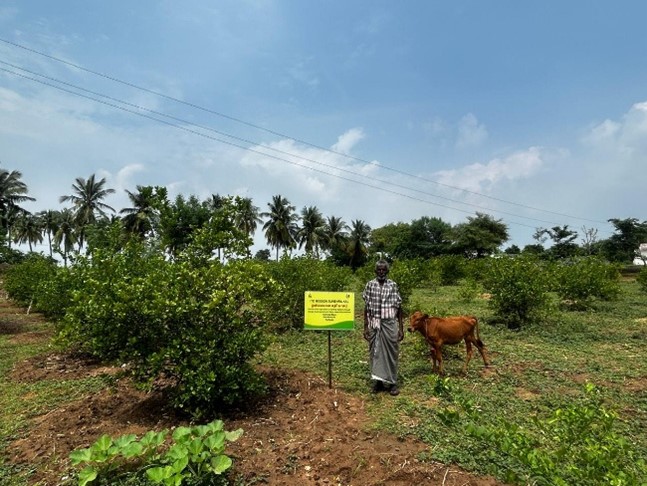
One such inspiring farmer is Mr. Chinnapa, a 60-year-old cultivator from Annathanpatti in Menaveli Village. He owns 25 cents of land located near the Kanapattan irrigation tank and another 1.75 acres irrigated by a well and bore well. The Kanapattan tank was rejuvenated by the Vayalagam programme in 2021–22 through desilting, bund strengthening, and sluice renovation. This intervention significantly improved water availability, encouraging many farmers, including He does paddy cultivation in that land and uses the harvest only for self-consumption. With his only son employed in a private company in Viralimalai and limited family income, sustaining agriculture had become a challenge, especially after he developed a leg ailment that restricted his ability to work as before. Mr. Chinnapa, to adopt diversified crop. The erratic climate and the pandemic had further affected his yields, leaving him uncertain about the future of farming.
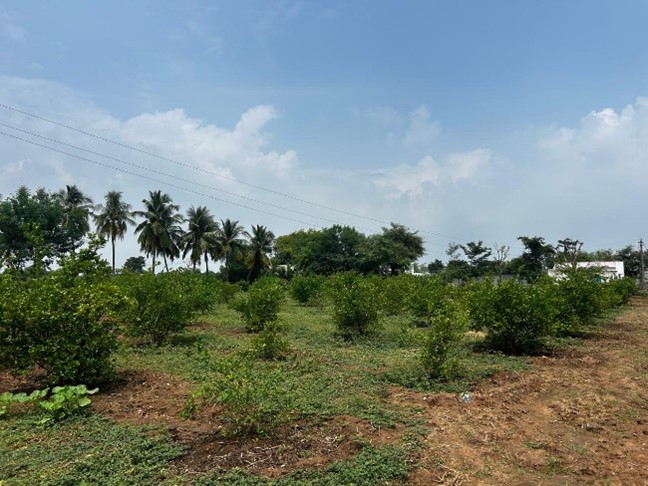
Recognizing this need for diversification, the Vayalagam team introduced an orchard-based intervention in the panchayat. Four farmers, including Mr. Chinnapa, came forward, and they received fruit saplings—lemon (Balaji variety) and mango (Banglura variety). The cost of the trees were taken care under the CSR contribution, transportation and planting cost were taken care by the farmers themselves. Drawing from his prior experience with lemon cultivation nearly 15 years ago, he opted to plant 60 lemon trees on one acre of land. This time, with assured irrigation and improved soil conditions, he committed to careful management. He ensured regular watering and practiced mulching every six months, using three tractor loads of organic waste at a cost of ₹7,500. He also spent ₹2,000 every six months on pest control. To optimize his land use, he practiced intercropping with brinjal, chilli, and cotton in alternate years, earning about ₹20,000 per crop cycle, though spending around ₹8,000 on fertilizers.
After three years of consistent care, his orchard began yielding results. His first lemon harvest brought him around 1,000 fruits, sold locally for ₹700. The second harvest fetched ₹2,000 at the Manaparai market. Encouraged by this outcome, he anticipates earning about ₹50,000 per year from the orchard in the coming years. Recently, with support from the Vayalagam team, he attended a training session on preparing organic fertilizers, which further strengthened his confidence in producing high-quality fruits without chemical inputs. He believes that orchard farming suits his age and health conditions, as it requires less strenuous labor than field crops. His son can also contribute part-time, making it a sustainable and steady income source for their family. With the profits earned, he has already purchased ten sheep to further diversify his income.
The success of this model has inspired many others in the region. Building on this momentum, in 2024–25, the programme scaled up the initiative by distributing 7,990 fruit plants across 203 acres, and in 2025–26, another 5,000 plants covering 100 acres. Altogether, 18,251 plants have been established over 407 acres, marking a significant shift toward orchard-based livelihood systems among small and marginal farmers. The model has been widely appreciated for its practicality, low maintenance, and steady returns. It stands today as an innovative approach for farmers across Tamil Nadu—and indeed across India—demonstrating how smallholders can embrace orchard farming to build resilience, ensure stable income, and secure their agricultural future. Farmers are encouraged to come forward and adopt orchard farming as a sustainable livelihood option that ensures steady income with minimal maintenance.
This model not only diversifies cropping systems but also strengthens resilience against climate and market uncertainties. By embracing orchard farming, small and marginal farmers can transform their lands into long-term sources of prosperity
 Facebook
 Instagram
Comments