Issue 4: Jul - Sep 2025
www.dhan.orgLife Journey of Mr. Ramalingam
Mr. K. Ramalingam was born in 1947 in Porangal village, located in Chengalpattu district. He is the eldest of five children, with three brothers and one sister. His father worked as a village administrator, and though he held a salaried position, he remained deeply involved in farming activities and social activities in the village. Watching his father balance both administration and agriculture left a lasting impression on young Ramalingam, who developed a natural passion for farming from an early age.
At that time, Porangal did not have a school, so his father decided to move the family to Tambaram, Chennai, to ensure that all his children could receive a good education. Mr. Ramalingam completed his primary schooling up to Class 5 in Tambaram and continued his studies from Class 6 onwards at the Ramakrishna Mission School in T. Nagar, Chennai. Later, he pursued his undergraduate studies at A.M. Jain College, earning a B.Sc. degree in Mathematics, and subsequently completed his graduation in Law. Although he was academically inclined and successfully completed his law degree, his heart always remained in agriculture. Even during his law studies, he got married and later decided to return to his native village to take up farming full-time.
Initially, Mr. Ramalingam managed around 60 acres of agricultural land belonging to his father. After the division of family property, he inherited 15 acres and continued cultivating his share through an integrated agricultural system. He recalled that this was the time when the Green Revolution was transforming Indian agriculture, and like many farmers of that period, he adopted the use of fertilizers and chemical inputs to increase productivity. However, after a few years, he noticed the declining quality of soil and the increasing cost of cultivation due to over-dependence on chemicals. Realizing the long-term risks, he attended training programmes conducted by the Krishi Vigyan Kendra (KVK), where he learned about organic and integrated farming practices.
In the 1990s, DHAN Foundation initiated a watershed project in his region. In 2000, Mr. Ramalingam became a member of the Vayalagam programme and gradually took up leadership roles. Between 2000 and 2005, he served as a member, then as president of the sub-basin association, and later as an Executive Committee member of the Asarapakkam Federation. His dedication and leadership were recognized, and in 2011, he became an Executive Committee member of the Vayalagam Mutual Movement. For about six years, he served as its Secretary and is currently one of its senior advisors. He often shares how his association with DHAN and Vayalagam helped him grow his public speaking, leadership, and community mobilization skills, which in turn allowed him to help many farmers in his region access various government schemes and technical support.
Under the watershed project, the Vayalagam took the initiative to deepen the irrigation tank in Porangal village, ensuring that the work was completed efficiently and economically, directly benefiting about 65 farmers. The quality of the work was so impressive that villagers praised the efforts as being far better than that of private contractors at the time.
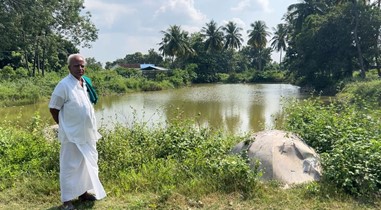
Inspired by the principles of integrated farming, Mr. Ramalingam diversified his activities. He began with farm pond-based fish rearing and later expanded to include indigenous chicken, cows, sheep, pigs, and native Indian dog breeds. This approach not only improved the ecological balance on his farm but also ensured multiple sources of income throughout the year. To promote natural farming among other farmers, he began collecting, storing, and selling native seeds, encouraging others to shift away from chemical-based agriculture.
Adding further value to his produce, he established a small-scale coconut processing unit, refining coconuts into oil and selling it directly to consumers. This value addition enhanced his profitability and reduced market dependency. He also introduced orchard cultivation on part of his land, growing mango, guava, teak, and red sandalwood trees. These long-term crops provided both environmental and economic benefits, creating a sustainable system that he could manage with minimal labour.
Over the years, his consistent efforts and innovation turned his farm into a model of integrated and sustainable agriculture. He adopted drip irrigation through government subsidy programmes, ensuring efficient water use. He remains vigilant about new government schemes, subsidies, and welfare programmes and ensures that information reaches all Vayalagam farmers in his federation. This proactive approach has helped many farmers access entitlements and improve their livelihoods.
Today, his federation includes around 600 families across 22 villages. Although he observes that agricultural activity in his area is slowly declining due to urbanization, nearby industries, and colleges offering alternate employment opportunities, he remains committed to farming. Adapting to the changing context, he is now shifting from paddy cultivation to coconut-based orchards that require less labour and can be managed by him independently.
Through his hard work and perseverance, Mr. Ramalingam has secured a stable and dignified life for his family. His son now works as a manager in a company in Chennai, and his daughter is having own medical clinic in Bangalore. With the income earned from farming, he was able to help both of them build comfortable homes and settle well in their respective careers.
For his achievements in integrated and sustainable farming, Mr. Ramalingam has received several recognitions and appreciations from the KVK, various government departments, and NGOs. Many farmers and students regularly visit his farm to learn from his experiences and replicate his practices. Reflecting on his journey, he shares with pride and hope that his lifelong dream is for the next generation to come forward, embrace agriculture with renewed passion, and continue to serve the country through farming.
 Facebook
 Instagram
Comments