
Issue 4: Jul - Sep 2025
www.dhan.orgBook Launch: ‘Flowers of Adavi’
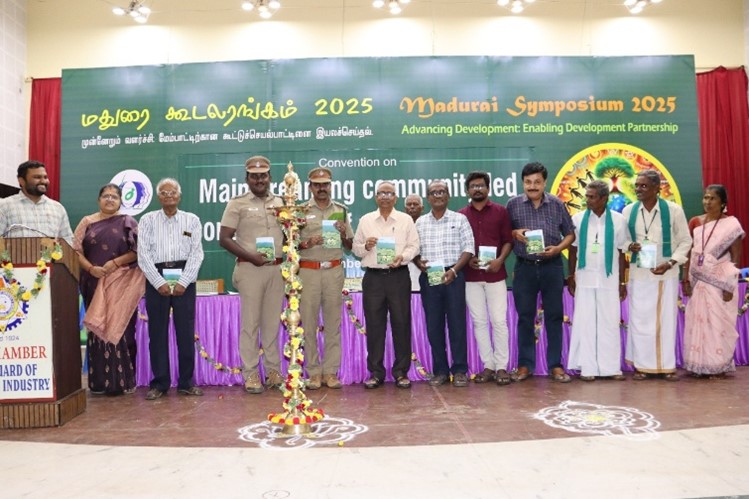
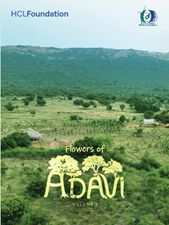
The book was released during Madurai symposium event, during the convention Mainstreaming community-led conservation of water commons in the presence of District Forest officers, Chief Guest Dr Satyagopal, Vayalagam and Kalanjiam leaders.
‘Adavi’ is a collaborative effort of the HCL Foundation, Madurai Kamaraj University, and the DHAN Foundation. Beginning with the ecological restoration of four acres of degraded land in 2021, today it has expanded to over 50 acres in the foothills of Nagamalai Hills, Madurai.
This book is a compilation of photographs of flowers captured in ‘Adavi’ across different seasons. The photographs were captured through series of workshops and camps involving student volunteers and local photographers—most of them being early enthusiasts rather than professionals. The book showcases 135 flowers, including four types of grasses, 61 herbs, 15 climbers, 37 shrubs, and 18 tree species.
Although this book documents plant species at an early stage of Adavi’s development, its primary purpose is to highlight the floral beauty of often overlooked herbs and shrubs. While these plants are frequently dismissed as weeds in agriculture, they play a crucial role in forming a rich habitat that supports diverse insect populations. These plants may be small—some only inches tall, with flowers just millimeters wide—and host insects that are minute in size but they contribute to vast and intricate ecosystem functions. That is the beauty of the ‘small.’ We extend our gratitude to all the photographers for capturing these details and providing an opportunity to appreciate the true grassroots of Adavi.
In this book, flowers are categorized based on their growth habits—grasses, herbs, climbers, shrubs, and trees—and arranged by flower diameter in ascending order. This allows users to identify flowers while exploring Adavi. The book also includes information on flower characteristics such as colour, fragrance, diameter, and flowering season. Additionally, it provides fascinating facts about each species, its medicinal value, and the dependent fauna. Although the book primarily aids in identifying flowers found in Adavi, it can also be used in similar landscapes with hard, gravelly soil and semi-arid conditions in Southern India. A complete list of floral species presented in the book. Categorized based on the family, is provided in the Index.
 Facebook
 Instagram
Comments