
Introduction: The Night the Water Came
In 2022, the Parambu Kanmai reservoir in the Melur Arikkai region filled up for the first time in sixteen years. For the residents of Kanmaipatti, a small village straddling the border of Madurai and Sivagangai, the event was a nightmare rather than a milestone. Heavy rains caused the reservoir bund to breach, sending a wall of water into the residential areas. For three nights, families huddled in the dark, watching as the floods washed away livestock shelters, cooking vessels, and the very foundations of their lives.
"We have nothing left," the villagers told local officials. "The flood has washed away everything." While the District Administration, led by Madurai Collector Mrs. Sangeetha, IAS, eventually approved 27 new permanent houses under the Kalaignar Kanavu Illam (KKI) scheme, a massive hurdle remained. Government grants are often a lifeline, but they rarely cover the true cost of a modern, climate-resilient home.
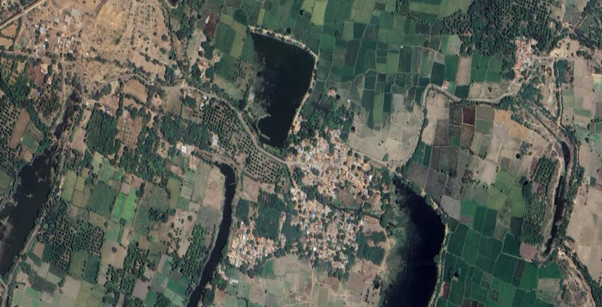
In Kanmaipatti, the community faced a daunting "funding gap" that threatened to leave them with unfinished skeletons of houses. How does a village that has lost everything bridge a shortfall of hundreds of thousands of rupees? The answer lies in a blend of 1970s architectural innovation, strategic financial engineering, and the sheer grit of collective action.
The "Rat Trap" Secret: Why Hollow Walls are Stronger and Cheaper
At the heart of the Kanmaipatti reconstruction is a masonry technique that seems counter-intuitive: leaving air gaps inside the walls. Known as the Rat Trap Bond (or the Chinese Brick Bond), this modular masonry method places bricks in a vertical orientation to create an internal cavity.
While a solid wall might seem more robust, the Rat Trap Bond offers superior performance. The internal air pockets act as thermal insulation, keeping the house cooler during the blistering Tamil Nadu summers and warmer during the winter. Beyond comfort, the economic impact is transformative. By creating hollow spaces, the technique drastically reduces the volume of bricks and mortar required without compromising structural integrity.
Data from DHAN HOPE, the technical wing supporting the project, highlights a staggering efficiency:
On a per-house basis, this innovation saves approximately ₹1,00,000. In a project where every rupee counts, this "air gap" became the primary bridge for the village’s financial survival.
"This technique was first introduced in Kerala in the 1970s by architect Laurie Baker and has since gradually gained recognition worldwide due to its low construction cost, enhanced thermal efficiency, and reduced material requirement."
The Financial Jigsaw: Building a ₹5.6 Lakh Home on a ₹3.5 Lakh Budget
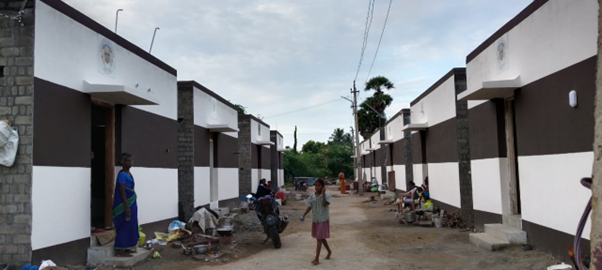
The financial reality of rural development is defined by the "gap." In Kanmaipatti, the Government G.O. specifies the value of a standard house at ₹5,62,000. However, the actual state allocation was only ₹3,50,000. This left a daunting ₹2,12,000 shortfall per family.
To solve this, DHAN HOPE and the villagers assembled a three-pillar financial strategy:
When Geography Wins: The Failure of the "Stub Footing"
Even the most brilliant "cost-effective" models must bow to local geography. Initially, the project intended to use "Stub Footing"—a foundation technique that reduces concrete and steel usage, perfectly suited for stable red clay or gravelly soils.
However, the site’s reality was different. Proximity to an irrigation canal and a history of deep-water accumulation meant the soil was too unstable for the "stub" model. Technical engineers from DHAN HOPE, conducting rigorous quality checks, made the difficult call to abandon the cost-saving foundation in Favor of a traditional, deeper structure. This pivot underscores a vital lesson: technical authority is not about blindly following a template; it is about having the expertise to know when local soil demands a more expensive, safer alternative.
The Human Element: Why Boundaries are Harder to Build Than Walls
If building a house is a technical task, building a neighbourhood is a psychological one. To manage the project, the village formed the Kanmaipatti Housing Mutual Group, led by office bearers Murugeswari (Chairman), Nagaraj (Secretary), and Archana (Treasurer). This "Housing Mutual Group" was the project’s social engine, managing a collective bank account and overseeing expenses.
However, as walls went up, social capital began to fray. Without historical boundary lines for the 25 original plots, disputes over land limits and wall alignments emerged. "Declining involvement" became a real threat; as houses neared completion, some beneficiaries stopped supervising the work or grew reluctant to transfer their agreed-upon contributions.
The struggle is best captured in the words of the villagers during the initial disaster:
"Sir, the water is coming! The bund has broken... We have nothing left, sir. For how many years they have promised to build houses for us... They only come asking for our votes, sir."
This highlights a deep truth in social innovation: physical infrastructure like the Rat Trap Bond is easy to engineer, but social infrastructure—maintaining trust and cooperation over a long-term project—is where most development initiatives succeed or fail.
Logistics vs. Tradition: The Five-Day Festival Bottleneck
Construction in a living village is a logistical dance. The project faced several unique bottlenecks, including a 3.24% spike in material costs—specifically M-Sand and aggregates—which added an average of ₹11,352 to the cost of each house.
Furthermore, narrow roads used for drying laundry and five-day village festivals frequently halted deliveries. To keep the project alive, the team implemented "Immediate Community Coordination" and "Delivery Windows" (such as 9:00–11:00 AM). By negotiating these specific windows with households, they ensured material trucks could pass through narrow lanes without disrupting the domestic rhythms of the village.
Conclusion: A Blueprint for Incremental Hope
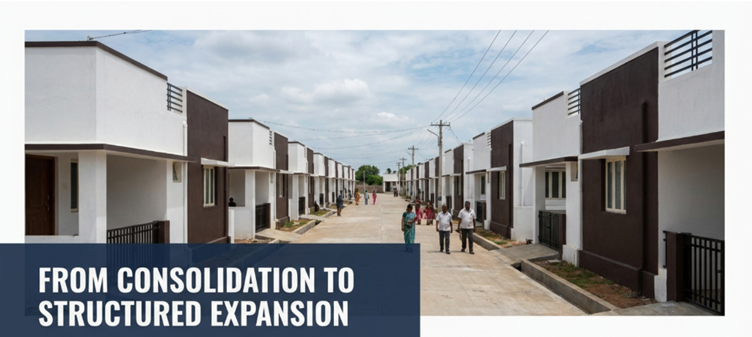
The reconstruction of Kanmaipatti, monitored by officials like Additional Collector Mrs. Monika Rana, IAS, is more than a housing project; it is a demonstration of Incremental Housing. This philosophy treats a house not as a static gift from the state, but as a progressive improvement of habitat that grows through community agency and technical innovation.
By using hollow bricks to build solid futures, Kanmaipatti has shown that resilience isn't just about the strength of the material—it's about the ingenuity of the system
If a village can build resilience through hollow bricks and mutual groups, what does that say about the future of our 'solid' but often inflexible modern cities.