
1. Introduction
Social development in India aims to secure the basic needs and wellbeing of its vast and diverse population. Over the years, the country has developed an increasingly complex social sector encompassing education, health, livelihoods, housing, sanitation, nutrition, and risk protection. Among these, social security—the protection against risks such as illness, death, disability, unemployment and old age—is critical for ensuring that individuals and families do not fall into poverty when confronted with adverse events.
India’s journey in social security has witnessed significant growth, especially in the last decade. Despite economic advancements, millions of citizens, particularly those in the informal sector, remain vulnerable due to irregular income, limited access to formal insurance, and insufficient safety nets. Against this backdrop, microinsurance — insurance designed for low-income populations—has garnered attention as an important tool for inclusive risk protection. This article discusses the evolution of the social sector in India, highlights key government schemes with data, examines the role of microinsurance, and concludes with the DHAN People Mutuals experience as a community-centred model.
2. Expansion of Social Security in India: A Statistical Overview
India’s social security landscape has expanded substantially over the past decade. According to the International Labour Organization (ILO), national social protection coverage has increased dramatically. Coverage nearly doubled from 24.4% in 2021 to 48.8% in 2024, marking major strides in social protection outreach, with nearly 920 million people—around 65% of India’s population—now covered by at least one form of social protection through central government schemes by early 2026.
Another notable data point shows that between 2015 and 2026, social security coverage expanded from 19% to 64.3%, benefiting approximately 940 million individuals. The Economic Times High growth reflects policy focus, increased enrolment and active outreach to historically underserved communities.
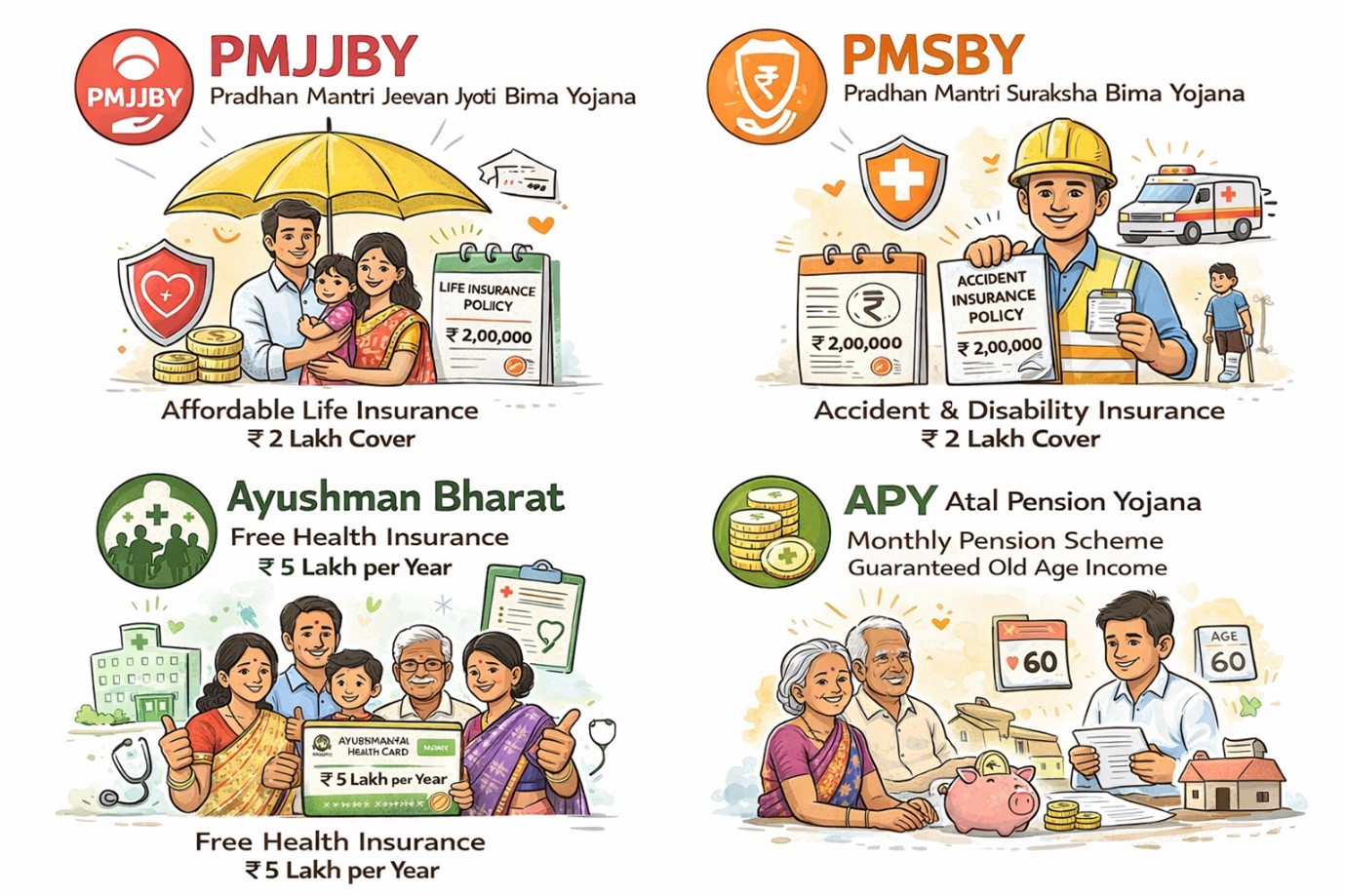
The expansion reflects not only broad coverage numbers but also intensification of large government insurance and pension schemes. For example, the flagship Jan Suraksha schemes—Pradhan Mantri Jeevan Jyoti Bima Yojana (PMJJBY), Pradhan Mantri Suraksha Bima Yojana (PMSBY) and Atal Pension Yojana (APY)—completed ten years in 2026 with remarkable cumulative enrolments. As of April 2026, PMJJBY had over 23.6 crore enrolments, PMSBY had more than 51 crore enrolments, and APY had over 7.66 crore subscribers. The schemes have disbursed ₹18,398 crore in life insurance claims and ₹3,121 crore in accidental insurance claims respectively. These figures underline the transformative scale of policy efforts to bring insurance and retirement security to millions of Indian households.
Life, Accident and Pension Coverage
The PMJJBY provides affordable life coverage, offering a death benefit typically around ₹2 lakh for a nominal premium deducted from the insured’s bank account annually. Wikipedia PMSBY provides accidental death and disability cover at a very low premium, making it accessible to low-income populations as a first step into formal risk protection.
Atal Pension Yojana focuses on old-age income security, particularly for the unorganised sector. It promises a fixed monthly pension after age 60 depending on contributions, and by mid-2026 its enrolments had crossed 8 crore subscribers, pointing to the increasing recognition of retirement risk protection among informal workers. These schemes now form pillars of India’s social insurance architecture and are integrated with digital financial infrastructure such as Jan-Dhan bank accounts and online portals to simplify enrolment and claims.
Social Pensions and Welfare Programs
Beyond insurance, social security includes social pensions and welfare transfers. Centrally sponsored programmes like the National Social Assistance Programme (NSAP) provide pensions to the elderly, widows, and persons with disabilities below poverty thresholds. States have complemented these with their own pension programmes—for instance, Odisha’s Madhu Babu Pension Yojana supports elderly and disabled individuals with monthly financial assistance. The increase in direct benefit transfers to beneficiaries under pension and welfare schemes demonstrates the widening reach of social safety nets across states.
Health Security and Welfare Integration
While social insurance focuses on life and pensions, health security is equally essential. Government health missions and schemes such as Ayushman Bharat–PMJAY have expanded financial protection against catastrophic health expenses for economically vulnerable households. Studies show that clusters of government insurance schemes now feature dual coverage—many rural households are covered under PMSBY and PMJJBY, with a significant share also enrolled in public health insurance. Collectively, these programmes demonstrate a deliberate policy effort to create an integrated social security framework that buffers citizens from financial shocks across life stages.
Concept and Purpose
Microinsurance refers to insurance designed explicitly for low-income individuals, offering affordable products to help them cope with and recover from financial losses due to health issues, death, accidents, or other risks. This concept recognises that the poor are particularly vulnerable to risk, and without protection they often resort to distress sales of assets or debt. India was among the early adopters of a regulatory framework for microinsurance, positioning itself as an important market with considerable potential. Despite this, microinsurance in India still faces low penetration relative to the size of the population and the scale of underlying need.
Market Size and Growth
Emerging market analysis indicates that India’s microinsurance market is poised for robust growth, with projections estimating an expansion from around USD 5.41 billion in FY2024 to USD 8.77 billion by FY2032, reflecting ongoing digitisation, awareness campaigns, and supportive policy environment.
Nonetheless, large proportions of the population, particularly in rural and informal sectors, remain uninsured or underinsured. Academic research suggests that despite significant demand and regulatory frameworks, barriers such as lack of awareness, low financial literacy, and inadequate local distribution networks constrain wider adoption of microinsurance.
Awareness, Inclusivity, and Challenges
Surveys on social security awareness indicate that many beneficiaries are still not sufficiently informed about the nature, benefits and processes for claiming insurance benefits—even when enrolled. In many cases, individuals do not understand whether they are covered or how to invoke coverage in times of need.
These challenges reflect deeper issues of financial literacy, trust, and institutional capacity that must be addressed to make microinsurance work effectively as part of India’s broader social security fabric.
Integrating Microinsurance within the Social Sector
The combination of government-led social insurance schemes and microinsurance complements illustrates an evolving approach to risk protection. While Jan Suraksha schemes have dramatically extended coverage, microinsurance models can bridge the last-mile service delivery gap. They can embed risk protection within people’s institutions and everyday interactions, generate community trust, and improve claim facilitation.
For instance, studies have shown that many low-income rural women—when offered access through local agents—opt into government and microinsurance products both for themselves and their families. These patterns affirm the latent demand for risk protection when awareness and access barriers are reduced.
The Experience of DHAN People Mutuals
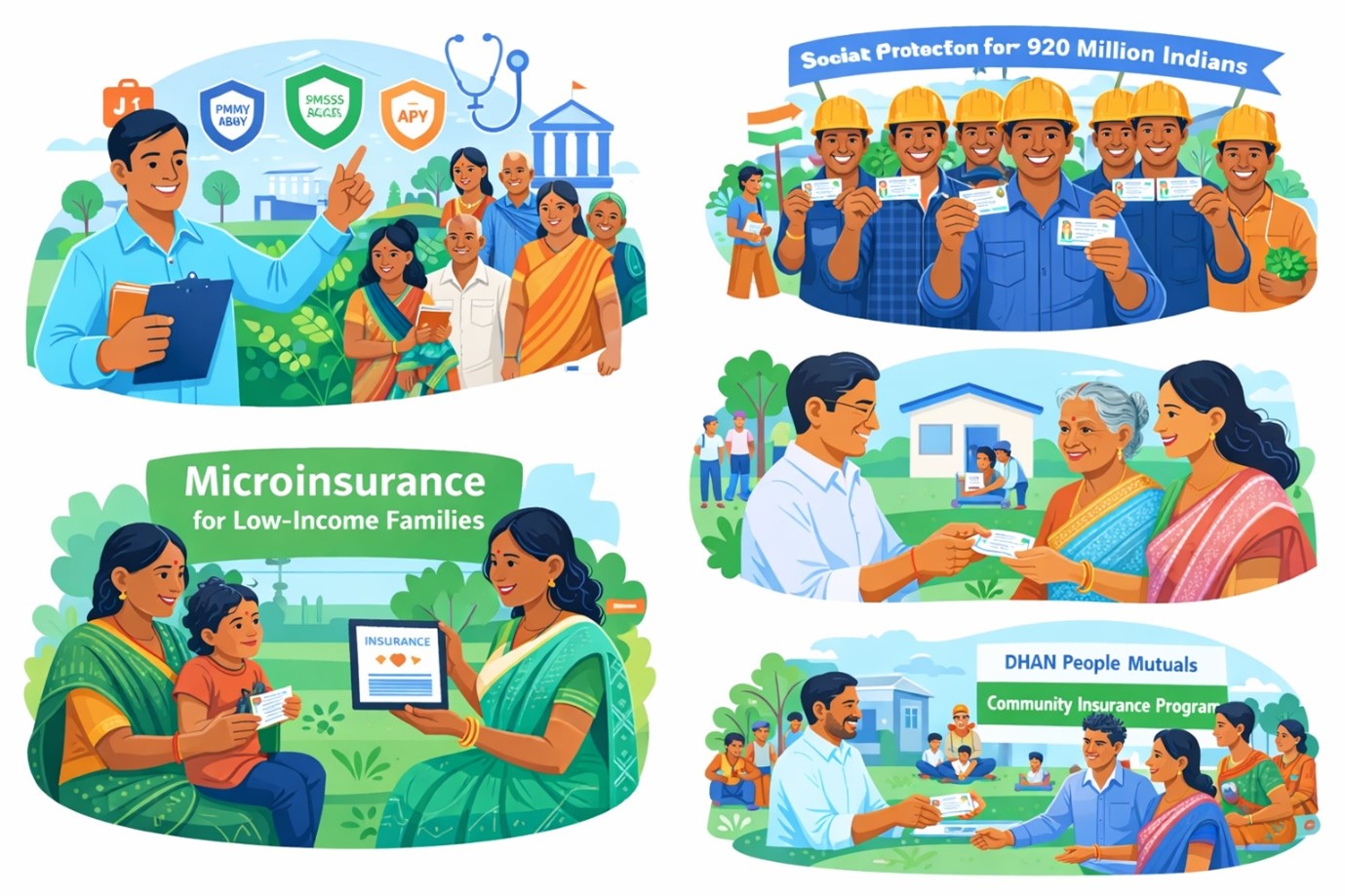
Within this policy and market context, DHAN Foundation has pioneered a community-centric approach to microinsurance through People Mutuals. Instead of viewing social insurance as an isolated financial product, DHAN embeds it within broader community institutions such as federations and clusters.
People Mutuals combine government social security schemes, mutual insurance products, and other group insurance policies to offer broad-based risk coverage including life, health, accident and old-age risks. A key innovation lies in harmonising enrolment and renewals, reducing complexity for members. The governance of People Mutuals ensures that local leaders are involved in mobilisation, claim facilitation, and continuous awareness-raising, which strengthens trust and accountability.
A distinctive feature of this model is the treatment of claim settlement as a collective responsibility. Leaders participate in funerals and certify deaths locally to expedite claims, often settling them within days. This process not only restores dignity to bereaved families but also reinforces confidence in the insurance system.
By strengthening digital enrolment systems, conducting pilot studies to understand barriers, and maintaining detailed coverage data, People Mutuals have evolved evidence-informed practices that improve responsiveness and member engagement. Such community-embedded models demonstrate how microinsurance can go beyond enrolment figures to provide meaningful social protection that resonates with local realities.
Conclusion
The social sector in India has made remarkable strides in expanding coverage and deepening protections, particularly through integrated social security schemes. Government initiatives have brought hundreds of millions into the insurance and pension net, while microinsurance markets continue to grow and innovate. Despite progress, significant challenges remain in awareness, financial literacy, and last-mile delivery.
Community-based approaches, such as People Mutuals, offer a complementary pathway to enhance inclusivity, trust and utility of risk protection. These models show that embedding microinsurance within people’s own institutions and social networks can transform social security from a policy instrument into a lived reality for vulnerable populations. As India continues its social sector evolution, integrating such community-anchored approaches alongside formal schemes will be key to building resilience and ensuring dignified, sustained wellbeing for all.
Sources