
Kalanjiam – My Lifeline and My Journey of Empowerment
Ms.Manimegalai, Senior Kalanjiam Associate
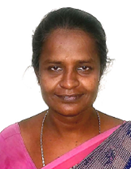
Early Life and Family Background
My name is Manimekalai, and I was born in 1980 in Chakkudi village, Sivagangai District, Tamil Nadu. My father worked in a cotton mill, and I grew up with two sisters. I completed my schooling up to 10th standard in Manalur.
At the age of 17, I was married to my maternal uncle, who worked as a driver. Our life was simple, but after five years of marriage, tragedy struck when my husband passed away. I was left alone with two young children — my youngest was not even two years old. I felt hopeless and unsure of what to do next.
A New Beginning with Kalanjiam
In 2001, I became a member of the Muppilian Kalanjiam under the Gangai Vattara Kalanjiam in the Madurai Rural Region. I helped with small accounting tasks for the group.
Thirty days after my husband’s death, I was offered a position as a Kalanjiam Associate. That opportunity came at the most difficult moment of my life and gave me the strength to stand on my own feet. It was the turning point that brought stability and hope back into my life.
Learning through Movement Workers Training
In 2002, I was selected to attend the Movement Workers Training at DHAN People Academy (DPA), Madurai, and joined the 29th batch. Until then, I didn’t even know what a bank was or how to write a challan. I had never spoken to a bank manager. But during the training, I learned everything — about savings, loan management, group promotion, and leadership development.
At first, I was quiet and hesitant to participate, as my thoughts were always with my children staying with my mother. But my fellow trainees encouraged me to take part in discussions, debates, and all activities. That 42-day training was like going back to school again — studying, writing charts, preparing for exams, and learning late into the night.
Those days at DPA gave me new energy and confidence. I realized that Kalanjiam was not just a job; it was my lifeline.
Field Training and Exposure
As part of the training, I went for field exposure to the Pothigai and Chinnamanur Federations. There, I learned how to start Kalanjiam groups, mobilize members, and connect with communities.
The coordinators and staff taught me how to speak confidently, how to earn people’s trust, and how to explain the Kalanjiam concept in simple words. I also learned how to handle practical work — visiting banks, preparing documents, and communicating with managers.
These experiences helped me overcome my shyness and built my courage to work with people and institutions.
Building Groups and Lives in Silaiman
After completing my training, I was assigned to Silaiman, where there were only 8 groups. I took it as a challenge to expand Kalanjiam’s presence there. With dedication and support from my Federation Coordinator, I formed 35 new groups in the area.
I motivated members to save regularly and use loans wisely for income generation. I am especially proud that I encouraged 20 members to purchase 5 cents of land each to build their homes, creating long-term assets for their families.
I also facilitated housing loans for 600 members, enabling many families to move from rented houses to their own homes. These achievements gave me immense satisfaction and deepened my commitment to the community.
Building Confidence and Bank Linkages
Initially, I was nervous about handling bank work. I was afraid to write applications or meet bank officials. But my Coordinator believed in me and entrusted me with the responsibility of linking Kalanjiam groups with banks. With guidance from senior associates, I learned how to prepare loan applications, maintain documents, and communicate confidently with bank staff. I even persuaded one bank manager to accept applications written in Tamil, so that our members could understand them easily. Today, I can confidently approach any bank manager in our area and discuss financial matters — something I never imagined possible years ago.
Transformation and Reflections
Looking back, I see how far I have come — from a young widow struggling to survive to a confident woman leading and supporting hundreds of others.
The Kalanjiam Movement has completely transformed my life. It gave me financial independence, courage, and a strong identity. It taught me to believe in myself and to help others do the same. I will never forget the day I first entered the DHAN People Academy campus. That was the day my journey of empowerment began.
“Kalanjiam is not just my workplace; it is my family, my school, and my strength. It gave me back my life.”
An 18-Year Journey of Growth, Service, and Self-Discovery
Mr.Ramachandra B M, Senior Programme Associate, Pavagada, Tumkur region
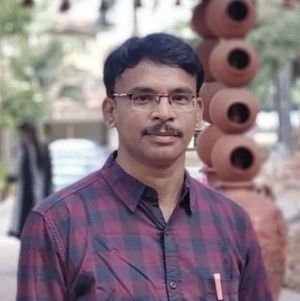
When I first joined the DHAN Foundation in 2007, I had no idea that the path I was stepping onto would shape not only my career, but my entire outlook on life. I began as a Computer Operator in Pavagada, part of the Kolar Region in Karnataka. At that time, the JSYS (Jala Samvardhane Yojana Sangha) project of the Government of Karnataka was being implemented to renovate traditional tanks — a vital lifeline for the farming community.
In those early days, my work was mostly technical. I handled data entry, reporting, DHANAM updates, estimate preparation, and correspondence with officials. I learned the discipline of accuracy and the importance of timely reporting. Yet, something was missing — I couldn’t interact directly with the communities whose lives our projects were meant to change.
“I could see the numbers — reports, estimates, and entries — but I wanted to see the faces behind those numbers.”
That thought stayed with me. Two years later, in 2009, my life took a new turn when I was promoted to Programme Associate and became a permanent member of the DHAN family. Along with the promotion came a transfer — from my hometown Pavagada to Sira — a place I had never been before.
New Challenges, New Strengths
Moving to Sira was not easy. Everything felt unfamiliar — the place, the people, even the rhythm of life. It was my first major transfer, and I struggled to adjust. But the experience taught me something invaluable: growth happens outside your comfort zone.
I was fortunate to work under my Regional Coordinator, Mr. Ramappa K. T., whose calm guidance helped me find my footing. My wife, Sandhya, was my greatest emotional support through those days. Together, they became my pillars of strength. Under Ramappa Sir’s mentorship, I learned the finer aspects of community engagement, team management, and leadership. He taught me that true development is not about completing a target — it’s about transforming lives, step by step.
“Working with the community taught me that trust cannot be demanded — it must be earned with patience and sincerity.”
Stepping into Community Work
At Sira, I finally found what I was seeking — direct engagement with people. I began facilitating bank linkages and KDFS (Kalanjiam Development Financial Services) connections for farmers and women’s groups. My days were filled with field visits, loan appraisals, and coordination meetings.
I helped open savings bank accounts for Agriculture Finance Groups (AFGs), organized loan disbursements, and participated in financial literacy sessions. Slowly, I began to see the change: women who once hesitated to enter a bank were now confidently managing group savings; farmers who feared taking loans were now investing wisely in their livelihoods. These moments of transformation gave me a sense of purpose that no office desk could ever provide.
Learning the Technical Side
While community engagement was rewarding, my journey at Sira also deepened my technical knowledge. With the mentorship of Mr. Raghavendra H. G., my next Regional Coordinator, I learned to prepare waterbody renovation estimates, take levels, and measure completed works.
It was an incredible experience to stand on the banks of restored tanks — watching farmers draw water from what was once a dried pit. I realized that behind every tank renovated, there was a story of hope — of livelihoods revived, of communities united.
Recognition for Collective Effort
One of the proudest moments of my journey came when our team received recognition for achieving remarkable milestones in the Vayalagam Programme. Together, we reached over 150 Agriculture Finance Groups (AFGs) and facilitated ₹1.50 crore in bank linkage support — all within a single financial year. Our success was made possible with the strong partnership of Corporation Bank, Sira branch, and the unwavering trust of our community members.
“When the community succeeds, it is never one person’s achievement — it is the result of many hands, many hearts, and one shared vision.” That recognition didn’t just make me proud — it strengthened my commitment to serve with even more sincerity.
Returning Home — New Challenges, New Dreams
After nine fulfilling years in Sira, I requested a transfer to Pavagada, my native place, in August 2018. I wanted to balance my personal commitments — including building a new home — while continuing to contribute to the community that raised me.
Returning home was both joyful and challenging. I discovered that the Vayalagam Federation and FPOs (Farmer Producer Organizations) were struggling due to overdue loans and management issues. Many members had lost confidence in the process. Instead of feeling disheartened, I saw an opportunity to rebuild. Along with the Board of Directors and Kalanjiam members, I began focusing on reviving the FPO.
Rebuilding the Farmer Producer Organization
In 2018, our FPO had just ₹1,000 as share capital. With persistence, community trust, and teamwork, we gradually rebuilt the organization. Within three years, we mobilized ₹8 lakh in share capital. The FPO’s business, which started with ₹1 lakh per year, grew to an impressive ₹72 lakh in 2024–25, supported by NABARD, the Krishikalpa Foundation, and the collective spirit of our members. Today, the FPO stands on its own feet — financially stable and institutionally strong.
“The greatest satisfaction in development work is to see a system thrive even when you step aside — because then, you know it truly belongs to the people.”
Expanding Responsibilities
My role soon extended beyond one FPO. I became the Nodal Person for promoting and ensuring legal compliance for three additional FPOs in the region. I also coordinated the establishment and capacity building of six Resilience Centres, each focusing on community-based adaptation and sustainability. These experiences enriched my leadership and gave me a broader understanding of how communities build resilience in the face of change — whether it’s economic, environmental, or social.
As a Community Accountant — Strengthening Systems and People
Alongside these responsibilities, I took on the role of Community Accountant for both Kalanjiam and Vayalagam programmes in Pavagada. My work involved conducting loan appraisals, disbursements, and overdue recoveries, while also resolving conflicts within groups. But beyond numbers and records, my heart lay in empowering people through learning.
I organized capacity-building programs on Livelihood initiatives like Jeevidam, Consumer Mutuals, Prosumer Mutuals, and Output Marketing, Health and social security programs like Nallam Fund, Jyothi Fund, LTS, Vidyadhanam, and Shramadhan, Environmental initiatives like sapling distribution and water literacy programmes and Access to government entitlements and financial education
I also helped strengthen leadership among Top 25 and 5 group leaders, Joint Secretaries, and FPO Board members, ensuring that every initiative had strong local ownership.
Values That Define My Journey
Looking back over 18 years of service, I can say that every phase of my journey has taught me something essential — about people, about life, and about myself. I have learned the importance of patience, empathy, and consistency. My colleagues recognize me for being calm, respectful, and willing to take on any responsibility. I believe that success in community work doesn’t come from authority, but from trust.
“I never say no to helping others — because every small act of support strengthens the fabric of our community.”
Gratitude to the Institution
I am deeply thankful to DHAN Foundation for the freedom it has given me to experiment, to innovate, and to grow.
This institution taught me that leadership is not about position, but about purpose. It nurtured my communication skills, strengthened my confidence, and instilled in me a deep sense of equality and teamwork.
I owe much of my growth to my mentors and leaders: Mr. Ramappa K. T., for his composed and insightful guidance, Mr. Raghavendra H. G., for his technical precision and mentorship and Mr. Vasanth Kumar N. K., for his integrated and holistic approach to development
Lessons for Life
Over the years, I have faced many challenges — differences with colleagues, leadership struggles, and external pressures. But I learned to respond not with words, but with consistent work.
“From my 18-year journey, I’ve learned that sincerity and hard work never fail. Every challenge faced with patience and integrity becomes an opportunity for growth — both personal and collective.”
As I look to the future, I feel proud to be part of an institution that continues to empower communities across India. My journey with DHAN is not just a career — it is a calling that has given meaning to my life.
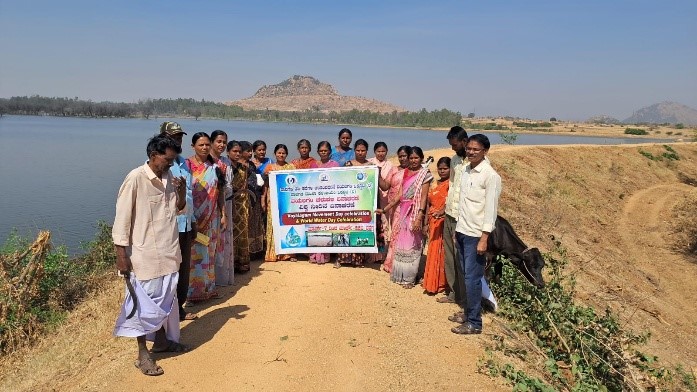
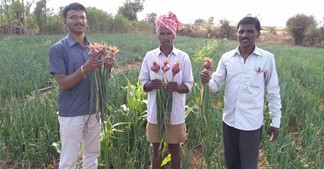

From Sericulture to Social Impact: 23 Years with DHAN Foundation
Mr. Vasanth Kumar , Programme Leader
In 2003, I had just completed my M.Sc. in Sericulture from Bangalore University and was preparing for banking exams. It was during this phase that I learned about Tata Dhan Academy. I wrote the exam, but the age limit posed a challenge — I was 26 years and six months, while the limit was 26. Instead of closing the door, life opened another: DHAN Foundation offered me a chance to join directly as a Development Associate.
“I never imagined that missing an age cutoff would lead me to a 23-year journey of learning, service, and growth.”
I joined DHAN on 9th April 2003 in Pavagada, a remote taluk in Karnataka bordering Andhra Pradesh, under theKalanjiam Community Banking Programme (KCBP). Out of 28 candidates who wrote the exam, only three joined DHAN, and I am the only one from my batch still with the organization.
The Early Days in Pavagada
Pavagada was rural, remote, and rainfed. The KCBP team was small — just four of us worked together under one roof. Initially, I worked as a Development Associate, promoted to Development Apprentice after six months, and then confirmed as Project Executive within a year. We started savings groups with contributions of five or ten rupees, and the first bank link was only ₹15,000 through KDFS. Though my background was in agriculture, my work involved community banking, team coordination, and direct engagement with marginalized communities.
“I had to learn the local language, Telugu, to communicate effectively, and understand the lives of people far poorer than most rural areas near Bangalore.”
We promoted nearly 200 groups under the government’s SwaShakti program, far exceeding the target of 50. This period taught me the value of sustainability, as we introduced a small service charge of ₹20 per group for bookkeeping — a model initially questioned but ultimately vital for long-term success. By 2005, we had formed Pavagada Mahila Kalanjiam Okuta, the first of its kind in Karnataka, recognized at the district level. It was a proud moment — 250 groups united under one federation, with a large Mahasabha celebrating their collective achievements.
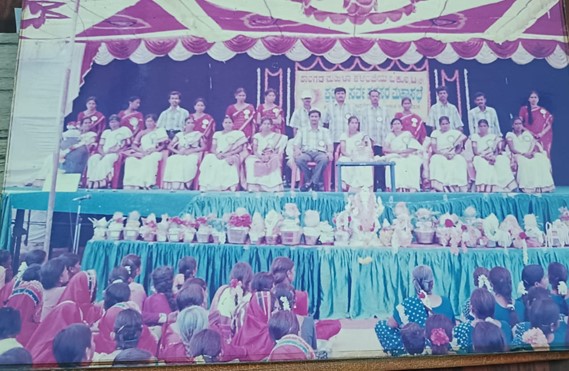
Family and Work Balance
In 2005, I got married and requested a transfer. In 2006, I moved to Malavalli in Mysore region to promote the program there. The region was more developed, but saving money from higher income was a challenge. We introduced specialized savings products, more than eight types, and organized Mahasabhas attended by 6,000–7,000 people.
“Even the Managing Director of Vijaya Bank, Delhi, visited us and appreciated our work. These moments showed me that community banking is as much about trust as it is about finance.”
Balancing family and work were challenging, but I involved my wife in exposure visits to help her understand the purpose and scope of my work.
Leadership and Expansion
From 2008 to 2009, I was promoted to Regional Coordinator for Bangalore Rural region, managing six locations. I also gained exposure to high-performing regions like Salem, Ramnad, Dindigul, and Madurai Rural, learning best practices in management and federation building.
During my time in Ramanagara (2008–2013), I faced significant challenges. One of our federations was hijacked, requiring extensive legal intervention. Despite recovering 65–70% of the social capital, we learned to strengthen governance and safeguard community assets.
I also played a role in HR recruitment, campus interviews, and talent development, broadening my understanding of organizational systems.
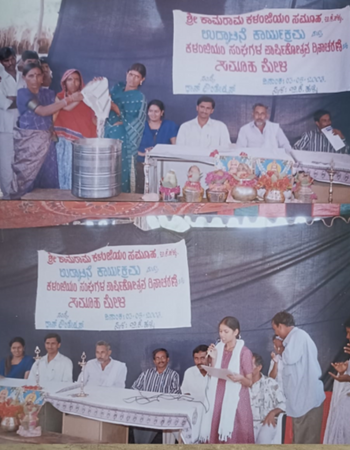
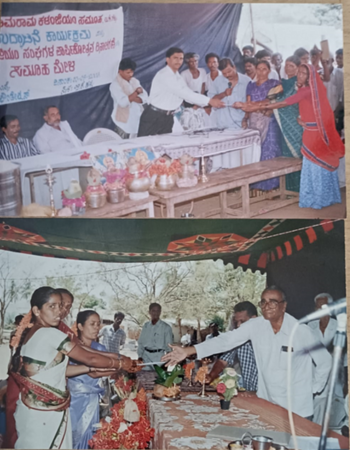
Returning to Tumkur: Strengthening the Region
In 2013, I returned to Tumkur, where my journey with DHAN began, as Regional Coordinator. From six locations, I expanded to nine, promoted multiple federations, and supported other regions such as Adilabad, Solapur, Nanded, Beed, Aurangabad, and Gulbarga.
Under my leadership:
“Our slogan, ‘Alli Alli Alli DHAN, Mane Mane Ello Kalanjiam’ captures the spirit of reaching every home, empowering every individual.”
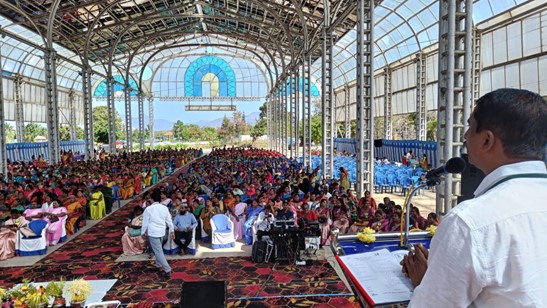
Community Impact
Over 23 years, the Tumkur region achieved - Turnover of ₹180 crores, supporting 39,000 families with an operational cost ratio of 2.5, Over 5,000–6,000 families moved out of poverty, Distribution of 38,000 nutrition gardening kits annually and Contribution to education, health, water, and sanitation — from school materials and toilets to medicine kits and forest trees.
We also fostered a culture of documentation and knowledge sharing, producing 28–30 publications and coordinating 84 issues of the internal magazine DHAN Pragati Jyothi, with over 5,000 copies circulated across Karnataka.
Reflections on 23 Years
Looking back, I am grateful for a journey that taught me:
“Despite challenges, especially financial, the satisfaction of seeing communities thrive, and knowing that my family supports this mission-driven work, makes every step worthwhile.”
Today, my wife manages our home and two children, while I continue to travel across regions, supporting DHAN’s mission and mentoring the next generation. My journey is a testament to the vision of DHAN Foundation — of empowering communities through collective effort, trust, and innovation.