Jan - Mar 2025
www.dhan.orgTowards ‘commoning’ the Urbanscapes
Centre for Urban Water Resources (CURE), Madurai
The life and livelihood of land-poor and marginal communities in rural contexts center on the environment commons, say Irrigation tanks, domestic drinking water ponds (ooranis – ponds that augment sub-surface groundwater flow), and grazing lands. These environmental commons are accessible to the whole/part community of a village and on which no individual has exclusive property rights. These commons support the livelihood of land-poor and marginal communities in terms of additional incomes and other provisional ecosystem services/supplies. The resource-poor households interact with the CPRs, say, irrigation tanks for irrigating the command area, cultivating rainfed crops in the tank-bed, cultivating vegetables in the tank bund, rearing fish, cultivating lotus, using soil for pottery and mud houses, collecting fuel wood and making charcoal, collection of other minor produces from trees in the commons, herbs for medicines, washing clothes, bathing livestock, and so. Similar was the interaction with other environmental commons. In specific to the interactions, though the power relations towards access, sharing benefits, and burdens vary across the groups, the linkages of commons and resource-poor remained critical in poverty reduction.
In 1990s, concerns for commons became a rising issue. This is when, DHAN Foundation, through its water thematic subsidiary DHAN Vayalagam Tank Foundation (DVTF), with a vision of poverty eradication, started investing in building people and people institutions centring the water commons for sustainable development. DVTF with its exhaustive interventions in diverse geographies of plains and coasts, in a period of two decades, developed a community-centred people institution model that addressed poverty eradication through sustainable development. In 2010s, DVTF promoted an exclusive division called ‘Centre for Urban Water Resources (CURE)’ to address the tragedy of comms in the urban fabrics. Initiated operationally in Madurai City, CURE has currently expanded itself to Vishakhapatnam too.
Protecting the commons:
Historically and etymologically, the environmental commons, exist as a dynamic and collective resource governed by evolutionary custom and constantly negotiating, rebuffing, and evading the fixity of social norms. However, urbanization has been engulfing the environmental commons at an accelerated pace to meet the demands of the teeming population and infrastructural and economic growth and bridging the gaps in development indicators at regional and state. The commons have been under consistent pressure due to competing demands from different sectors leading to land use land cover conversions, transfer of ownership, shrinkage, and even extinction. Despite the urban pressure, some commons thrive and survive by dancing in and out of the ‘urban’ agencies’ gaze, by escaping its notice, because notice invariably brings with it the desire to transform commons into ‘public’ property or ‘private’ commodity. Therefore, CURE invested in tracing the water commons, that escaped from the urban agencies, geo-tagging them as ‘water commons’, eventually bringing them into the records of the government which were lost in the ‘transfer of ownership’ during agglomeration for urbanisation, and ultimately to protect them from further land-use conversions and illegal encroachments.
Villapuram is the major access for the main city of Madurai to reach Madurai Airport. It was obvious to a Madurai citizen that the roads were inundated even after 15 minutes of rainfall. The drains suffocated to carry the stormwater, diverting itself to a filthy depression near the Villapuram housing board, heavily disposed of by municipal waste. In 2021, with access to the historical records it was identified as a leftover portion of 5 acre-‘oorani’ (drinking water pond). Historically, the pond was in the command area augmenting the subsurface flow from the command area of the Avaniyapuram Irrigation tank, used by the rural communities for drinking. In the process of Urbanisation, as the command area turned into built-up and the pressure to relocate the urban-poor, the oorani was handed over by the then corporation to the State Slum Clearance Board and then to the Housing board that converted the commons as Housing complex for urban-poor leaving behind the small parcel, with no great intention.
A clan of native, who worshipped the Kanni Mari amman, a local deity, established near the oorani claimed the parcel of land to establish the temple. As the oorani-parcel was misused as a ‘free ride’ by constructing community toilet, septic tank, disposal of sewage, and municipal waste, the claim was dropped. People called the parcel as ‘Kanni Mari oorani, oorani, Sakadakuttai’. But the record says the oorani as ‘Kuchiliyan oorani’. The issue was taken to the then Madurai Municipal Corporation Commissioner Dr.K.P.Karthikeyan IAS, requesting the corporation to take over the oorani and issuing NOC for restoring the same. He took the issue seriously and visited the site with officials, inquired with the local communities and immediately ordered for including it in the records of the Corporation. He also sanctioned the NOC for rejuvenating the oorani. The oorani was surveyed, boundaries were demarcated encompassing an area of 0.9 acres, a restoration plan was co-developed with the communities, and execution was prioritized. With the support of the local communities, the temporary encroachments were evicted, Prosopis was uprooted, water spread area was desilted for a capacity of 4,500cu.m., 4 m wide bunds were created and stabilized. The rejuvenation process was financially supported by HCL Foundation. The experience of the Kuchiliyan oorani paved way for identifying the ponds and ooranis that were not on the list of the Madurai Corporation. CURE has identified 69 such ‘water commons’, left behind as land parcels, remained unnoticed and brought in the records along with the existing 34 ooranis.
Currently, CURE along with district administration and HCL foundation is working towards building a digital database for water commons in Madurai district, in which the cadastral maps of all the villages have been geo-tagged, and are being ground verified on the current status and possibilities of restoration, that would help in protecting the water commons for the future.
Restoring the commons – strengthening linkages with marginals:
Environmental commons and poor have strong interlinkages (food, income, habitat, sociocultural setting, and others); but the interlinkages are fragile due to varied ‘political ecology’. In the process of urbanisation, the land-rich who were dependent on the environmental commons in the past gained the benefits of real estate. However, the land-poor and deprived communities who have been traditionally dependent on these commons for sustenance; due to conversion of land use and shrinkage in the commons, are further being alienated and dispossessed from community trusteeship and usufruct rights that were exercised over centuries. Beyond conservation, restoration, and rebuffering commons; building capacities of marginal communities to re-establish claims and control, motivating collective investments, reassuring the traditional norms are critical in re-establishing the ‘sharing and sustaining’ relationships among marginalized communities and the environmental commons.
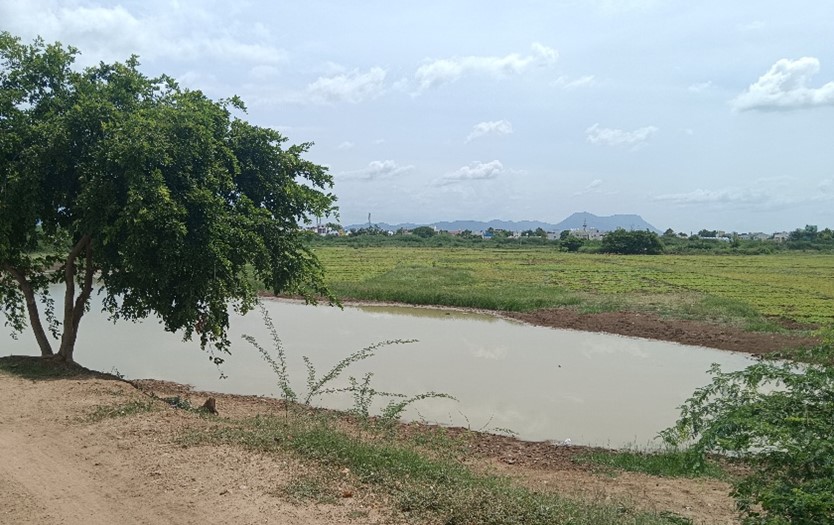
In Mangalakudi tank, the practice of tank bed cultivation by the traditional landless agricultural labourers was a traditional linkage between the marginals and environmental commons. Traditionally, about 300 families of Mangalakudi were employed as agriculture labourers by land-rich ayacut farmers of Mangalakudi irrigation tank, that had a command area of 120 acres. These landless labourers practiced tank bed cultivation in the post-harvest season, well utilising the soil moisture in the tank bed. Vegetable crops such as Brinjal, lady’s finger, millets, cucumber were cultivated and utilised either for self-consumption or marketed locally. Every Thalakattu (family) has a usufruct right over the land of 22 yards x 9 yards (1200 sq.ft. approx.) ensuring equity to all the community members. The 20-acre area of the tank bed best suited for rain-fed cultivation was identified and equally shared by the community members. This practice not only generated income for the landless but also acted as a defense mechanism against the Prosopis invasion. In the process of Urbanisation, the tank command area has been converted into residential plots and the tank has lost its feed from the irrigation canal (contributed by Periyar Main Canal). The agricultural labourers who were dependent on the tank command area have taken up various urban livelihoods. Prosopis julifolora invaded the tank water spread area due to the prolonged dry spells, an effect of monsoon failure. In 2019, the landless labourers of Mangalakudi were organised by CURE to promote ‘Mangalakudi tank conservation Vayalagam’. The Vayalagam, uprooted the invasive species for an area of 54 acres in the tank water spread area. After the removal of Prosopis, 100 families revitalized tank bed cultivation by cultivating bitter-guard that well suits the uncertain rainfall. The usufruct rights are regulated by the communities through their social norms. As a collective return, in 2021, the local Ayyanar temple in the tank bund that remained deteriorated for the past 20 years, was restored (Kambabisegam) by these tank bed farmers. The initiative not only increased the income of land-poor families but also protected the irrigation tank from invasion of Prosopis for more than 5 years, which would cost about Rs.6.5 lakhs to uproot.
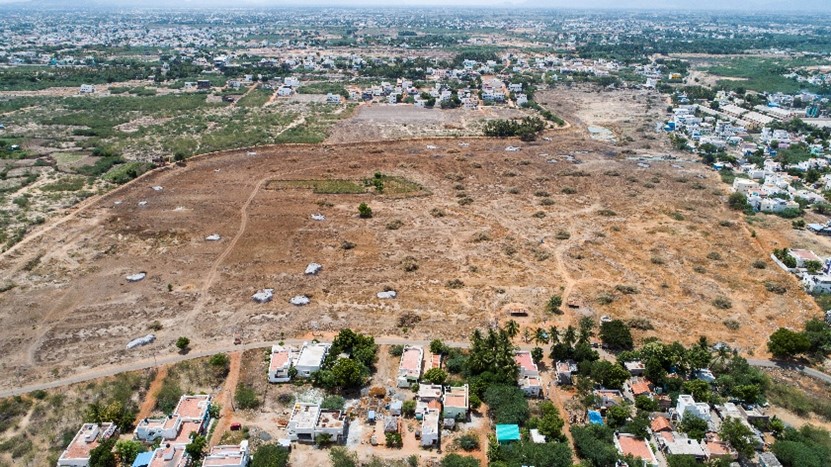
Usufruct sharing plays a critical role in strengthening the linkages between the marginals, resource-poor, and the commons. It keeps the commons and the communities alive. Thus, usufruct remains as a plausible pathway in reclaiming the commons, protecting and enlarging the “commons” stocks, and securing uses by the masses, particularly weaker sections. This necessitates the need for developing policies to maximize the usufruct potential by optimizing the ecosystem services of the environmental commons for the upliftment of the urban land-poor.
Commoning the Water bodies :
The very early stage of ‘social capital’ development for the environmental commons is that their ‘heterogeneous individual-inhabitants’ begin to see themselves as a group. Sharing expectations in their relations of living together; and the preservation of the socio-cultural elements that make the group, as a ‘group’ are vital elements. There are no commons without communing. ‘Commoning’, is a governing activity that not only cares for the existing commons but also generates new cultural norms developed from the practices inherited from the past and adapted to current needs. Very old urban establishments have developed their sense of ‘group’ by fulfilling their residential needs collectively. As they express good signs of cultural norms among them, the restoration of the commons is led by the community with few initial triggers. Starting from the rejuvenation planning process, the level of investment is high throughout the process and post-rejuvenation. The rejuvenation process serves as a platform for the communities to practice the acquired sense of ‘commons’.
Sooravalimedu Irrigation Tank, is one of the baby tank (Yendhal) that was irrigating a command area of 15 acres. In 1874, at Harveypatti, Madurai’s first township was established by the Scottish Harvey brothers. Geographically, the tank was well within the township. In a period of a century, the tank was silted, filled with sewage and municipal waste, and invaded by Prosopis. The tank vanished completely from the memory of the communities. In 2018, CURE with the financial support of Hi-Tech Arai Pvt. Ltd., initiated the restoration of the water commons as a new urban commons. Despite socio-economic-political diversities, a group of elderly people came forward to promote ‘Sooravalaimedu tank conservation Vayalagam’ association. These elders were the ones, who established ‘Atlas Gym’ for the then yongesters in 1974. The ‘Atlas Gym’ served as a space for youngsters to nurture themselves as ‘weight lifters’ and ‘wrestlers’. The gym produced a lot of policemen and soldiers from the locality. The Atlas gym weathered after two decades but not the acquired cultural commons such as ‘equity, self-regulatory, shared stake, democracy, serving the needy, collaboration, and oneness’.
After 34 years, the same ‘boys group’ had another platform to re-express their sense of ‘commons’. The committee was democratic, with the best mix of experienced women, men, and youth of diverse socio-political-economic backgrounds. The association had several rounds of interactions to democratize the composition of the association leaders. They completely redesigned the rejuvenation plan that was suggested by the City Corporation. They were highly consultative with the Corporation officials and other stakeholders during the co-planning process. They introduced the ‘walking track in the tank bund and a children's park’, the ‘women and children’ element in the rejuvenation plan compromising a few engineering structures, to ensure social justice. They expressed strong community negotiation in the eviction of encroachments. Their accountability was expressed during the implementation by analysing the effectiveness of the implementation on daily basis and maintaining transparency in the accounts handling size of 20 lakhs. The ‘commoning’ process itself pulled the communities who were initially resisting towards restoration of commons. The association has invested about 2 lakhs in the rejuvenation and also maintained the same on their own on a rotational basis. They are also in the process of transferring this ‘selfless collective trusteeship’ to the next generation to continue the legacy.
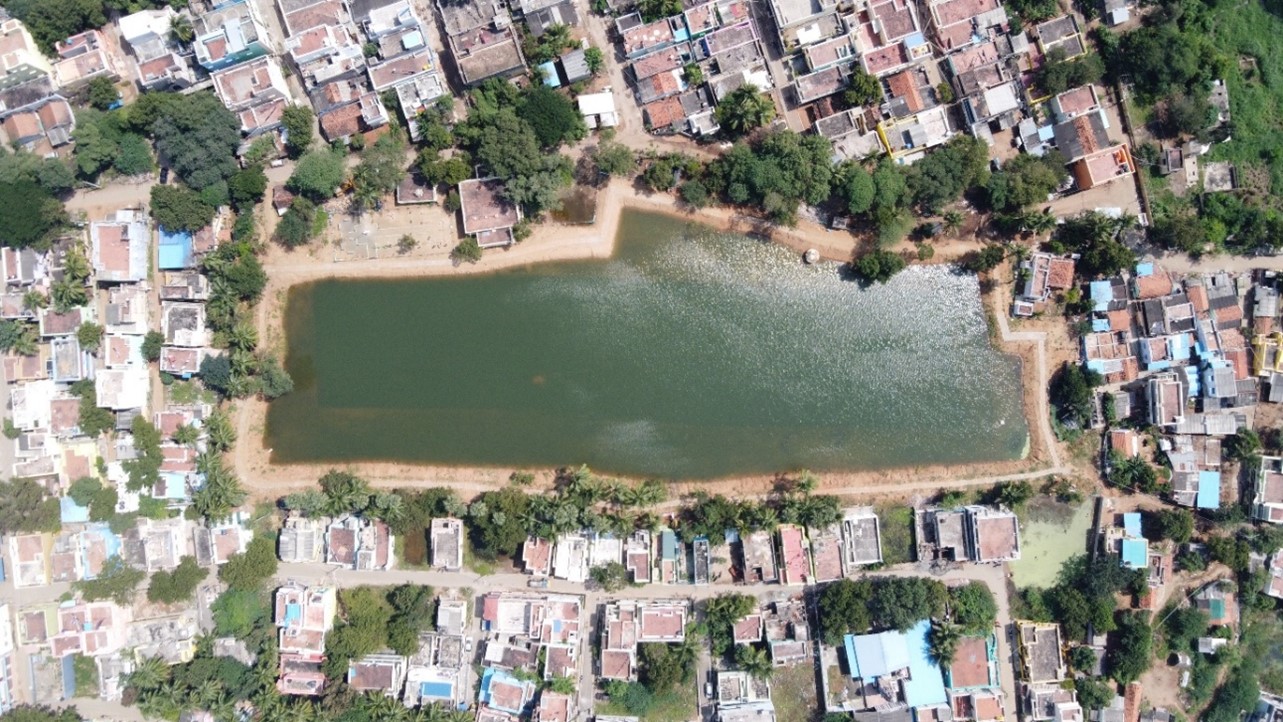
Commons are conflict spaces in Urban. The interests of communities may overlap, at different scales, either conflicting or cooperating. The way they relate to the commons differs from one another. This creates a political relationship among commons and communities. When the communities engage in the process of commoning, there is a greater probability that the commons will take a new shape of the interactions. The process and the struggles in redesigning the commons also increases the interaction between different social groups within the complex social geography of the urban neighbourhood.
Commoning the roof:
Environmental commons and civic commons are the major types of urban commons. While the environmental commons include air, waterbodies, wetlands, landfills, etc. the civic commons include public spaces, public schools, public transit, etc. Redefining the civic commons for the benefit of the resource-poor reduces the pressure on them and also the agencies that absorb the pressure to ensure the security for the resource-poor. While private players have taken up the ‘water market’ in the urban fabrics, CURE facilitated the school communities to conceive their roofs as commons, that harvest the rainwater for safe drinking.
Out of 96,048 Water Supply Connections provided by Madurai Municipal Corporation 4067 are Commercial Connections. The corporation that depends majorly on Vaigai Reservoir suffers severe water crisis in the summers. It has direct implications for supplying water to schools especially, corporation schools. The drinking water scarcity adversely affects the health of school children. DHAN Foundation’s study report ‘Evolving Policies for Integrated Water Resources Management for cities - Case studies of Chennai and Madurai ,2012’, emphasized that drinking water demand of schools and colleges (9 MLD approx.) shall be fulfilled by Roof Water Harvesting for Safe Drinking Water. DHAN Foundation in 2013 has designed its office building in such a way that water harvested in the roof shall meet the drinking water demand of the office. Striving hard through various stakeholder meetings, in 2019, CURE got an opportunity to pilot the initiative at corporation schools in Madurai.
DHAN’s SUHAM trust with financial support of the HCL Foundation constructed a roof water harvesting structure for a capacity of 13,000 liters in 6 corporation schools. Rainwater harvested in the terrace are conveyed through PVC conduits, filtered using a centrifugal filter, stored in leaky proof sump, pumped to an overhead tank for distribution, and consumed by school students. The idea has expanded further to 10 more schools beyond the geographies. The roofs are no longer just a part of infrastructure, it is a catchment for rainwater, that is augmented for strengthening the drinking water of the school students who are from the economically weaker sections. The roof is being maintained and water harvested is being monitored by the ‘Rain Water Harvesting Maintenance Committee’. The committee comprises of students and teachers, building their relationship with the new commons.
Commoning roofs as RWH structures for drinking in institutional buildings through self, government, and CSR supports will secure drinking water, reduces stress on public administration, diminish ground water abstraction by private ‘packaged RO treated water’ suppliers and cuts down pollution due to filters. CURE envisages harvesting rainwater falling on the institutional roofs to supply water to the deprived communities in the urban neighbourhoods.
Commoning the ground:
Degradation or deterioration of urban commons is obvious when the interactions by the relevant communities are weaker or adverse. The lands annexed by various agencies in the process of development or urbanization, under enclosures of the agencies that remain less/ unnoticed weather in time. Such environmental commons, along with the new emerging urban commons such as landfills and open space reserves shall be commoned as ‘Green commons’.
Originally known as the Forest of Kadamba Trees, or Kadamba Vanam, Madurai is gradually turning into Thoonga Nagaram, or the Sleepless City, as it loses its greenery. The HCL Foundation and CURE collaborated to co-create the concept of ‘Urban Sacred groves’. While obtaining land for greening remained a challenge, an acre of landfill site from Madurai Corporation, an acre of ‘free ride’ land from HRCE, 4 acres of degraded land from Madurai Kamraj University were seen as a great opportunity to establish green commons in urban. The removal of invasive species, the construction of contour trenches, breeding the soil and the installation of percolation ponds and tanks marked the beginning of the land's regeneration. The idea of ‘Sacred grove’, a green cultural common, embodied in the memory of the communities, pulled them towards nurturing the groves. The groves were named by the respective communities, especially women in form of SHGs as ‘Kundrangkadu’, ‘Poigai Vanam’ and ‘Adavi’. After gaining the trust of the local community and collaborating institutions, the "Adavi" grew from its original 4 acres and 3,200 plant saplings to an area of 28 acres and 35,000 saplings in just three years. At the moment, 134 companion species coexist with the 83 native tree species that have been planted in the grove. The deity is revered by the local people as having provided care for the grove, which also serves as a habitat for terrestrial birds, reptiles, wild deer, and boars who visit the area for shade, water, and breeding. The student communities and local communities collectively engage themselves in the collection of seeds of native species, nurturing them in the nurseries and growing them in the grove.
The Urban Groves creates an opportunity to contextualize a traditional existing environmental common native to the rural context, which shall be reinvented in the urban scenario, as it kindles the memory of the migrated communities to re-establish and express their cultural expressions, which were in their roots.
Commoning: Reimagining the Commons
The rights of access and allocation of share of marginals towards urban environmental commons are influenced by sociopolitical structures. Access to resources is regulated through political capital, the tools to negotiate and defend their resources. It necessitates the re-imagination of commons for future functionalities combating the current and future challenges.
Annexure of irrigation tanks and the respective agriculture lands to temples by the kings extended to other religions such as Islam and Christianity. Command Area of Kaathiyanoor tank is one of such agricultural lands which were donated to ‘Kazimar Periya Pallivasal (Mosque)’ of Madurai. The 38-acre command area was leased to 25 landless families of Airavathanaloor. The farmers spare a share of 6 sacks of paddy per acre yield and Rs. 72 per acre of Raggi yield to the ‘Kazimar Periya Pallivasal’ for its maintenance. The lease contracts of farmers will be canceled if they refuse to pay the deposits or leave the land fallow for an extended period of 6 years.
As the command area of the Kaathiyanoor tank is a ‘Wakf property’ it remained as cultivable land despite the urban pressure. But not the Sottathatti channel and the feeder channel that supplied the Kaathiyanoor Irrigation Tank. The channels were encroached by the urban settlements which were originally 12 meters to 3 meters; even less than 2 meters in few stretches. This reduced the inflow to the irrigation tank, pushing the farmers to leave agriculture, focusing on alternative livelihoods. The command area remained fallow for 5 years ultimately leading to Prosopis infestation. Zero income from the Kaathiyanoor command area created an opportunity for the Pallivasal trust to push the farmers away from agricultural land which they cultivated for more than 5 generations. They even permitted a few families to undergo cultivation using raw sewage in the foreshore of the tank. To increase their income, the foreshore cultivators started to encroach on the tank bed too. The unused tank became filthy dumped with domestic waste, cow shed washes, and construction debris.
In 2017, CURE facilitated the 25 landless farmers to promote ‘Kaathiyanoor Kanmoi Vivasayigal Vayalagam’ (tank farmers’ association). The association despite running back and forth among the line departments, obtained the NOC after a consistent effort of 9 months to restore the channel and the tank. With the financial support of the HUL Foundation and a community investment of 30% of the total estimate, the tank and channel were restored, evicting the temporary encroachments to a greater extent.
After three seasons of harvest, the farmers realized that the yield was in a falling trend. The tank was completely infested by water hyacinth. The tank filled with raw sewage smelled foul and turned almost dead. The soil and water quality analysis revealed that the ‘acidic nature of the water’ due to ‘heavy organic loading’ in the untreated raw sewage was the major factor behind the fall in the ‘paddy yield’. The association came forward with the idea of treating the raw sewage before using it for agriculture.
Most of the farmers strongly believed that their farm would yield high only when irrigated with the raw sewage that is rich in nutrients. It was very difficult for the association leaders to convince all the farmers to get into the idea of treating the sewage. Farmers were introduced to interact with experts, and exposed to various sewage treatment processes such as decentralized wastewater treatment system, Constructed and floating wetlands, and Enzyme based treatment methods in and around the country. Through these exposures, the farmers understood the various mechanisms their strengths, and limitations. Not as the previous implementation, the women's participation in this process was higher. With the acquired knowledge and technical support of CURE, the association co-developed the design for the ‘nature-based treatment system’ for sewage entering into the tank. Based on the water quality standards, tank was segmented and 2.5 acres of the water spread area of the tank was converted into a sedimentation tank. Benthic zones of varying depth ranging from 1 ft to 5 ft were created in the sedimentation tank so that the tank will function as a constructed wetland.
With the support of ‘United States Department of State, Bureau of South and Central Asian Affairs (SCA) and Caritas Switzerland’ farmers implemented the Nature-Based Solutions to treat the sewage and use it safely for agriculture. The farmers also created two soil heaps to facilitate the bird population that visits the tank. Mr.Sangili Pandian, the secretary of the association reflected, “Once we are the people who hunt the migratory birds that visit the tank, today we are creating islands to facilitate them”. The northeast monsoon filled the tank. The tank water improved from dark to light greenish tone. Nature created their own life in the bunds, islands, and the tank itself. Water quality results reflected the drop in BOD levels from 105 to 42 ppm and an increase in pH level from 6.5 to 8.2, indicating that the wetland has started functioning. The tank has become the learning and research space for students from various research institutes. The tank’s biodiversity has been enriching day by day with migratory birds and native fishes. It’s not just the tank that evolved over the period but it’s also the capacity of the landless families that have evolved to reimagine a tank as a ‘commons’.
The experience of Kaathiyanoor highlights that the reimagination and collective action will potentially change the public sense of order which was based on the gaze as a ‘nuisance’ to the ‘commons’ that evokes a new sense of the sensorium.
Way forward:
Towards commoning the Urbanscapes, CURE has taken its initial steps in protecting, restoring, re-imagining, reconceptualizing, and redesigning the urban commons within the existing limitations and opportunities in collaboration with relevant stakeholders. CURE has realised that the process of ‘commoning’ is the governing strategy, that is to be capacitated to the urban communities organized as commons conservation institutions. Strengthening the linkages among urban commons with marginal communities with a long-term process of building cultural commons, that protects the tangible urban commons remains critical and the core. The minor-commons, which are highly vulnerable to conversions remain a concern for new imaginations. Empowering marginalised communities and resources-poor with economic production, cultural vibrancy, democratic governance will help in defending the commons from further tragedy.
Comments