
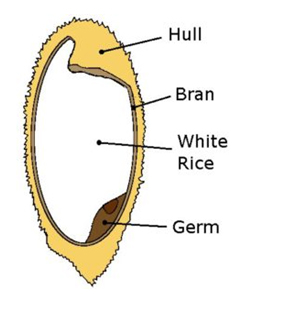
De-hulling is the process of removing the outer hull/husk from the grains, which are not human edible. It is a vital process for obtaining grain-rice and for further processing of grains for consumption.Small millets other than finger millet are well protected in glume encasements, hence the conversion of the grain to rice and other forms are time consuming and laborious. Traditionally, small millets were de-hulled manually by women in the production regionsusing pestle and mortar and/or wooden/stoner grinders, as there is little-to no local processing infrastructure in the villages. This process involves significant drudgery and time. Due to this reason, the consumption of small millets has drastically declined in the production regions.
The major challenges in processing small millets are:
The machines currently used for processing of small millets on a small to medium scale include,
Currently three types of de-hulling technologies are employed namely,
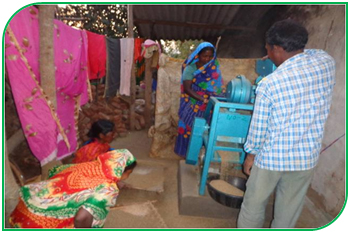
Most of these processing machines are improvised version of paddy processing machineries. The very few large-scale mills available in parts of Maharashtra and Tamil Nadu, produce highly polished grain-rice that considerably reduces the nutrition of small millets, since they remove the bran, which contains the fiber, the minerals and many phytonutrients. Furthermore, these large-scale centralized processing facilities resulted in movement of small millets away from the production areas.
The existing small millets entrepreneurs and small and medium enterprises (SMEs) were facing difficulty in removing extraneous matter and separating hulled and unhulled grains and have lower head-rice recovery. There were inadequateappropriate de-huller models that effectively met the village and regional level processing requirements of small millets. Appropriate models need to be developed urgently to revive small millets and address issues related to food and nutritional security.
Our work so for:
DHAN Foundation in collaboration with Tamil Nadu Agricultural University undertook the following research activities, as part of Revalorising Small Millets in Rainfed Regions of South Asia (RESMISA) project to address the above mentioned gaps.
This survey was undertaken in six sites in India to study the existing post-harvest handling practices followed in small millets, to identify the problems and constraints faced by the farmers, especially women, during various stages of post-harvest handling of focused crops and to identify the areas of research to address the issues of PHT of small millets. A participatory methodology involving key informant interview, focus group discussion, interview of other stakeholders and photo documentation.
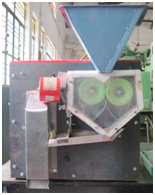
The project developed three prototypes. The single chamber centrifugal dehuller prototype developed for little and foxtail millet was field tested in 4 project sites. It was found that the improved dehuller prototype has reduced the time spent by women for dehulling by 50 to 70 %.
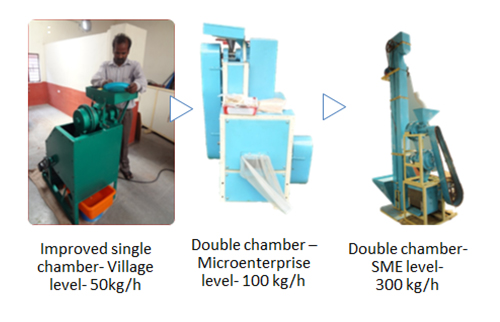
This model was further modified into a double chamber dehuller, to extend its capacity for dehulling of kodo and barnyard millets. The performance of double chamber model was tested for different grains parameters (viz. type of millet, moisture content, parboiling) and machine parameters (number of impellers, type of casing, speed of impeller, no of vanes, etc.) and the hulling efficiency and broken percentage were calculated.
Detailed report is given in http://www.dhan.org/smallmillets/docs/report/Addressing_post-harvest_constraints_of_small_millets_in_South_Asia.pdf Another project partner McGill developed household scale rubber roller dehuller under another IDRC project on millets. The profile of the dehullers developed is shared below.
| Sl. No. | Dehuller model | Critical parameters |
|---|---|---|
| 1 | Centrifugal prototype 1 | Impact type; single chamber; 40 kg per hour capacity; single phase; single hp; village level use |
| 2 | Centrifugal prototype 2 | Impact type; double chamber; 100 kg per hour capacity; three phase; three hp; Microenterprise level use |
| 3 | Centrifugal prototype 3 | Impact type; double chamber; 300 kg per hour capacity; three phase; three hp; Small and medium enterprise level use |
| 4 | Rubber roller mill | 5 kg per hour capacity; household level use |
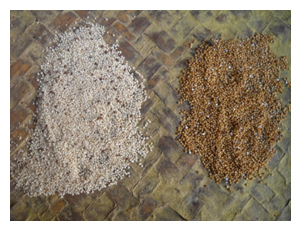
Advantages of prototypes developed
- Can be installed as part of existing mills
- Can be installed as part of existing mills
Parboiling studies were carried out for barnyard and kodo millets. The milled samples were analysed for hulling efficiency, head rice recovery, degree of parboiling, hardness, colour, cooking time, water uptake and swelling index using standard procedures.
The blackening of finger millet grains in the field was probed by All India Coordinated Small Millets Improvement Project (AICSMIP) using samples from Chitradurga District, Karnataka.
Samples of infected kodo millet grains were examined by AICSMIP for microorganisms. The species associated with kodo poisoning were found to be Fusarium, Aspergillus, Curvularia and Sclerotium spp. However, the Fusarium spp. was found prominent. Role of the toxin cyclopiazonic acid (CPA) was studied. It was identified that most CPA is concentrated in husk fraction. Further, the CPA content can be reduced by processing methods viz., soaking, roasting, cooking or by preparations like roti or porridge compared to raw. More Details Click Here
Our current work:
1.1 Supporting interested equipment manufacturers to scale up their operations The project has identified four equipment manufacturers in Tamil Nadu viz. 1) Victor Agro Sales, Salem, 2) AVM Engineering, Salem, 3) Perfura Technologies (India) Private Ltd, Coimbatore and 4) Agromech Engineers, Coimbatore for joint work on product improvement and scaling up the reach of small millet processing machineries. The following efforts were taken up to support equipment manufacturers in order to scale up their operations:
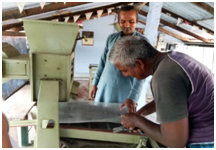
Product improvement: Structured assessment of small millet processing machineries of AVM Engineering and Victor Agro Sales was organised by DHAN, involving retired grain technology scientist from Central Food Technology Research Institute (CFTRI) and experts from McGill, Earth 360 and TNAU. The observations on the strengths and areas of improvement of equipment and possible ways for improvement were shared with the equipment manufacturers for validation, learning and follow-up action. Furthermore, the project channelled the feedback from processors and followed-up with equipment manufacturers for product improvement. As a result, the capacity of manufacturers for equipment design was improved and design modifications were made by them. Business development: Support was given to link the equipment manufacturers with potential buyers and for marketing through Indiamart, an online platform for machineries. Improving visibility of the product: Website creation was facilitated for AVM Engineering and Victor Agro Sales and support was given for display of equipment at the Agri Expo 2016 and Food Expo 2017 held at Madurai, Tamil Nadu.
1.2 Reviving existing small millet processing units in Tamil Nadu Support was given by DHAN for 14 small millet processing units in Tamil Nadu for improving the functionality of the existing machineries and for obtaining additional machineries. Structured capacity building was offered through training for operators on equipment operation and maintenance to improve quantity and quality of output.
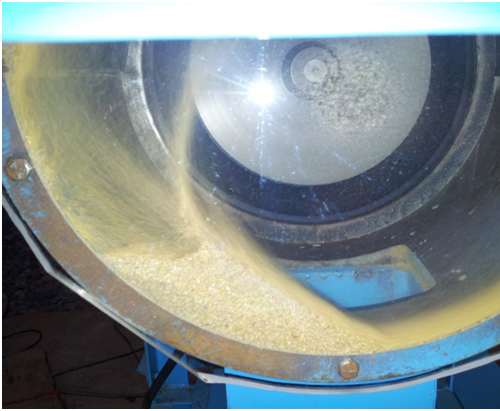
2.1 Assessment of existing small millet processing machineries Concerted efforts were taken for assessment and improvement of existing small millet processing machineries during the project period with the following objectives: i) To improve the quantity and quality of output, ii) To reduce drudgery in processing, iii) To improve ease of use, maintenance, safety and stability, and iv) To reduce footprint and cost of the machineries. A structured assessment was conducted by DHAN in the facility of equipment manufacturers (M/s. AVM Industries and M/s.VICTOR AGRO SALES) in Salem, Tamil Nadu between June 22nd and 24th, 2016 by constituting a team of experts: Dr. Malleshi, a retired Grain Science & Technology expert, CFTRI; Dr. Samson Sotocinal of SAS Technologies, Canada, an engineer with considerable expertise on building of agricultural machineries, and Mr. Dinesha Kumar, an experienced processor of small millets from Earth 360. The team assessed the equipment with reference to i) Structure & frame, ii) Safety & maintenance features, iii) Drive: Motor, Pulleys & Belts, iv) Material flow & transfers, v) Grading & cleaning operations, vi) Feed hopper and vii) Fan box & Aspirator. The team extensively interacted with equipment manufacturers actively involved in equipment design. Further focused interactions with processors using these machineries were carried out for getting users’ perspective for improvement. A second spell of trial was organised by DHAN with SAS technology for understanding the internal operation of centrifugal dehuller and to fine tune the same for different small millets by using VFD (variable frequency drive).
The summary of the areas in need of improvement is shared below.
2.2 Trials on using specific gravity separator for removal of unhulled grains from rice and grits Trials using specific gravity separator of Westrup were initiated by TNAU, using dehulled output of kodo, foxtail, barnyard, proso and little millets. Response Surface Methodology was used with the Box Behnken Method. The results will be shared in the next reporting period.
2.3 Comparison of nutrient content of small millet processed using different processing methods A comparison of the nutrients of little millet processed using centrifugal dehuller and manual dehulling with the one available in the market (processed using emery mill and cone polishers) was done in the project period to understand the differences. The results are shared in Table 1. It can be seen that both grade 1 and 2 rice processed using centrifugal dehuller fared better or are on par in terms of nutrient content with the one processed manually. Both of them fared much better than the market sample, particularly with respect to fat, ash content, antioxidant and protein content.
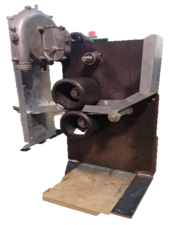
2.4 Development of new rubber roller dehuller prototypes by McGill
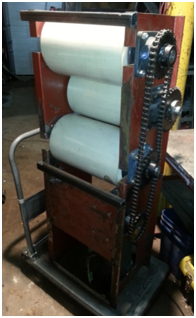
A hand-operated rubber roller dehuller has been developed for the household level. This was the project of a Master student, Mr. Subhash Palaniswamy and the prototype has been tested on different types of millets, namely foxtail and kodo millets. This dehuller has over 90% efficiency after two passes for little and foxtail millets. The hand operated dehuller is ready to be transferred and scaled up in India. A large scale rubber roller dehuller with a theoretical processing capacity of 175 kg small millet per hour was designed and built at McGill by Dr. Samson Sotocinal of SAS Technologies. It was initially tested with little millet and achieved approximately 90% efficiency with one pass. This prototype will be shipped to India for further on-site testing and multiplication.
2.5 Preliminary evaluation of adoption and impact of village level dehulling equipment on the largely female users and entrepreneurs Small Millets Processing Units (SMPUs) are being promoted at the village level in production regions, as availability of local processing infrastructure is expected to reduce drudgery in processing, which in turn is expected to improve consumption of small millets. But there is inadequate understanding of the utilization and the consequent outcomes of the promotion of SMPU. In this backdrop, a preliminary assessment study of SMPUs was undertaken in i) Jawadhu Hills, Tamil Nadu, ii) Peraiyur, Tamil Nadu and iii) Semiliguda, Odisha, areas that vary in cultivation intensity and socio-economic background. Results indicated that most of the users viewed reduction in drudgery and time taken for processing as the main benefit of using SMPU, realised mainly by women. But the extent of this benefit varied across the users, SMPUs and sites. The existence of SMPUs did not result in changes in decision making by women on the quantity of grains to be processed and the role of women in preparatory works before processing grains in SMPU. But it has resulted in sharing of roles of processing using SMPUs between men and women. Not shifting from ‘non-eater’ to ‘eater’ of small millets by families around SMPU mainly resulted in its low utilisation. The other important reason for even ‘eaters’ to not utilize SMPU in the study areas was the poor opinion about SMPU communicated by users namely the lower rice recovery, broken kernels and the need for further cleaning after processing with SMPU. While complementary efforts along with promotion of SMPUs for motivating non-eaters to consume small millets is vital for improving utilisation of SMPUs, there is critical need for improving the quality of output, mainly by improving the skills of operators, to create a positive image on SMPUs and to educate about the product quality.
2.6 Storage trials on enhancing the shelf life of dehulled small millets The short shelf life of dehulled small millets (two to three months) is a great constraint for commercialization of small millet products. Poor keeping quality of small millet grains is attributed to presence of higher amount of fat than other cereals and deterioration of its triglycerides through lipolysis and subsequent oxidation of de-esterified unsaturated fatty acids. The lipase enzyme, which is concentrated in the pericarp, aleurone layer and germ, accounts for the hydrolysis of the triglyceride, which results in off odour and taste in the flour and its products. In order to increase the shelf life, storage trials involving three different environments namely vacuum packaging, modified atmosphere packaging, and hermetic storage are being taken up by TNAU. The samples are analysed at 10 days interval for the various bio-chemical and nutrient contents. These experiments are in progress.
3.1 Demonstration of dehulling and processing equipment in strategic locations The different dehuller models have been demonstrated by TNAU at Krishi Unnati Mela, a national level Agriculture Fair-cum-Exhibition organized by Department of Agriculture, Ministry of Agriculture and Farmers Welfare, Government of India and Indian Agriculture Research Institute (IARI) at Indian Agriculture Research Institute at New Delhi from March 19-21, 2016. Demonstrations were also done by TNAU at CODISSIA Trade Fair Complex, Coimbatore on 15th July, 2016 and at AGRI EXPO on 3rd September, 2016 at VIT, Vellore for the benefit of the millet growers, traders and processors. Demonstrations of processing equipment were organised in three sites in Odisha and three in Tamil Nadu by DHAN. Demonstration cum testing was organised in the Indian Institute of Millet Research, Hyderabad.
3.2 Advertising on the equipment Visits were organized by DHAN for Krishi Vigyan Kendra and FPO from Chitradurga, Karnataka, and INHERE, Uttarakhand to introduce and expose them to small millet processing machineries and processing units. A guidance note for potential buyers was prepared which covered small millet processing equipment available on the market, how to choose the set of equipment based on need, the testing of the equipment at the manufacturer site, the floor plan and installation steps to be followed, and the testing of the equipment after installation.
3.3 Capacity Building on small millet processing Given the challenges in processing small millets due to the small size of the grains, variations in the raw materials, and the short shelf life of the processed rice, building adequate knowledge and skills of the operators for effectively using processing machines is critical for increasing head rice recovery and quality of the output. The project has taken up the following initiatives to address the above mentioned concerns:
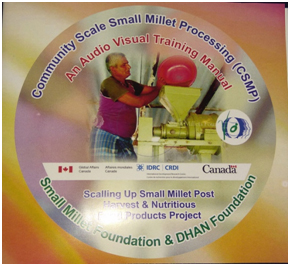
Preparation of training materials on small millet processing A training manual is being prepared for Community Scale Small Millet Processing (CSMP) by DHAN in both written and audio-visual format in English, keeping in mind the training needs of the operators of village level and small scale processing units, and of potential buyers.
The topics covered in the film clips of the CSMP manual are:
Training on utilization of dehulling and processing equipment :
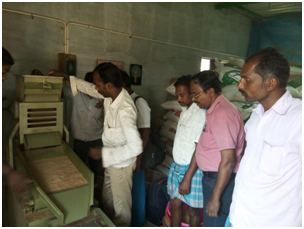
Four training sessions were organised by DHAN for … small millet processing unit operators and potential buyers, of which three were organized in Tamil Nadu and one was organized at Koraput district, Odisha. The training programme covered assessment of raw material, demonstration of process flow using grader, destoner, and dehuller to improve the quantity and quality of output, and periodic maintenance procedures
3.4 Consultation offered The project team participated in a consultation meeting of the Comprehensive Revival of Millets Project, Andhra Pradesh, to help the project in choosing appropriate processing equipment, and sound procurement and installation procedures. Similarly the project team participated in two consultation meetings organised for Special Programme for Promotion of Millets in Tribal Areas in Odisha and shared their inputs.