Tsunami- Relief and Restoring Livelihoods & Habitats
DHAN Foundation Initiatives - Update 21
Reaching the Un reached
The 20th update was on
DHAN’s initiatives in identifying alternate sustainable livelihood support
systems for the vulnerable community in the tsunami affected areas in Tamil
Nadu. In this update the focus is on
DHAN’s intervention with the marginal community that got limited attention and
support after the tsunami.
The tsunami invasion
has devastated the livelihoods of both fisher and farming community in the
coastal areas of Tamilnadu. Though the response from the civil society and the
state was overwhelming in terms of providing relief and rehabilitation to the
affected communities, there were a few marginal sections among the affected
community to whom the rehabilitation and even relief is yet to reach or got
delayed. These communities were basically wage labours in fishing and farming,
the fishing community involved in backwater fishing and those who do blind fishing
or hand fishing in backwaters.
DHAN’s field staffs
were able to reach such marginal communities and initiate the process of
livelihood restoration. This update focuses on two such initiatives.
DHAN
intervention in Jonaskuppam
Jonaskuppam
is located at a distance of 36 km south of Chennai on the East
Coast Road located next to Kovalamkuppam. Kovalamkuppam
or Kovalam popularly called is a famous tourist attraction next to
Mahabalipuram in Kanchipuram District. There are about 280 families in Jonaskuppam
and all of them belong to minority community. About 177 families are directly
involved in fishing in this hamlet. In the adjacent Kovalamkuppam there are
about 357 families of the majority community and are all involved in fishing.
The main approach to Jonaskuppam is thru Kovalamkuppam only. Though the hamlets
were located next to each other there is a vast difference in terms of basic
fishing implements in use, their life style and economy. The pre-tsunami
infrastructure of both the fishing hamlet is given below :
Table – 1: Pre tsunami
infrastructure in Kovalamkuppam and Jonaskuppam
|
|
Kovalamkuppam |
Jonaskuppam |
|
No.
of FRP Boats - |
42 |
Nil |
|
No. of
Catamaran with engines |
38 |
10 |
|
No. of
catamaran without engines |
63 |
85 |
|
Varieties
of nets used |
12 |
8 |
Due to the invasion of Tsunami the craft and gear got severely damaged.
The livelihood of the fisher community in both the hamlets came to a stand
still. The loss due to tsunami in both the hamlets is given in the following
table.
Table – 2 : Impact of tsunami on the life and
livelihoods in Kovalam and Jonaskuppam
|
Impact of Tsunami |
Kovalamkuppam |
Jonaskuppam |
|
No.
of FRP Boats - |
25 |
- |
|
No. of
Catamaran with engines |
16 |
10 |
|
No. of
catamaran without engines |
8 |
85 |
|
Fishing
nets |
Total loss of fishing
nets reported in both the hamlets |
|
|
Houses |
53 |
22 |
The main loss is on Catamarans (wooden logs tied together) which is used mainly by the economically weaker sections among the fisher group. The loss of lives due to tsunami as reported is 7 (Male–3, Female-2, Children-2) in Kovalamkuppam.
Immediately after the tsunami, voluntary organisations started
intervening and providing relief and rehabilitation to the community.
 The
intervention started with providing relief and then on livelihood
The
intervention started with providing relief and then on livelihood
rehabilitation. During this stage the majority community in Kovalamkuppam got
the attention of most of the organisations and hence took advantage of the
relief and rehabilitation assistance provided. But since the minority community
in Jonaskuppam is to be reached only after crossing Kovalam most of the relief
and rehabilitation support drained in Kovalamkuppam itself and very limited
percolated to Jonaskuppam. Hence the minority community were under severe
stress immediately after the invasion of tsunami. When DHAN intervened in the fishing hamlet
during the last week of January 2005 a rapid need assessment was carried out to
assess the basic needs of the community in both the hamlets. During this
process the disparity came out quite clearly and hence the rehabilitation was
focussed on Jonaskuppam. At one point of time about 14 organizations involved
in tsunami rehabilitation but supporting only the majority community. Based on
the assessment DHAN mobilized relief materials to Jonaskuppam and
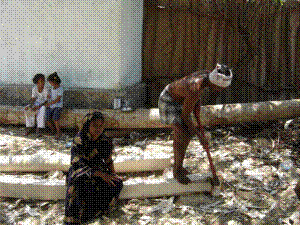
the livelihood rehabilitation process also was initiated immediately. DHAN so far provided 48 new
catamarans for a total cost of Rs. 8,04,200 supported by NOVIB Netherlands. The community contributed Rs. 50000 as their contribution and also
provided the working space (temporary shed) for the carpenters to work on the
catamarans. Also the community contributed the daily food for the carpenter.
DHAN’s insistence on community contribution is mainly to ensure a participation
and sense of ownership among the community.
Future
Interventions Planned
DHAN organized the fishermen of the Muslim
community in the form of Self Help Groups called Meenavar Kalanjiams. The
amount contributed towards catamaran by the community will be given back to
these groups as seed money that will be used as revolving fund within the
members of each group. DHAN has planned to organise the women in the hamlet
into Women Self Help Groups called Kalanjiams. The process of savings and
credit will be initiated among the groups. Micro finance will support this
marginal community to come out of the debt trap .
DHAN
intervention in Ambedkar Nagar
Ambedkar Nagar is a small hamlet located in Kurinchipadi Block of
Cuddalore district. It is located on the banks of
Uppanar backwaters There are about 191
families belong to the marginal section of the community (Dalits). Their main
source of livelihood is through fishing in Uppanar backwaters. Some of them
also work as agriculture wage labours and as industrial wage labours in the
nearby towns. During tsunami the raise in water level in the backwater has
totally washed off the 15 catamarans with 60 Kg of nets. In addition huge
amount of marine silt got transported and deposited in the backwaters making it
un suitable for fishing. Among the worst affected are the community that were
involved in blind fishing or hand fishing. They just sit in the knee deep water
and search with bear hands in the backwater and catch whatever is available
like crabs, prawn, small fishes etc.,
Radhakrishnan with his Wife Ammaponnu has to manage with meagre catch he gets after tsunami in the Uppanar backwaters
The raise in water level in the backwater
also entered the nearby agriculture fields increasing the salinity in the top
soil. It has also spoiled the standing crop. At present no support has reached
this hamlet from any source. DHAN intervened in this hamlet and started
establishing the livelihoods of this marginal community. With the support from NOVIB Netherlands catamarans have been provided to the backwater fishing
community. The women were organised as Kalanjiams (Self Help Groups) and
livelihood support activities such as back yard poultry and goat rearing has
been provided.
also spoiled the standing crop. At present no support has reached
this hamlet from any source. DHAN intervened in this hamlet and started
establishing the livelihoods of this marginal community. With the support from NOVIB Netherlands catamarans have been provided to the backwater fishing
community. The women were organised as Kalanjiams (Self Help Groups) and
livelihood support activities such as back yard poultry and goat rearing has
been provided.
Case Study
V.Radhakrishnan who belong to the marginal section
resides in Ambedkar Nagar with his wife and 5 children. He is the only earning
member for his family through fishing in backwaters. Earlier Radhakrishnan use
to work as wage labour in the trawlers in the nearby Palaiyar village. With
meager earnings he found it difficult to run his family and hence decided to go
back to his native village (Ambedkarnagar). Before tsunami , Radhakrishnan goes
for fishing in his catamaran at 10.30 PM and returns back at 4.30 AM and earns on an
average Rs. 200 per day. During lean periods his earnings gets reduced
drastically to Rs.100 a day. Due to tsunami he lost his craft (catamaran) and
gear and now do fishing in a rented catamaran with old torn nets. As rent he
has to part half his catch with the boat owner. Radhakrishnan has not been to
school but he wants his children to go to school. Young looking Radhakrishnan
does not even know his age or date of birth but is confident of getting back to
his normal livelihoods provided he gets a catamaran with nets.
People organizations for sustaining development
In the Tsunami affected
coastal area, three major communities are existing and the same were affected
much during the Tsunami disasters. There are Fishermen communities, the
landless laboures are depending up on the other two communities. During the
Relief work undertaken for the affected people, their basic needs were timely
fulfilled and the common infrastructures were temporarily constructed to turn
them in to normal life. Hundreds of NGO’sand other Institutions were involving
and very successfully completed the relief works. After completion of relief
works, Livelihoods restoration was the immediate need of the affected communities.
DHAN’s approach to development is through the people organizations. It has experienced this approach successfully in rural, tribal and urban context. The same approach was followed in Tsunami affected coastal communities to restore their livelihoods. So, promotion of people organization was considered essential to organise the affected communities and enough focus was given to promote people organizations affected people.
Farmers association
The affected farmers are
organized in to Associations based on the proximity of the land holdings. Focus
is given for organizing the small and marginal farmers who would occupy
decision making space in these community organizations.
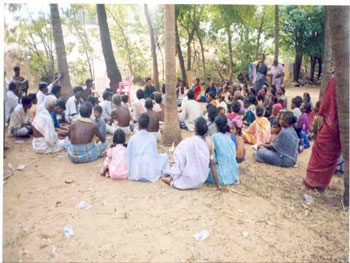 These associations
would bring in scale advantages to small farmers and there by lead to reduction
in costs and increase in incomes. More over, they would anchor the
technological interventions tried out in the areas and their horizontal spread.
Steps have been taken to organize farmers association in the affected area and
246 farmers associations have been promoted in the affected villages through
which 4551 families have been covered
These associations
would bring in scale advantages to small farmers and there by lead to reduction
in costs and increase in incomes. More over, they would anchor the
technological interventions tried out in the areas and their horizontal spread.
Steps have been taken to organize farmers association in the affected area and
246 farmers associations have been promoted in the affected villages through
which 4551 families have been covered
Kalanjiam Women Association
 Poor women from Landless
category and the fringe community are organized as self help groups for
restoring their livelihoods. Mostly deserved families are taking part in these
women self help groups. These groups are engaged in saving and credit
activities from the day one itself and they access to credit for starting their
own livelihood activities. DHAN Foundation has promoted 586 women self help
groups covering 9927 poor families in the Tsunami affected Districts of
Cuddalore, Nagapattinam, Karaikal and
Pudukottai.
Poor women from Landless
category and the fringe community are organized as self help groups for
restoring their livelihoods. Mostly deserved families are taking part in these
women self help groups. These groups are engaged in saving and credit
activities from the day one itself and they access to credit for starting their
own livelihood activities. DHAN Foundation has promoted 586 women self help
groups covering 9927 poor families in the Tsunami affected Districts of
Cuddalore, Nagapattinam, Karaikal and
Pudukottai.
Fishermen Associations are promoted for resuming
strengthening and sustaining the fishing livelihoods. So, all fishermen who were
affected in Tsunami are organized as small associations consisting of 20-40
families in the same habitats. By this initiative, the scattered affected
families are organized and they meet atleast once in a month. The village level
Associations give opportunity to a poor fisherman attend the meeting and share their
views. Now they have opportunity to move jointly to promote their livelihood
and other facilities of their village. DHAN field teams have promoted 331
fisherman associations from 168 habitats in the coastal affected areas through
which 5646 families have been organized in the people organisation.
People Organization Details (April – August 2005)
|
S.No |
Name of the Region |
Women SHG's |
Fishermen Group |
Farmer groups |
Total |
||||
|
No |
Mem |
No |
Mem |
No |
Mem |
No |
Mem |
||
|
1 |
Kanchipuram |
0 |
0 |
164 |
2864 |
0 |
0 |
164 |
2864 |
|
2 |
Cuddalore |
259 |
4640 |
58 |
948 |
59 |
1095 |
376 |
6683 |
|
3 |
Nagai I |
194 |
2994 |
41 |
631 |
31 |
483 |
266 |
4108 |
|
4 |
Nagai II |
74 |
1218 |
43 |
786 |
156 |
2973 |
273 |
4977 |
|
5 |
GOM |
59 |
1075 |
51 |
417 |
0 |
0 |
110 |
1492 |
|
|
Total |
586 |
9927 |
357 |
5646 |
246 |
4551 |
1189 |
20124 |
As a whole, during the last
five months, more than thousands people organisations have been promoted among
the affected families of Tsunami and more than 20,000 families have been
organized in these organizations. These are basic organizations which are going
to undertake required livelihood activities for the betterment of the affected
people. Still the promotions of people institutions are focusing for covering
all affected people.
These three types of People
Organizations are having similarity their functions.
They all are having meeting once in a month regularly and
discuss their issues. Their views are pooled and plan for their development
-
All people organizations are having financial transactions like savings and credit programmes
-
Development activities are planned at the group meetings for the individuals and do implemented
-
Strict group norms are framed among themselves, to regulate their functions smoothly
-
Each group is maintaining books of accounts and having bank account for financial transactions.
-
People decisions are respected and get in to action
-
All financial support received from donor agencies for development activities are routed through these groups and the groups take decision on implementing activities
-
All these groups are governed by the selected representatives of the respective groups and they have staff for looking after the group activities and other functions