Tsunami- Relief and Restoring Livelihoods & Habitats
DHAN Foundation Initiatives - Update 20
Livestock support to Marginal Communities
The 19th update was on DHAN’s initiatives in organising the coastal community and promoting alternate livelihoods in the Gulf of Mannar Region. In this update the focus is on identifying alternate sustainable livelihoods support systems for the vulnerable community in the tsunami affected areas in Tamilnadu.
One of the major livelihood supports for the coastal community is their livestock. In addition to the loss of lives and properties, the coastal community lost their livestock, which were the backbone of the coastal farming community. Even the fisher community use to have livestock as livelihood support particularly the marginal sections that depend on backwater fishing in the coastal areas of Cuddalore and Nagapattinam districts. In addition to the 13,000 hectares of agriculture fields becoming saline it is also reported that about 10,000 nos. of livestock of all kind were lost during the recent tsunami invasion in Tamilnadu alone. DHAN as part of its livelihood restoration activity initiated the process of providing livestock to the marginal community in the tsunami affected areas. Livestock to the worth of Rs. 53 Lakhs have been provided to the vulnerable sections of the community under the assistance of ACTED, France. About 690 families of 46 groups get benefited out of the first phase of the programme in Cuddalore district. The main focus of this update is on the importance of livestock to the coastal community, process involved in sourcing, supplying of the livestock and capacity building of the community to maintain the livestock so that a constant source of income gets generated in the affected families. The profile of some of the beneficiaries have been documented also forms part of the update.
Importance of Livestock in Coastal Community
Most of the farming families in coastal Tamilnadu had livestock such as cows, buffaloes, goats, sheep, poultry etc as a source of additional income. Even the fisher families had smaller livestock like goats, sheep and poultry. Livestock is integrated with local economy is an important asset for the poor farmers, particularly for its liquidity and for the employment opportunities, they provide in the lean season. Loss of livestock has definitively put the livelihoods of the landless, small and marginal farmers in danger, particularly in the wake of no insurance cover for these livestock.
Another important observation was that the relief providers ignored the backwater fishing and farming communities in total. In the case of Kurichipadi Block of Cuddalore district there are about 28 villages that got affected by tsunami of which only 9 villages got the relief and rehabilitation. In the rest of 19 villages the community depend on backwater fishing and agriculture. The tsunami invasion has crippled the livelihoods of this community by sea water entering into the agri fields thus making the top soil saline in nature and the fishing community involved in backwater fishing losing their craft and gear mainly catamarans and nets. They have not only lost their investments, but also the asset base for their livelihoods. The tsunami invasion has totally stalled the farming activity in the coastal areas thus severely affecting the daily wage labourers involved in farming activity. So far the community is yet to receive any rehabilitation support from any source.
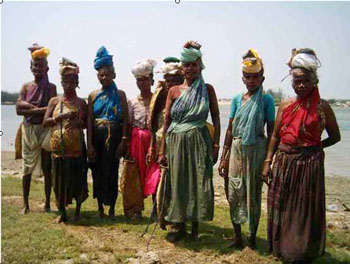 In addition to
agriculture and fishing there is one more sect of group basically
old women who were involved in fishing in backwaters.
They
just sit in the knee deep water and search with bear hands in the
stream floor in backwater and take whatever is available like crabs,
shrimp and small fishes. The invasion of tsunami has transported
huge quantity of marine silt into the backwaters area (about 1ft -
2ft of silt being transported) making the areas slushy and uneasy
to walk, making life miserable for this particular community called
“Thadavaravanga” - hand fishing. They need to be supported also as
it would take considerable period to flush out the transported
marine mud from the backwaters and for whom livelihoods could be a
viable option.
In addition to
agriculture and fishing there is one more sect of group basically
old women who were involved in fishing in backwaters.
They
just sit in the knee deep water and search with bear hands in the
stream floor in backwater and take whatever is available like crabs,
shrimp and small fishes. The invasion of tsunami has transported
huge quantity of marine silt into the backwaters area (about 1ft -
2ft of silt being transported) making the areas slushy and uneasy
to walk, making life miserable for this particular community called
“Thadavaravanga” - hand fishing. They need to be supported also as
it would take considerable period to flush out the transported
marine mud from the backwaters and for whom livelihoods could be a
viable option.
Livestock Support - Objectives of the programme
The immediate prime objective of this programme in the tsunami-affected villages of Cuddalore district is to restore and rehabilitate the livelihoods of the affected communities as early as possible through interventions in the livestock sector. The long term objective is to strengthen the community
organisations to enable them to become financially and institutionally sustainable, to conserve natural resources such as coastal eco-system, marine bio-system, water bodies, coastal farms etc, to reduce poverty and vulnerability and to make fisheries and coastal agriculture sustainable.
The programme aims at:
-
Increasing the capacity of the affected communities to restore the livelihoods of the most vulnerable affected population in these villages.
-
Increasing the capacity of the affected individuals / families to produce food for their own needs and generate income.
-
The long term objective would be to develop small dairy production, animal breeding enterprise and egg production enterprises.
Plan of Action
Restoring and Securing the Livestock sector
Livelihoods restoration requires the proper understanding of the indigenous systems and practices that exist in the coastal areas among fishery, farming and animal husbandry based livelihoods. The proposed framework on value creation integrates a few of the critical components in restoring livelihoods. Community infrastructure, production machinery, technology, marketing, skill building and building forward and backward linkages are the key components identified that requires focus in restoring livelihoods. Compensating the affected families alone definitely will not help to hasten the restoration of livelihoods processes. In this scenario, option before the development community is addressing these issues creatively by closely working with coastal communities.
Framework for Value Creation: Restoring the Livestock Sector
|
S.No |
Key components |
Animal husbandry |
|
1 |
Organizational / Community Infrastructure |
Primary Producer Groups for the members engaged in poultry, goat rearing, dairy and in such other activities |
|
2 |
Production Machinery |
Providing goats, Milch animals, Establishing poultry units |
|
3 |
Technology/ Modern Practices |
Fodder development Cross breeding |
|
4 |
Marketing |
Linking primary producers with milk cooperatives Organizing street vendors |
|
5 |
Skill Building |
Training in Livestock Maintenance |
|
6 |
Forward and Backward Linkages |
Linkage with the supply markets for inputs like cattle feed. Streamlining the local seller and buyer markets |
Organising the Community
The affected communities are organised into different functional groups to cater to their differing needs. Women of fishing and farming communities are organized into kalanjiams, the women self-help groups. Livestock owners would be organised into Primary Producers’ Groups (PPGs) to take care of their administrative and operational needs. These PPGs would have financial link with the kalanjiams, but otherwise would perform as separate entities. Focus will be on understanding the needs of the communities that will be the basis of a coordinated plan for rehabilitation. The involvement and the active participation of the communities are vital for the implementation of rehabilitation programme.
Local cadre staff have been identified, trained and placed in the affected villages to organize the community and to support in rehabilitation activities. People of leadership qualities would be identified and groomed to take up active role in the process of organizing the community, rehabilitation activities, and governance of community organisations.
Promotion of
Dairy activity
Dairying is an important source of subsidiary income to small and marginal farmers and agricultural labourers. The manure from animals provides a good source of organic matter for improving soil fertility and crop yields. The gobar gas from the dung is used as fuel for domestic purposes as also for running engines for drawing water from wells. The surplus fodder and agricultural bi-products are gainfully utilised for feeding the animals. Almost all draught power for farm operations and transportation is supplied by bullocks. Since agriculture is mostly seasonal, there is a possibility of finding employment throughout the year for many persons through dairy farming. A farmer can earn a gross surplus of about Rs. 12000 per year from a unit consisting of two milch animals.
Criteria for selection of beneficiaries:
-
The poor from the farming and in-land fishing communities in the tsunami affected coastal villages, with a prior experience in dairying have been identified.
-
Families from the most vulnerable segments of the communities that include those whose habitats were destroyed or largely damaged, women headed families, widows, families with more number of girl children, families with aged and crippled.
-
Another criterion would be that these families belong to socially down trodden castes like the scheduled castes and scheduled tribes.
Each of these families will be provided with two animals such that there is a continuous production of milk to increase food availability for the families and increase in household income. The Primary Producers Groups that would be promoted in these areas would support procurement and supply of inputs and marketing of milk through appropriate linkages.
Rearing of goats
Goats occupy an important place in rural economy, through its contribution to the economy in the form of milk, meat, manure, skin and fibres. The demand for the meat of these small ruminants has been strong in India. Goat population in India has been increasing in last three decades in the fastest rate (2.71 % per annum) among all major livestock species. This growth reflects not only its adaptability but also confirms its utility under the multi-facet economy of the country. The contribution of goats manifests in the rural area, where goats are closely associated with the poorest of the poor. The worth of goats in India lies primarily in their quick proliferation intervals, higher rates of growth and the ease with which the goats as well as their derived products can be marketed for food and fibre. Studies on the economic viability of goat keeping show that it has highest benefit: cost ratio among the different animal farming practices. In short goat keeping is a good enterprise for the following reasons: low purchase price / investment, quick onset of reproduction and high fecundity, production of several products for family and market, high survival under less favourable or even stress environment and easy availability, cheaper replacement and easy to handle.
Families who have access to grazing lands and who could manage keeping a flock and with adequate space for keeping the goats and the kids were identified. These families were supported for having a flock of six goats (5 female + 1 male). This may be in addition to their existing stock. Improved breeds are introduced in these villages. The bucks of improved breeds are supplied for the interested families, which would serve the breed improvement in the given area. Over the period of three to four years, there would be a significant improvement in the characteristics of the local breed.
Backyard Poultry
Backyard poultry is a traditional occupation in the rural areas which is undertaken for both meat and egg purposes. This is a good source of animal protein for the rural families. Besides nutrition, this also becomes a source of supplementary income for the families. But in the recent years, the backyard has lost its prominence among the rural families as a source of supplementary income. This has a telling effect on the nutritional status of the families not being able to have access to better nutrition; also as a drain on the families’ income when it is accessed from the market.
The ‘Kroiler’ birds, which have the dual characteristics of, egg laying and gaining weight for meat purpose could be ideal to revive the backyard poultry in these villages. The kroiler would lay about 150 -180 eggs. It will gain a weight of two kilograms within three months. DHAN has already tested this many of its working areas and has found to be most suitable for backyard poultry. The identified families were given 40 days old chicks for rearing. Each family gets 10 birds, of which five would be male and the rest five would be female. This would ensure nutrition for the family as well as supplementary income for the families. This intervention would supplement the requirements of the families already assisted with dairy or goat units.
Fodder Production
Grazing lands have become scarce in the recent years. Most of them are converted as agricultural lands or turned for other uses. Even the other common lands that were used for grazing purpose have also been occupied for other purposes. It becomes important to promote fodder production to strengthen the livestock based livelihoods. Without access to adequate fodder livestock rearing cannot thrive in any area. Small landholders would be identified for support in fodder production. These families would be supplied with quick growing and high nutritional fodder seeds such as ‘kolukattai pul’, desmanthes, cumbu napier etc for cultivation. This could be taken up in fringe lands. Some could even think of cultivating fodder for supply to others. Fodder tress such as ‘subabul’, neem etc could be promoted in these areas in common lands for making it available for the goat rearers. The goat rearers could cultivate these trees in the homestead with waste water.
Animal health care services
Access to better health care services is still a problem in remote rural areas despite the large infrastructure created and operated by the government. Vaccination, de-worming etc and many others are not common practices among the livestock holders. Awareness on health care issues is also low in these families. Due to lack of access to health care services, both the production and productivity of the animals is less. Sometimes it leads even to the death of the animals making the families more vulnerable. DHAN would promote two to three animal health care centres in the villages where livestock based livelihoods is promoted. These centres would extend services such as vaccination, de-worming, artificial insemination, general treatment etc and they would be managed by the community organisations. The centres would be adequately staffed with livestock inspectors.
Animal
insurance
DHAN has
facilitated Insurance for cows and goats initially for an initial
period of 2 years after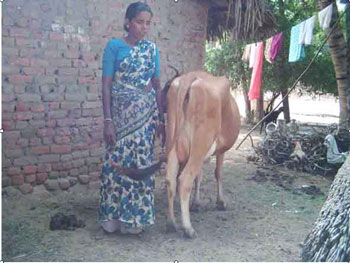 which the community will be encouraged to avail on their own.
Various insurance products would be tried with the mainstream
insurance companies through adequate negotiation processes.
Around three to four percent of the costs of the animals would be
earmarked for meeting the insurance premium charges.
which the community will be encouraged to avail on their own.
Various insurance products would be tried with the mainstream
insurance companies through adequate negotiation processes.
Around three to four percent of the costs of the animals would be
earmarked for meeting the insurance premium charges.
Profile of
Beneficiaries
One of the beneficiaries of DHAN’s livestock support in Ms.
T.Lakshmy aged 38 of Thiruchopuram village. She lost her husband Mr.
Thavamani about 6 years back and at present is the only earning
member of the family. She is mother of 5 children (4 girls and a
boy). Lakshmy is a land less agriculture wage labourer and take up
jobs in the agriculture farms. Her daily earnings is a meagre Rs. 30
per day. Even this is not assured for her on all days. After tsunami
the farming activity has come to a stand still and Lakshmy was under
severe stress. With limited earnings Lakshmy was forced to
discontinue the schooling of three of her children and at present
only two of her children goes to school. Lakshmy’s average monthly
requirement is about Rs.1500 per month. To meet her shortcomings
she depends on private money lenders with a very high interest rate
(more than 100% per annum). Now she being a member of Pongu Thamizh
Kalanjiam she opted for cows and now being provided with 2 cows. She
is able to earn about Rs. 40 per day by sale of milk and she is
confident of getting out from the clutches of poverty once the other
cow also starts milking. Savings and credit facilities will form
part of the group activity and over a period of time the group will
get linked with mainstream financial institutions to avail loans at
bank interest rate so that she need not depend in money lenders.
In the same village resides Chandra wife of S.Thangaraj. They have two children girl and a boy studying in 10th and 7th standard respectively. Thangaraj is the major bread winner of the family. As a wage labour he earns about Rs. 80 per day. On an average he gets job for 15 days in a month. At times Chandra also supports the family. During lean periods of farming activity their only alternate source of income is through goats. They had 3 goats prior to tsunami and all were lost during tsunami. The couple has to depend on private money lenders and were under their constant clutch. Chandra says”we don’t avail and get loan more than Rs. 1000 as it would be impossible for us to repay and hence we get small loans of Rs. 500 – Rs. 1000“. ON an average they go in for Rs. 3000 per year as loan every year. The money they require is mainly for their children education. Chandra being a member of Pongu Thamizh Kalanjiam opted for goats and she got 6 goats (5 female and a male). The couple also has prior experience in goat rearing.
6.0 Training, Monitoring & Evaluation:
Local staffs are being recruited from the local communities. They would be systematically trained on various aspects that include organising the community, accounting, book keeping, liasing with mainstream banks and organizations, and orientation on livestock management etc. The veterinarian and the para-veterinarian would also require a thorough understanding on the approach, mission, principles and values of DHAN Foundation. They would require adequate grounding in these aspects before they venture into Project implementation. While a preliminary orientation is essential, much of the capacity building would be done on the job.
DHAN always believes in community driven development. The communities would be involved right from identification of families and articulating their needs to individual / collective management of their interventions. The traditional knowledge of the local community in sourcing and selecting good quality cattle and goats was utilised in the initial stage of sourcing. They would be facilitated to promote primary producers’ organizations (PPGs) to extend support for the member families in production and marketing.
These organizations would have elected representatives such as president, secretary, treasurer etc, who are among the most trusted leaders of the communities. They would be directly responsible for monitoring the various aspects of Project implementation. Two training on various aspects of livestock management will be given to these leaders periodically. Besides, the local staff would also be closely working with the communities and be responsible for monitoring in the respective villages. DHAN has rich experience in promoting PPG’s. It has so far promoted 25 Livestock based PPG’s in the districts of Theni, Dindigul and Madurai in Tamilnadu.
7.0 Present DHAN
Livestock coverage of villages and families
| S.No. |
Village Name |
Dairy |
Goat |
Poultry |
No. of |
|||
|
Families |
Cows |
Families |
Goats |
Families |
Birds |
|||
| 1 |
Thiruchopuram |
45 |
90 |
25 |
150 |
50 |
500 |
120 |
| 2 | Kambilimedu | 40 | 80 | 25 | 150 | 55 | 550 | 120 |
| 3 | Boodamkatti | 15 | 30 | 15 | 90 | 50 | 500 | 80 |
| 4 | Manthoppu | 10 | 20 | 10 | 60 | 20 | 200 | 40 |
| 5 |
Devanampattinam (Valluvar Colony) |
15 | 30 | - | - | 25 | 250 | 40 |
| 6 | Nanamedu | 40 | 80 | 10 | 60 | - | - | 50 |
| 7 | Subauppalavadi | 35 | 70 | 15 | 90 | 50 | 500 | 100 |
| Total | 200 | 400 | 100 | 600 | 250 | 2,500 | 550 | |
Note:
-
The cost of dairy unit consists of two cows, one yielding and one pregnant is Rs.20,000/- (Rs.12,000 for yielding cow & Rs.8,000 for pregnant cow)
-
The cost of goat unit consists of 5 female and one buck is Rs.10, 000/-.
-
The cost of poultry unit consists of 5 hens & 5 cocks is Rs.500/-. 45 days old ‘kroiler’ birds will be given for rearing. The cost is inclusive of initial feed stock.
8.0 Future Plans
In order to sustain the initiatives DHAN has planned to intensify livestock activities in the tsunami affected coastal areas by providing more livestock support to the marginal sections of the affected community. The PPG’s will supply milk to the units and thus the unit will stabilise a steady flow of income to the affected community.