|
Tsunami- Relief and Restoring Livelihoods & Habitats DHAN Foundation Initiatives - Update 18
1.0 Initiatives by DHAN Foundation
The seventeenth update was on the Coastal Agriculture practices in Tamilnadu, the impact of tsunami on agriculture fields and the initiatives of DHAN Foundation in rehabilitating the saline affected agriculture fields in the tsunami affected areas.
At present, the main thrust of tsunami rehabilitation is on livelihood restoration; at the same time DHAN feels that it is equally important to initially understand and then to empower the village level institutions that already exists in the coastal areas particularly with the fishing community. As a first step in this direction it was decided to start networking among the fisher folk panchayats basically to understand more about the institutional set up, strengths and weaknesses etc., Hence the focus of this update is on the existing fishing panchayats in the fishing hamlets in Tamilnadu and the kind of interventions planned by DHAN in enabling these grass root level institutions. The interventions made in other sectors also forms part of the update.
2.0 Fishing Panchayats in Tamilnadu There are about 591 fishing hamlets along the coast of Tamilnadu with a population (as per 2000 census) of 6,79,700. Traditionally in each fisher village namely “Kuppam” there existed an informal community based organization (CBO) called Meenavar panchayat (or) fishermen Panchayat/ Kuppam Panchayat. Though very little is known about their role, structure and administration the general opinion is that these village level institutions are very strong in terms of organizing themselves and in decision making. After the recent tsunami invasion many of these panchayats played a pro-active role in relief and as well as rehabilitation so that whatever benefit that flowed into that village was shared among the entire community. Also there are instances where these panchayats played very limited role during the tsunami relief and rehabilitation. In most of the cases the role of fisher women and youths in these panchayats is very much limited or rather nil. 3.0 Interventions by DHAN Foundation DHAN Foundation strongly feels that these panchayats have a significant role to play in post tsunami scenario, mainly in livelihood restoration and habitat reconstruction. Hence it becomes essential to understand more about these panchayats and then plan for the kind of interventions that can be made so that a very strong and vibrant community based organisation can be created at the grass root level. In the above context DHAN Foundation has planned to start networking among fisher folk panchayats basically to understand the following issues:
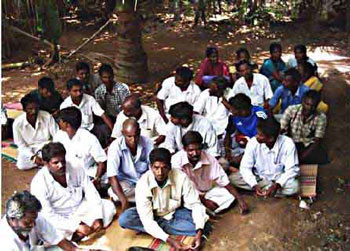
The first network meeting was organised in Thirukalukundram block of Kancheepuram district on 10th May 2005. About 20 participants (Panchayat leaders) from 8 villages participated in the meeting and shared their role and experiences. The participants are: Mr.Murugesan, Mr. K.P.Rayar, Mr.T.Ezhumalai-South Sadras kuppam Mr.S.P. Kumar, Mr. Thangaraj, Mr.Padavettan-Meiyur kuppam. Mr.Gunasekaran, Mr.Sivanandham, Mr.Dosappan-Pudupattinam kuppam Mr.Gunasekar,Mr.Sankar-Devaneri kuppam Mr.Boopalan, Mr.M.Durai, Mr.K.Baskar-Mamallapuram kuppam Mr.Moorthi, Mr.Gothandaraman, Mr.Ramjeyam-Uyyalikuppam Mr.Thiyagarajan, Mr.Krishnan-North Sadras Mr.Sundar (Volunteer)-Kovalam.
Fishermen
Panchayat representatives in the This system of fishermen Panchayat is in vogue for the past 12 – 15 years in the villages (kuppam) of Thirukalukundaram Block. It has been involved out of need for the fishermen, as there were clashes and squabbles occurred among fishermen during fishing as well as during marketing their product. The general characteristics of the fishermen panchayat were as follows:
During the course of interaction one major issue that was raised cutting across all the villages is the marketing of their product. As they have to deal with a very highly perishable commodity, a very high percentage of catch is being sold at low price by distress sale. Hence they felt the need for provision for extending shelf life of the fish caught so that they can get better price for their catch. Also it was felt that there were no facilities like cold storage units nor nearby ice factories for storage and hence they are at the mercy of the middlemen. Hence the community representatives from all the eight kuppam village who participated in the meeting expressed their urgent and immediate need for ice production plant atleast one plant for four villages. Currently they all have to go near Chennai or Chengalpet to buy ice bars for preserving their catch. This is not only cost intensive but also they were not able to get the required quantity of ice whenever they needed. Hence it was felt by all fisher folks that there is an immediate need for an ice plant since ice bars are required to store fish which will increase its shelf life so that they can take advantage in marketing their produce for a substantially higher price. This will benefit about 2000 fisher families who were engaged in fishing in these eight fishing villages. 4.0 Plan of ActionIt is planned to organise similar meetings in all the blocks where DHAN is involved in tsunami rehabilitation so that the community’s perception can be captured in detail. Accordingly the intervention strategies can be prioritized. The main focus of the interventions will be on : 4.1 Promoting and Strengthening of Village level fishing panchayat InstitutionsThere is a greater need to strengthen these village level Panchayat Institutions by way of promoting functional groups, introducing village level Grama Sabha, strengthening of village Councils and formation of Working Groups at village level. Promotion of such new forums would enhance the people’s participation at greater level. It would lead to effective participation of people at Grama Sabha meetings and other activities at village level. The proposed forums would be promoted at hamlet wise to ensure the full participation of the people at all hamlets. The village can be the structure of many functional groups. More focus would be given at the hamlet level than at the Panchayat level. So all the household members will be organised in any forum and encouraged to participate actively. More focus will be on setting the systems, building governments and staff system in the village level forum during the experimentation. Each fishing panchayat should undergo its micro-planning process for five years and the people in the Panchayat should participate in all the planning process. People will implement the plan. The Panchayat would negotiate with resource institutions and its community to mobilize funds according to their plan. The plan process would be done at hamletwise. This plan would be approved at the Grama Sabha meetings and it would be shared at the next level. The whole Panchayat should take necessary initiatives to mobilize resources for implementing the plan. This process would create people’s participation and ownership among them and it would lead to healthy administration also. Building the people would be the main factor in the process. The elected representatives and the proposed functional groups are to be orientated properly to play their role effectively. Capacity building of the presidents and members would enhance their administrative efficiency. Most importantly the people who are in various functional groups would be equipped to play their role in a proper manner. Besides this, the functionaries at Panchayat level will be equipped as facilitators so as to build the people towards strengthening the grassroots democracy. So, extensive capacity building events would be arranged to build the capacity of the stakeholders. 4.2 Sustaining the Panchayat Institutions It could be observed that in most of the Panchayats the effective measures are missing in generating funds from their own sources. There are plenty of opportunities for generating funds at local level to meet out their requirements significantly. Exclusive efforts and innovative ideas are needed to make the Panchayat as self-reliant institution. When the people’s involvement is high in a Panchayat, it is very much possible to attain the self reliance stage. It needs creation of awareness among the people. Hence, during the experimentation phase, people’s innovative ideas will be followed to generate local resources. The Panchayat level micro plan would be strictly implemented by way of taping various poverty alleviation programmes, Infrastructure promotion programmes and other development works from the government. This would ensure employment to the people and other facilities at village level. Effective implementation of development programmes will enhance the people’s participation and involvement in all aspects right from planning to monitoring at Panchayat level. The real benefit of the decentralisation will be reaching the people, when it implements the development programme in an effective manner with the involvement of the people. This would create confidence and ownership among the people. To implement various development programmes, the Panchayat administration would generate required funds from various sources. An exclusive forum would be promoted at the village level to implement the development activities, if needed. Present Panchayat Institutions are very poor in keeping systems. Though it has enough information it is not shared properly with the people. Formal data are kept at Panchayat level. The information system and the database are to be improved at Panchayat level so as to create transparency among the people. So, we can introduce computer system at Panchayat level experimentally to keep all the information and using the same in an effective manner. This would help to the Panchayat for ensure effective monitoring and information sharing at various levels. To carry out the interventions, teams of young professional will be placed in each block and an associate will be placed for each Panchayat. Entire experimentation will be led by a programme leader in DHAN Foundation. Local team will be set up whenever need arises. All initiatives during the experimentation phase will be with the high participation of the people at the village level. At the end of the each year, the outcome of the programme and the experiences will be properly documented reviewed and shared to all the stakeholders. Information & Communication Technologies for Coastal Communities (ICT4CC) - DHAN’s Initiative in Nagapattinam District
ICT Initiatives in Sirkali location
Other Initiative
Pondy fishermen oppose desalination plant: Fishermen forum of Periakalapet and Kalapet blocks here are up in arms against the plan of privately managed chemical factories situated on the East Coast Road, close to the villages here, to install a desalination plant. Delegates of the two villages, attached to the fishermen village panchayats, told newsmen here today that they had requested the Chief Minister to abstain from taking part in the function, scheduled to be held on the premises of Chemfab Chemical Factory in Kalapet tomorrow to lay the plant's foundation and also urged him to ban the desalination project. V Ramalingam, village panchayat president, told reporters here today that fishermen in the coastal pockets in Pondicherry were already suffering the brunt of pollution caused by chemical factories as they were discharging the effluents into the sea indiscriminately. If the desalination project came into existence, the industrial units would lay massive and gigantic pipelines to draw sea water from a distance of 850 metres. The fishermen would be put to suffering as the nets they spread over for catches would get entangled with the pipelines and the factories' effluents that would be discharged back into the sea would also prove harmful to the various fish species. Ramalingam said the fishermen panchayat also appealed to the local MLA and other ministers and officials to abstain from attending the function. The village panchayats would also launch an agitation if the factories went ahead with its plan to start desalination plant, ignoring the fishermen's safety and their avocation. (Agencies) Source : www.chennaionline |